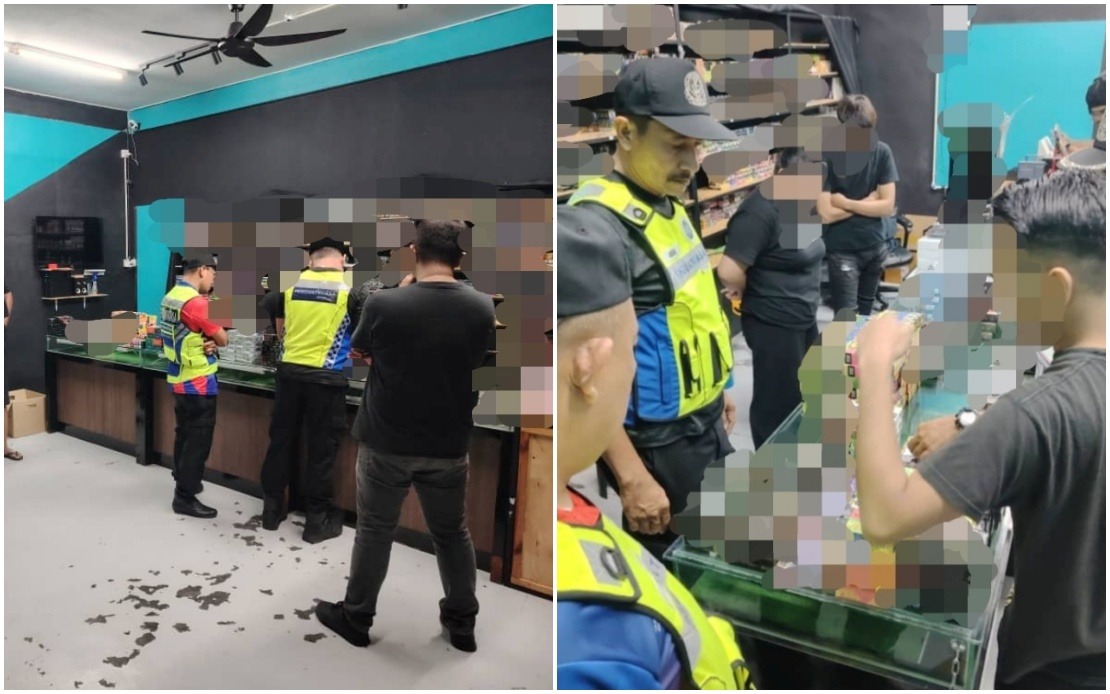
The Kangar Municipal Council (MPK) has intensified its crackdown on illegal vaping operations, confiscating 400 units of electronic cigarette liquid and 70 accompanying devices worth RM15,000 during a coordinated enforcement action. The operation, conducted between 10.30 pm and 1 am at a location on Jalan Padang Behor in Kangar, marks a significant step in the municipal authority's commitment to eliminate unauthorised vape retailers ahead of Perlis state's comprehensive prohibition on vape sales operations.
MPK president Affendi Rajini Kanth confirmed the seizure occurred in partnership with the Royal Malaysia Police (PDRM), operating within the framework of the council's Trade, Business, and Industry Licensing By-Laws. The enforcement action directly supports the Perlis state government's proclamation banning all vape sales premises throughout the state, a regulation scheduled to take full effect on August 1, 2025. This coordinated approach demonstrates how local authorities and police are aligning enforcement mechanisms to achieve uniform compliance across jurisdictions.
The targeted establishment had already been identified as a persistent violator of municipal regulations. Despite receiving multiple fines in previous months and being formally issued a business cessation notice in August 2025, the proprietor continued operating the vape sales operation, effectively defying regulatory orders. This pattern of non-compliance suggests determined commercial interests resisting the state's anti-vaping policy, necessitating increasingly direct enforcement interventions.
Under the provisions of MPK's licensing by-laws, violators face substantial financial penalties designed to deter continued contraventions. The regulation imposes a primary fine not exceeding RM2,000, with additional daily penalties of up to RM200 for each day the offence persists following conviction. These escalating charges create mounting financial liability for operators who refuse to cease activities, effectively raising the cost of non-compliance beyond simple commercial calculation.
Perlis state's move toward a comprehensive vape prohibition reflects growing regional consensus on restricting access to electronic nicotine delivery devices. Several Malaysian states have already implemented or are considering similar restrictions, viewing vaping as a public health concern requiring regulatory intervention. The Perlis approach, combining state-level proclamations with municipal enforcement mechanisms, demonstrates how multi-tier governance can coordinate to implement health policy objectives.
The vape market in Malaysia has expanded considerably over the past decade, with retail operations proliferating across urban and semi-urban areas. This growth has occurred despite evolving regulatory uncertainty, with different states adopting varying approaches to licensing and operation. The absence of uniform federal regulation has created a patchwork enforcement environment, allowing operators to exploit jurisdictional gaps or continue business even after facing local restrictions.
Public health authorities in Malaysia have increasingly emphasised concerns about vaping's potential health impacts, particularly regarding youth exposure and nicotine dependency. The devices seized in Kangar represent part of a broader supply chain servicing what authorities view as an unregulated and potentially harmful market. By removing these products from circulation, MPK aims to reduce availability and discourage consumption patterns.
The enforcement operation illustrates operational cooperation between municipal authorities and federal police, a coordination model that may expand as states implement stricter vaping regulations. Police resources have been deployed to support compliance operations, suggesting law enforcement considers vape regulation enforcement a legitimate priority alongside traditional criminal matters. This integration of municipal code enforcement with police support reflects how authorities categorise regulatory violations within broader public safety frameworks.
Business operators in Perlis and neighbouring states face increasingly constrained operating conditions for vape retail. The combination of state-level prohibition declarations, municipal licensing restrictions, daily penalties for non-compliance, and product seizures creates multiple deterrents against continuing such operations. Some retailers may choose to transition to legal business categories, while others might attempt relocation to jurisdictions with less stringent regulations.
For consumers, the enforcement action signals that vape availability will contract progressively in Perlis as regulations take effect. Access to vaping products through legal channels will become difficult or impossible, potentially driving some users toward black-market alternatives or prompting behavioural substitution toward conventional cigarettes or cessation attempts. The public health implications of enforcement-driven supply reduction versus demand-reduction strategies through education and cessation support remain subject to ongoing debate among health policymakers.
The RM15,000 value attributed to seized stock represents meaningful commercial loss for the operator, reinforcing financial consequences of regulatory non-compliance. Product confiscation alongside monetary penalties creates dual consequences that extend beyond simple fines to include direct destruction of commercial inventory. This approach aims to make non-compliance economically untenable, compelling compliance through cumulative financial pressure.
Moving forward, MPK and other municipal authorities implementing vape restrictions will likely conduct additional enforcement operations throughout the phase-in period before the August 2025 deadline becomes fully operational. The pattern established in Kangar—combining licensing violations with product seizure and police partnership—appears likely to become standard enforcement methodology. Operators who continue violating prohibitions should anticipate escalating consequences as authorities demonstrate commitment to implementing state policy mandates.

