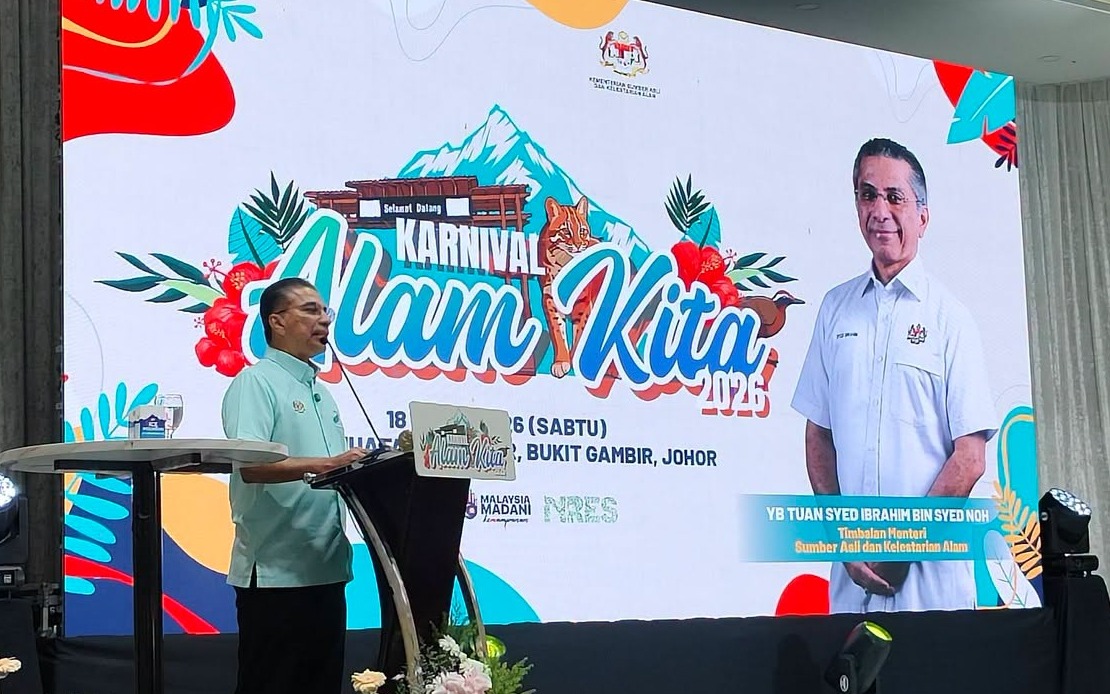
Malaysia's environmental sustainability agenda is shifting toward grassroots engagement as the Ministry of Natural Resources and Environment brings Karnival Alam Kita 2026 to Johor Bahru, marking a departure from top-down policy approaches to community-centred environmental action. The initiative, launched at Dewan Muafakat Bukit Gambir in Tangkak district, reflects a deliberate strategy to translate complex environmental challenges into practical, relatable terms that resonate with everyday citizens rather than remaining abstract policy priorities.
Deputy Minister Syed Ibrahim Syed Noh articulated the philosophical underpinning of the carnival's design: environmental stewardship cannot rest solely on governmental shoulders but must become a shared responsibility woven into household routines, educational institutions, workplaces, and neighbourhood communities. This framing acknowledges a critical gap in Malaysia's environmental communication—that discussions of rare earth elements, electronic waste management, and carbon neutrality often alienate ordinary Malaysians who struggle to connect these issues to their own consumption patterns and daily choices. The ministry's challenge lies in bridging this comprehension divide by demonstrating that sustainability is not an elite or specialised concern but an integral aspect of modern living.
The carnival's portfolio extends beyond awareness-raising into tangible behavioural change mechanisms. A centrepiece initiative, the Young Environmental Ambassador Programme, targets secondary school students for structured environmental training designed to cultivate a cohort of peer educators capable of influencing family and community practices. This youth-focused approach recognises that adolescents possess both the cognitive flexibility to adopt new habits and the social influence to reshape household decision-making, particularly in Southeast Asian contexts where family structures remain culturally significant. By positioning teenagers as environmental ambassadors rather than passive recipients of information, the ministry is attempting to create multiplier effects that traditional awareness campaigns cannot achieve.
Practical waste management initiatives complement the broader messaging framework. The KUDAH clean-up drive, executed by the ministry's Lestari Squad in partnership with Bateriku (M) Sdn Bhd, collected 37 kilograms of waste during the launch event—a modest figure that nonetheless carries symbolic weight. The quantification of environmental impact, specifically the claim that 17.3 kilograms of collected plastic bottles translates to 43.2 kilograms of carbon dioxide equivalent reductions equivalent to a 100-kilometre car journey, represents an attempt to make environmental gains tangible and measurable for participants. Such metrics, though modest in absolute terms, serve a pedagogical function by illustrating that individual actions accumulate into meaningful environmental outcomes.
The carnival's integration of electronic waste recycling and used cooking oil collection campaigns addresses Malaysia's growing challenge with hazardous household waste streams. Electronic waste presents particular complexity in Southeast Asia, where rapid device adoption and limited formal recycling infrastructure create disposal bottlenecks that often result in informal and environmentally damaging processing. Used cooking oil collection addresses both environmental contamination and potential circular economy opportunities, since recovered cooking oil can be refined into biodiesel and other industrial applications. These focused campaigns suggest the ministry recognises that blanket sustainability messages prove less effective than targeted interventions addressing specific waste categories.
Governmental coordination across multiple agencies and strategic partnerships indicates an institutional recognition that environmental objectives require cross-sectoral alignment. The participation of non-governmental organisations and private sector partners in the carnival structure reflects an implicit acknowledgment that the ministry alone cannot drive behaviour change at population scale. This collaborative approach mirrors evolving governance models in Southeast Asia where environmental outcomes increasingly depend on public-private-civil society coalitions rather than unilateral state action. For Malaysia specifically, such partnerships may help address implementation gaps that have historically constrained environmental policy effectiveness.
The carnival's staged rollout across Johor positions the state as a testing ground for environmental engagement strategies that may eventually scale nationally. Johor's selection reflects both its population density and economic significance, but also the state's vulnerability to environmental pressures including deforestation, water quality degradation, and industrial pollution. The Tangkak district's hosting of the launch event particularly signals attention to rural communities that often experience environmental degradation without proportional access to sustainability resources and information. Extending environmental initiatives beyond urban concentrations represents a significant shift in Malaysia's environmental governance, historically concentrated in metropolitan areas.
The ministry's framing of sustainability as achievable within existing lifestyles—rather than requiring radical transformations—carries important psychological and political implications. By emphasising that green practices integrate into conventional daily routines rather than demanding wholesale lifestyle overhauls, officials reduce perceived barriers to adoption. This pragmatic positioning may prove more effective than aspirational messaging in motivating sustained behavioural change, particularly among middle-income households balancing multiple financial and social pressures. However, it simultaneously risks understating the structural adjustments necessary to achieve Malaysia's net-zero 2050 target, which ultimately requires systemic economic and technological transitions rather than incremental consumer adjustments alone.
The carnival's interactive format—combining awareness exhibitions, product sales, and hands-on clean-up activities—reflects contemporary understanding that environmental education functions most effectively through experiential engagement rather than passive information dissemination. The inclusion of green product sales represents a subtle but significant element, acknowledging that sustainability increasingly operates within market frameworks where environmentally conscious consumption becomes economically feasible and socially aspirational. This commercialisation of sustainability raises questions about whether environmental citizenship becomes narrowly defined as consumer choice available primarily to economically advantaged households, potentially limiting the universality of the sustainability agenda.
For Malaysian and regional observers, Karnival Alam Kita 2026 exemplifies a broader shift in how Southeast Asian governments approach environmental governance post-recognition of climate urgency. Rather than relying primarily on regulatory enforcement or international commitments, the approach emphasises cultural and behavioural transformation as foundational to environmental improvement. This reflects empirical evidence that legal mandates without corresponding citizen engagement prove ineffective in producing durable environmental outcomes. As Malaysia positions itself as a regional sustainability leader, particularly in natural resource management and green economy transition, initiatives like KAK 2026 represent crucial investments in the social foundations necessary to translate policy ambitions into measurable environmental gains.
Looking forward, the carnival's success will depend significantly on whether the ministry can sustain engagement beyond the carnival period itself. One-off events risk generating temporary enthusiasm without embedding lasting behavioural shifts. The Young Environmental Ambassador Programme's potential to create sustained peer-to-peer influence suggests recognition of this sustainability challenge—transforming episodic awareness into institutionalised practice requires continuous reinforcement through trusted community networks. For a nation confronting complex environmental pressures from industrial development, agricultural intensification, and rapid urbanisation, whether such community-centred approaches generate sufficient scale and speed of change remains an open question requiring rigorous monitoring and iterative programme refinement across Malaysia's diverse communities.

