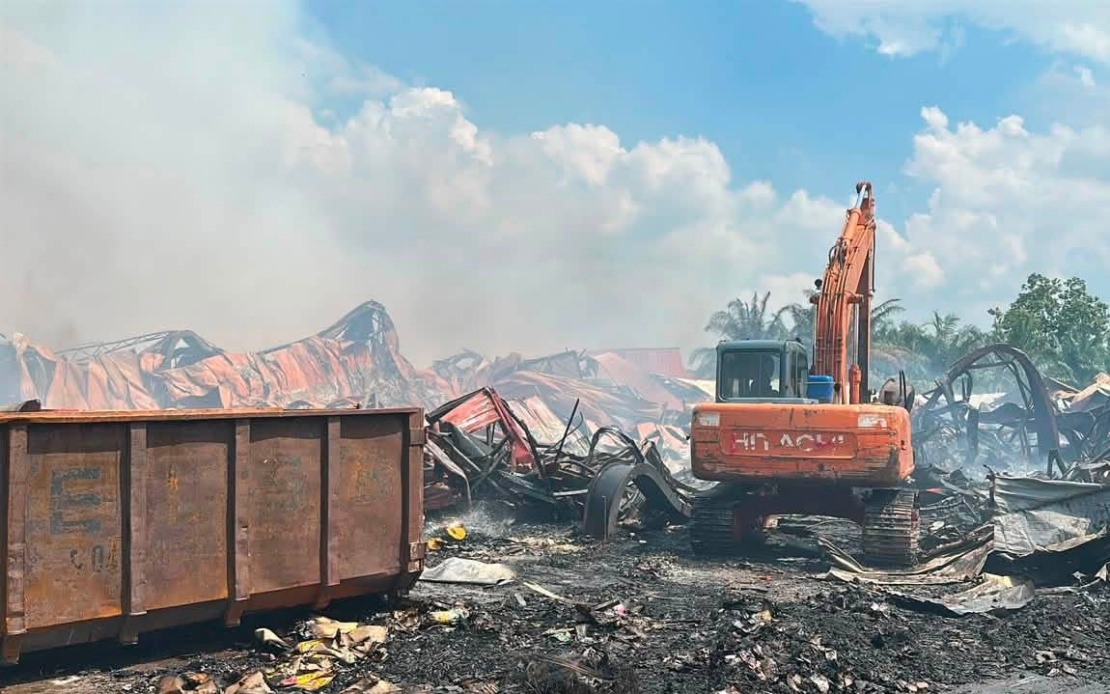
Environmental authorities in Kedah are closely tracking atmospheric conditions following a significant industrial fire that consumed multiple manufacturing facilities in the Lunas district on July 28. The blaze, which broke out in Taman Makmur industrial zone early in the morning, engulfed four separate factories and prompted an immediate response from state regulators concerned about potential airborne pollution affecting nearby residents and workers.
The Kedah Department of Environment (DOE) swiftly initiated monitoring protocols to assess the impact of the fire on local air quality. According to Sharifah Zakiah Syed Sahab, the department's director, readings from the Kulim Hi-Tech Air Monitoring Station recorded an Air Pollutant Index (API) measurement of 68, which falls within the moderate classification. Particulate matter measuring 2.5 micrometers or smaller—commonly abbreviated as PM2.5—emerged as the primary air quality concern, a typical consequence of industrial fires where fine particles become suspended in the atmosphere and can travel considerable distances on prevailing winds.
The department indicated that its monitoring network extends across multiple states, offering a comprehensive regional perspective on air quality conditions. Sharifah Zakiah noted that API readings at various monitoring stations throughout Kedah, Penang, and neighbouring territories similarly registered moderate levels, suggesting that atmospheric pollution stemmed from multiple sources rather than solely from the Lunas incident. This geographical distribution of elevated readings provides important context for understanding how industrial emissions and other pollution sources interact across state boundaries in the northern corridor.
The Kedah Fire and Rescue Department received an emergency alert at 6.57 am, initiating a rapid deployment to the Taman Makmur industrial park. Senior Assistant Fire Commissioner Awang Hidzel Awang Bujang confirmed that firefighting efforts successfully prevented loss of life, though property damage proved substantial. The four affected facilities comprised two garment manufacturing operations, a candle production factory, and a box manufacturing plant—a diverse industrial mix representing different sectors within Kedah's manufacturing ecosystem.
The incident highlights vulnerabilities in Malaysia's industrial safety infrastructure, particularly within clustered manufacturing zones where multiple facilities operate in proximity. When fires spread across adjacent factories, containment becomes exponentially more challenging, and environmental impacts multiply. The destruction of two garment factories is particularly significant given their reliance on synthetic materials that release toxic fumes when combusted, potentially including acrolein and other volatile organic compounds that contribute substantially to air quality deterioration.
Fire investigators have not yet determined the incident's origin, leaving open multiple possibilities ranging from electrical faults to chemical reactions or mechanical failures. The investigation process typically involves detailed examination of remaining structures and equipment, interviews with workers and facility operators, and analysis of security footage where available. Until preliminary findings emerge, regulatory authorities must maintain heightened vigilance to detect any unusual air quality patterns that might suggest ongoing combustion or chemical reactions within debris.
The moderate API classification, while not reaching hazardous levels that would trigger health alerts or activity restrictions, warrants continued attention. In Malaysia's tropical climate, atmospheric conditions shift rapidly with wind patterns and humidity levels, meaning air quality can deteriorate or improve significantly within hours. The DOE's commitment to continuous monitoring reflects this reality and demonstrates responsive governance following an industrial emergency.
For residents and workers in surrounding areas, the fire serves as an unwelcome reminder of environmental risks inherent in dense industrial clustering. Lunas, like many Malaysian manufacturing hubs, concentrates diverse production facilities within relatively compact zones to leverage shared infrastructure and logistics advantages. However, this proximity creates cascading risks when accidents occur, as firefighting challenges intensify and pollution dispersal affects wider populations. Communities adjacent to industrial parks face environmental exposure that rural or residential areas do not encounter.
The incident also underscores the importance of cross-agency coordination during environmental emergencies. The DOE's integration with fire rescue departments and other state agencies demonstrates how Malaysia's emergency response framework attempts to address both immediate safety threats and longer-term environmental consequences. This multi-departmental approach, while sometimes slow to coordinate in practice, represents recognition that industrial disasters generate complex challenges requiring expertise from multiple sectors.
Looking forward, the Lunas fire will likely prompt regulatory reviews of safety protocols at similar industrial concentrations throughout Kedah and neighbouring states. Insurance companies, facility operators, and government inspectors may implement stricter fire prevention measures, emergency response procedures, and environmental monitoring capabilities. The incident provides valuable—if costly—evidence about how industrial zones respond to major disruptions and where improvements remain necessary.
As monitoring continues, the DOE's ongoing assessments will help establish a baseline for how quickly air quality recovers following industrial fires and what long-term environmental impacts might persist. This data proves invaluable for planning future industrial development and establishing appropriate buffer zones between manufacturing facilities and residential areas. The moderate API readings suggest that current dispersal patterns are managing emissions reasonably well, but sustained monitoring over coming days will confirm whether air quality progressively improves or whether unexpected complications emerge.

