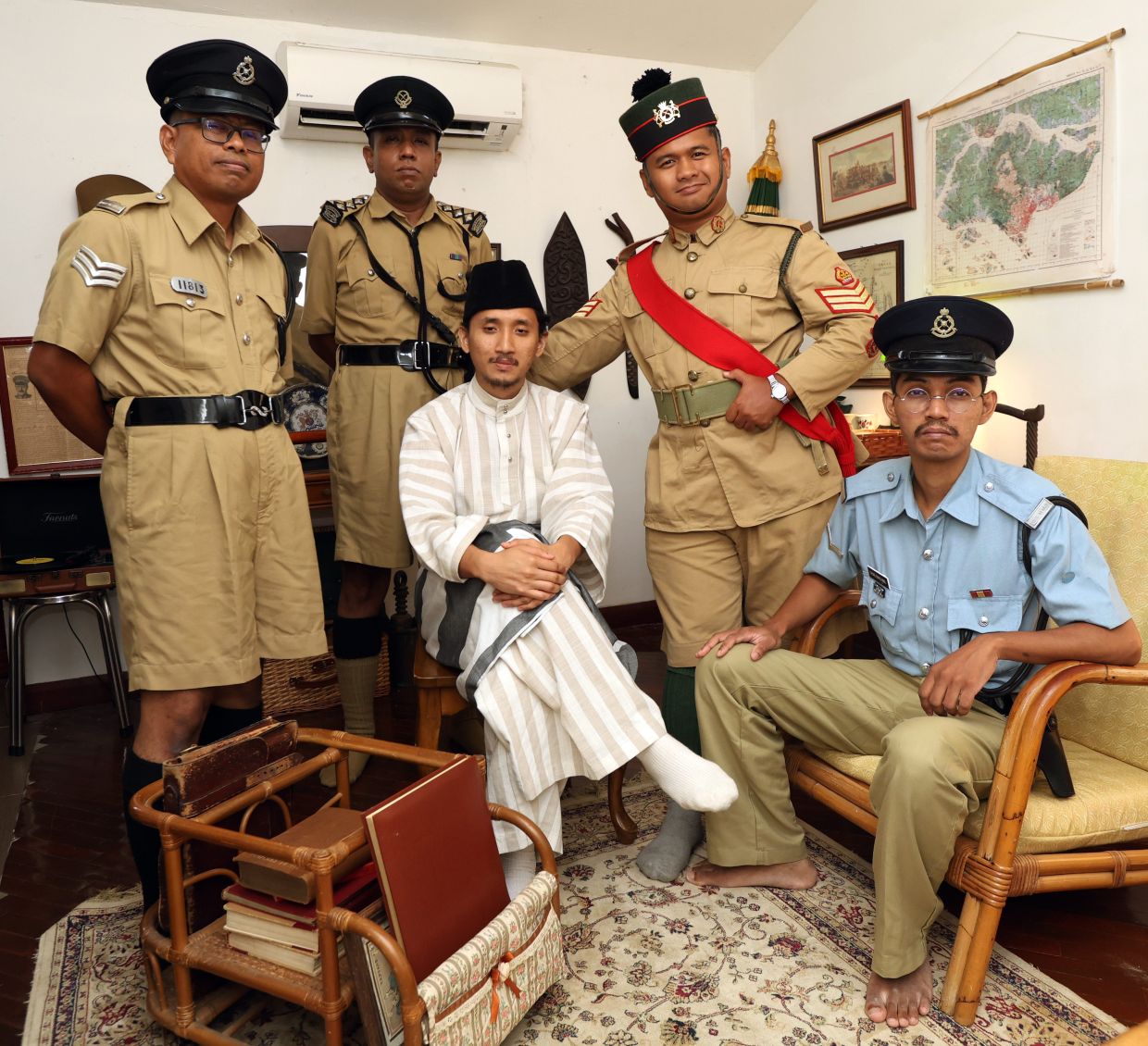
Weekend gatherings at Persatuan Reka Ulang Sejarah (PRUS) have become more than casual meetups for history enthusiasts. Members dressed in meticulously researched military uniforms settle into a room filled with the ambiance of another era—the gentle hum of a vintage record player, the creak of rattan furniture—to discuss and plan their next historical preservation initiative. For this registered society, history exists not within the confines of textbooks but as a living, breathing experience that can be worn, demonstrated, and transmitted through narrative and experiential learning.
The organization's core mission reflects a recognition of a pressing gap in Malaysian historical consciousness: younger generations increasingly lack familiarity with the nation's military heritage and the figure who shaped it. By translating historical knowledge into visual and experiential formats, PRUS attempts to make abstract historical concepts tangible and memorable. What distinguishes this group from casual costume enthusiasts is their commitment to educational rigor and historical fidelity, treating each re-enactment as an opportunity to authentically represent not just the appearance but the behavioral and operational dimensions of Malaysia's military across different historical periods.
The society's origins trace to the early 2010s, when collectors of vintage military uniforms and related artifacts began congregating at events such as those organized by the Port Dickson Army Museum at the now-decommissioned Royal Malaysian Air Force Base in Sungai Besi, Kuala Lumpur. These informal gatherings eventually coalesced under the banner "We Are Re-enactors" before the group formalized its operations in 2023 by registering as PRUS, a transformation that significantly expanded their capacity to deliver educational programming at schools and museums across the country. This evolution from hobby collectors to registered educational organization reflects a maturing understanding that historical preservation carries both cultural and pedagogical significance for Malaysia's national identity.
Chairman Abdul Hakim Abdul Rani identified a specific institutional problem that motivated PRUS's creation: widespread confusion surrounding historical military uniforms, particularly from eras when photography was exclusively black and white and different military branches appeared visually indistinguishable in archival images. This observation highlighted how gaps in visual historical literacy could perpetuate inaccurate understandings of Malaysia's military development. By documenting and demonstrating uniforms in their proper historical context, complete with accurate insignia, materials, and modifications specific to particular units and periods, PRUS members could address this knowledge deficit while simultaneously preserving institutional memory that might otherwise be lost as older veterans pass away and archives deteriorate.
What separates PRUS from historical cosplay lies in their attention to behavioral authenticity. The group recognizes that military protocol extended far beyond uniform specifications to encompass distinct patterns of etiquette, body language, marching formations, and verbal communication norms that varied significantly across different decades and colonial versus post-independence contexts. Achieving this level of authenticity demands extensive primary source research, consultation with former military personnel, and careful study of period manuals and photographic records. Abdul Hakim, who previously served in the Territorial Army and now works as a tour guide, emphasizes that this commitment to accuracy stems from viewing their work as fundamentally educational rather than purely recreational in nature.
The intensity of PRUS's research methodology became evident during a two-day, one-night jamboree held in July, where members engaged in systematic training based on original pre-independence military manuals. Participants practiced marching formations, map reading, navigation techniques, and basic combat maneuvers designed to illuminate how soldiers of the colonial and early independence periods actually operated in field conditions. Abdul Hakim led these sessions drawing on his military background, while deliberately substituting sticks for weapons to comply with safety and regulatory requirements. This approach transformed the jamboree from a theatrical exercise into a quasi-archaeological exploration of operational methodology, allowing participants to embody and understand the practical challenges and skill sets demanded of soldiers during specific historical periods.
Beyond educational exhibitions and public demonstrations, PRUS has established itself as a valued consultant to Malaysia's film and television production industry. Vice chairman Mohd Fadzreeq Mokti describes their role in ensuring visual and sartorial authenticity in period productions, arguing that their contribution extends beyond costume provision to encompass comprehensive advisory services regarding how uniformed personnel would have carried themselves, moved, and interacted within historically accurate frameworks. This collaboration with the entertainment industry amplifies PRUS's reach considerably, potentially exposing millions of viewers to more historically accurate representations of Malaysia's military heritage than might otherwise appear in locally produced media. The group's willingness to serve as extras in productions allows them to model not merely the appearance of historical uniforms but the embodied comportment that accompanied military service in different eras.
PRUS demonstrates particular vigor during August and September, when National Month celebrations and Malaysia Day commemorations activate heightened national consciousness around Malaysian identity and historical achievement. During these periods, members bring their collections to exhibitions and school programs, capitalizing on cultural moments when young people are especially receptive to historical narratives. Abdul Hakim has observed concerning gaps in younger Malaysians' knowledge of crucial historical figures and pivotal events, a deficit he attributes partly to the limitations of classroom instruction divorced from concrete visual and material evidence. By introducing historical content through schools when students are still forming foundational understanding of national identity, PRUS attempts to intervene early in the process of historical consciousness formation.
Mohd Fadzreeq, who serves as both a school teacher and PRUS vice chairman, provides firsthand testimony to the pedagogical efficacy of embodied historical learning. When he appears at his school dressed in historically accurate military uniform—a practice approved by the headmaster—his students exhibit dramatically heightened engagement compared to standard classroom discussions of the same historical material. Children persistently ask when he will return in uniform, indicating that the visceral impact of seeing an authority figure embodied in historical costume creates memorable learning moments that transcend typical instructional formats. This enthusiasm speaks to a fundamental truth about young learners: many possess innate curiosity about history but lack access to museums, heritage sites, or other venues where historical material culture becomes accessible and interactive.
Mohd Fadzreeq characterizes PRUS members as "walking museums," emphasizing that their performance of history goes beyond superficial costume display to constitute genuine embodied pedagogy. When members appear in public spaces wearing carefully researched uniforms and prepared to discuss their historical significance, they catalyze spontaneous educational interactions that might never occur in conventional institutional settings. Members invest substantial personal time studying historical texts, military manuals, and archival materials to prepare for these public appearances, treating historical accuracy as a professional responsibility rather than optional detail. This preparation-intensive approach reflects a conviction that casual or inaccurate historical representation risks misleading audiences and potentially entrenching historical misconceptions.
The implications of PRUS's work extend beyond immediate educational programming to address broader questions about how postcolonial societies maintain and transmit institutional memory, particularly regarding military heritage during transitional periods. Malaysia's armed forces underwent significant organizational and ideological transformation during the independence transition and subsequent decades of nation-building, yet much of this rich institutional history risks being forgotten as witnesses retire and contemporary demands consume public attention. By actively preserving and publicly demonstrating this heritage through carefully researched re-enactment, PRUS provides a counterweight to the potential erasure of military historical knowledge, ensuring that future generations of Malaysians possess access to authentic representations of their nation's security institutions at critical historical junctures.

