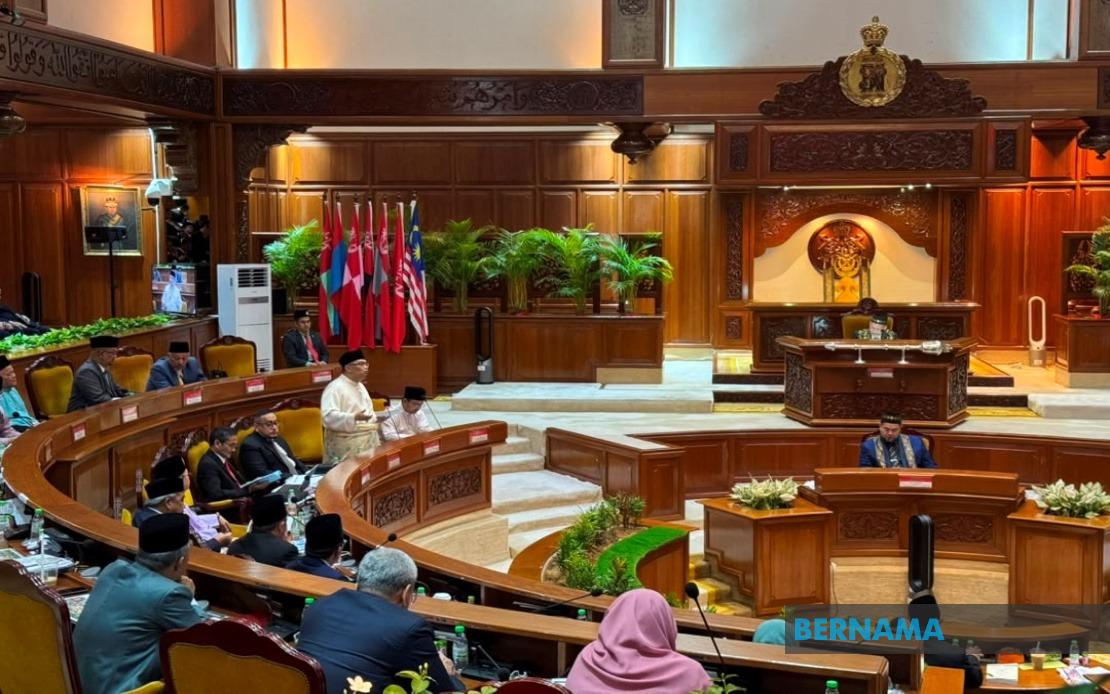
The Kelantan state legislative assembly in Kota Bharu has unanimously passed the Syariah Criminal Offences (Kelantan) Bill 2026, representing a significant legislative move to address constitutional complexities surrounding state-level Syariah criminal jurisdiction. Tabled by Deputy Menteri Besar Datuk Dr Mohamed Fadzli Hassan and subsequently wound up by both Dr Fadzli and Menteri Besar Datuk Mohd Nassuruddin Daud, the legislation proceeded through its second and third readings without opposition, securing the endorsement of Kelantan state assembly Speaker Datuk Mohd Amar Nik Abdullah.
The bill's passage follows intense parliamentary deliberation, with six state assemblymen representing Pasir Tumboh, Melor, Galas, Jelawat, Kota Lama and Chempaka engaging in substantive debate before the unanimous vote. Menteri Besar Mohd Nassuruddin emphasised that the 2026 bill represented the culmination of meticulous legislative drafting, having undergone multiple refinement stages prior to assembly presentation. His remarks underscored the government's commitment to producing legislation that would withstand constitutional scrutiny and demonstrate robust planning principles.
Structurally, the new enactment comprises nine distinct sections spanning 62 substantive clauses alongside a schedule of supporting provisions. These components codify numerous reforms addressing gaps identified in previous legislation, including specific requirements pertaining to obligatory prayer performance, protections for bodily integrity and organ preservation, safeguards for intellectual capacity, frameworks for restorative justice approaches, and revised punishment mechanisms that prioritise whipping as the preferred corrective sanction. Additionally, the bill introduces a compound system enabling settlement alternatives for certain Syariah offences.
The 2026 bill's introduction must be understood against the backdrop of a landmark February 2024 Federal Court decision that fundamentally reshaped Kelantan's Syariah legislative landscape. In an 8-1 majority ruling, the court invalidated 16 of 18 provisions contained in the Kelantan Syariah Criminal Code (I) Enactment 2019, determining that the state assembly had exceeded its constitutional authority by enacting criminal offences properly falling within exclusive Federal jurisdiction. This decision emerged following a constitutional petition filed by a Kelantan-based lawyer, triggering nationwide discourse on the precise boundaries separating state and federal powers in Syariah criminal matters.
The Federal Court's judgment created substantial uncertainty regarding state capacity to establish Syariah criminal frameworks, generating concern among Kelantan's leadership that the 2019 enactment's extensive invalidation undermined the state's ability to enforce religious law effectively. The court's reasoning reflected broader constitutional tensions inherent in Malaysia's dual governance structure, where states possess limited but meaningful authority over Islamic affairs and Syariah law whilst the Federal government retains supremacy in numerous overlapping domains. This ambiguity necessitated legislative recalibration to align state aspirations with constitutional permissibility.
Menteri Besar Mohd Nassuruddin contextualised the 2026 bill as an evolutionary development anchored in principles already embedded within the invalidated 2019 code. He characterised the revision as formalising and systematising approaches that reflected established Syariah jurisprudential traditions, rather than introducing fundamentally novel concepts. This rhetorical framing suggests Kelantan's government views the new legislation as fundamentally continuous with prior efforts, despite substantive modifications required to satisfy constitutional constraints.
For Malaysian observers and neighbouring regional governments, the bill's passage demonstrates how state-level Islamic governance initiatives must navigate Federal constitutional constraints while preserving meaningful jurisdictional space. The revision process illustrates the practical tensions when elected state assemblies seek to implement religious policies deemed preferable by local constituencies but face judicial limitations on legislative authority. Kelantan, as Malaysia's only PAS-governed state and a jurisdiction with historically strong commitment to Islamic administration, has particular incentive to maximise permissible Syariah criminal jurisdiction.
The emphasis within the 2026 framework on restorative justice mechanisms and compound alternatives suggests philosophical evolution beyond purely punitive approaches, potentially reflecting contemporary Islamic jurisprudential trends favouring rehabilitation and reconciliation. The prioritisation of whipping as the preferred punishment method indicates alignment with specific interpretations of Syariah criminal justice, though practical implementation will depend on enforcement agencies' capacity and willingness to apply these provisions consistently.
The bill's unanimous passage, whilst politically significant within Kelantan, raises substantive questions about whether revised provisions will survive potential Federal Court challenge. The previous enactment's near-total invalidation suggests that constitutional disputes regarding state-federal demarcation remain unresolved. Unless the 2026 bill's framers have identified previously overlooked constitutional distinctions or the court's membership demonstrates altered interpretive inclinations, similar challenges may eventuate. This uncertainty affects Kelantan's broader governance stability and confidence in legislative initiatives.
The passage also carries implications for other Malaysian states harbouring similar Syariah legislative ambitions. Kelantan's approach to constitutional constraint navigation may establish precedent that either encourages or discourages comparable initiatives elsewhere. The involvement of six different state assemblymen in debate suggests broad legislative consensus across constituencies, potentially reinforcing the bill's legitimacy and political durability despite constitutional uncertainties.
Moving forward, attention will focus on implementation mechanisms and whether Kelantan's enforcement agencies possess requisite capacity and training to apply the 2026 framework consistently and professionally. The bill's substantive provisions require complementary institutional development to translate legislative intent into effective administration. Additionally, monitoring whether Federal authorities challenge specific provisions will be essential for understanding actual constitutional boundaries governing state Syariah criminal jurisdiction in Malaysia's ongoing federal-state governance evolution.

