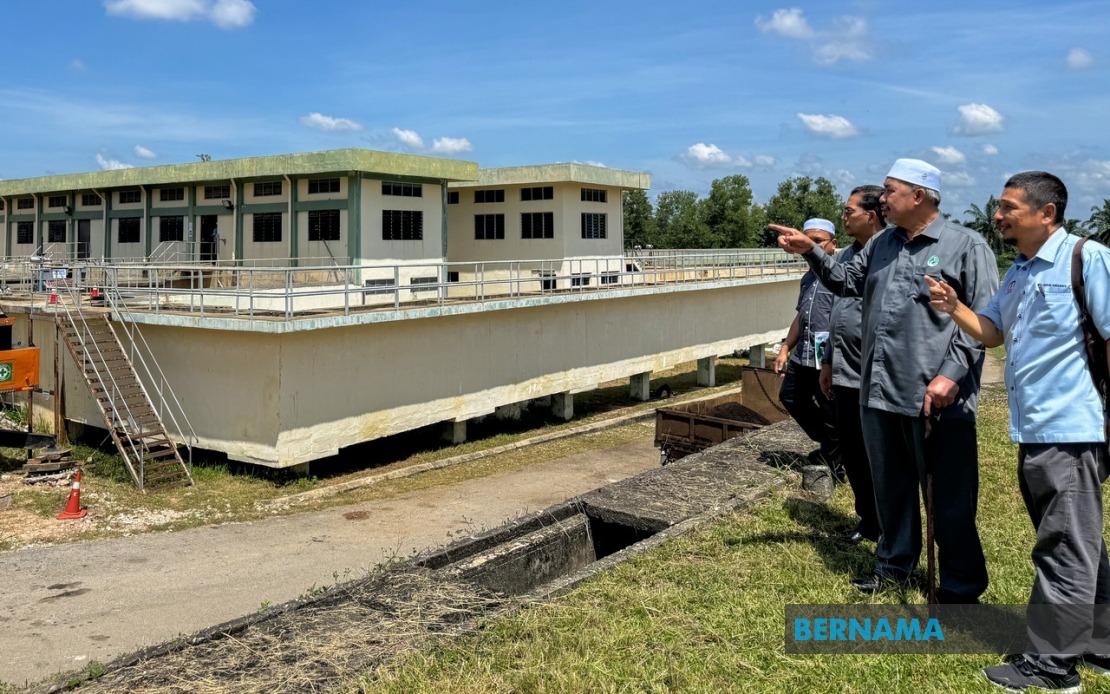
Residents across three districts in Kelantan will see tangible improvements to their water supply reliability from September, following completion of a substantial infrastructure upgrade at the state's key treatment facility. The Merbau Chondong Water Treatment Plant (WTP), which serves Machang, Pasir Puteh, and the southern section of Kota Bharu, has undergone an RM11.5 million enhancement that fundamentally transforms its operational capacity and treatment quality. Approximately 34,000 account holders in these areas stand to benefit from what officials describe as a watershed moment for water security in the region, ending years of intermittent supply challenges that have plagued domestic and commercial users.
The expansion targets a near doubling of production capability, with the facility moving from a previous capacity of 45 million litres daily to a new ceiling of 80 million litres per day. Datuk Dr Izani Husin, chairman of Kelantan's Public Works, Infrastructure, Water and Rural Development Committee, explained during a facility inspection that previous operational constraints reflected conservative management rather than genuine technical limitations. Air Kelantan Sdn Bhd (AKSB), the state's water authority, had deliberately maintained lower output levels out of concern that pushing production beyond safe thresholds would compromise water quality standards. The upgrading project resolved this dilemma by introducing advanced filtration technology.
At the heart of the improvement lies the implementation of a Xylem Underdrain Leopold filtration system, a technological solution that fundamentally enhances the plant's ability to process raw water at volumes previously considered risky. With this system installed, the facility can now treat between 70 and nearly 90 million litres of raw water daily, providing the operational headroom necessary to sustain consistent output without quality degradation. The new approach shifts the facility from a position of supply constraint to one of managed capacity, transforming how AKSB can allocate water resources across the state's distribution network. This shift carries particular significance for rural and semi-urban areas that have historically experienced lower priority in allocation decisions.
Quality improvements accompany the capacity gains. The turbidity level—a key water quality indicator measured through the Nephelometric Turbidity Unit (NTU)—has been reduced dramatically from above 10 NTU to precisely 3 NTU. This metric matters considerably to end users, as turbidity directly affects water clarity, taste, and the effectiveness of household filtration systems. Consumers in the three affected districts have frequently complained about discoloured water during peak demand periods, a symptom of plants operating at or beyond their design limits. The reduction in turbidity to 3 NTU brings the treated water quality into alignment with Malaysia's drinking water standards and addresses one of the most visible complaints from users in these areas.
Project timelines indicate final completion by the end of July, with water distribution from the upgraded system commencing in early September. This phased approach allows for testing and system validation before the facility fully transitions to serving the expanded user base. AKSB's methodical approach reflects the critical nature of water infrastructure—premature deployment without thorough testing could introduce new problems even as existing ones are solved. The September timeline also positions the facility to handle increased demand as the region enters its drier months, when supply pressures typically intensify and storage reserves become most critical.
Beyond the immediate upgrade, Kelantan's water authority has articulated broader infrastructure ambitions that position the state's water security on a longer-term trajectory. The state government and Pengurusan Aset Air Berhad (PAAB) are collaborating on construction of a new Machang 1 Water Treatment Plant, a facility valued at RM120 million and scheduled for completion by 2030. This plant will contribute an additional 50 million litres of daily capacity dedicated to Machang residents' needs. The strategic logic underlying this expansion involves redirecting existing capacity from Merbau Chondong—previously stretched to serve too many users—toward underserved districts elsewhere in Kelantan, a cascading reallocation that could benefit multiple communities simultaneously.
The Machang 1 project remains in pre-execution phase, with the state government and PAAB still finalising the operational and financial agreement that will govern the facility's construction and management. This administrative step, while procedurally necessary, represents a potential delay point; experience across Malaysia's water sector suggests that finalising agreements between state governments and federal water asset managers can encounter complexities around operational control, pricing mechanisms, and asset ownership structures. Once the agreement receives final endorsement, the contractor appointment process will commence, presumably beginning physical work within a defined timeframe. The 2030 completion target provides a reasonable development window, though inflation in construction costs and potential supply chain disruptions remain variables.
Contextualizing these developments within Kelantan's broader water situation reveals the scale of the state's supply challenges. Air Kelantan Sdn Bhd reports having resolved approximately 70 percent of water supply issues affecting 270,000 user accounts across the state, with a stated ambition to reach at least 90 percent resolution by 2035. These figures indicate that water supply instability affects a substantial minority of the state's population, reflecting decades of underinvestment in treatment and distribution infrastructure relative to population growth and development. The gap between current performance (70 percent issue resolution) and the 2035 target (90 percent) suggests that authorities view roughly 54,000 accounts as still experiencing material supply problems, a cohort significantly larger than those served by the Merbau Chondong upgrade alone.
For Malaysian readers outside Kelantan, these developments illustrate common patterns across the country's water sector. State-by-state variations in water security reflect historical investment patterns, governance approaches, and the interaction between urban growth and infrastructure capacity. While some urban corridors enjoy reliable supply from modern facilities, numerous districts across Malaysia face periodic shortages, quality problems, or both. The Kelantan experience—where a single facility upgrade benefits 34,000 users—underscores how critical such infrastructure improvements become in addressing supply stability. Equally, the extended timeline for the Machang 1 facility (seven years from now) reflects the reality that comprehensive solutions to supply constraints demand sustained capital investment and coordinated planning across multiple governmental entities.
The upgrade also carries implications for Kelantan's development trajectory. Water security fundamentally constrains industrial expansion, residential growth, and commercial development. Districts with unstable water supplies struggle to attract manufacturers requiring consistent supply or to expand high-density residential developments where per-capita consumption exceeds what degraded infrastructure can sustain. By resolving supply constraints across Machang, Pasir Puteh, and southern Kota Bharu, the upgrade potentially unlocks economic development opportunities in these areas. Agricultural operations requiring reliable irrigation, food processing facilities, and expanded housing developments become more feasible when water availability becomes dependable rather than episodic. From this lens, the RM11.5 million investment functions not merely as a utility upgrade but as an economic enablement project.
Looking forward, the success of the Merbau Chondong upgrade will provide practical evidence regarding whether the Xylem filtration technology delivers sustained performance under Malaysian operating conditions. If the facility maintains reliable output and water quality throughout the monsoon seasons and periods of peak demand, the technology becomes a potentially applicable model for similar treatment plants serving other Malaysian states confronting comparable capacity constraints. Conversely, if operational challenges emerge—whether relating to system maintenance, raw water quality fluctuations, or unforeseen technical issues—these lessons will inform future infrastructure projects. The September commencement of service marks the beginning of a multiyear evaluation period that will demonstrate whether this technological approach successfully addresses the treatment quality concerns that previously limited Kelantan's ability to expand supply.

