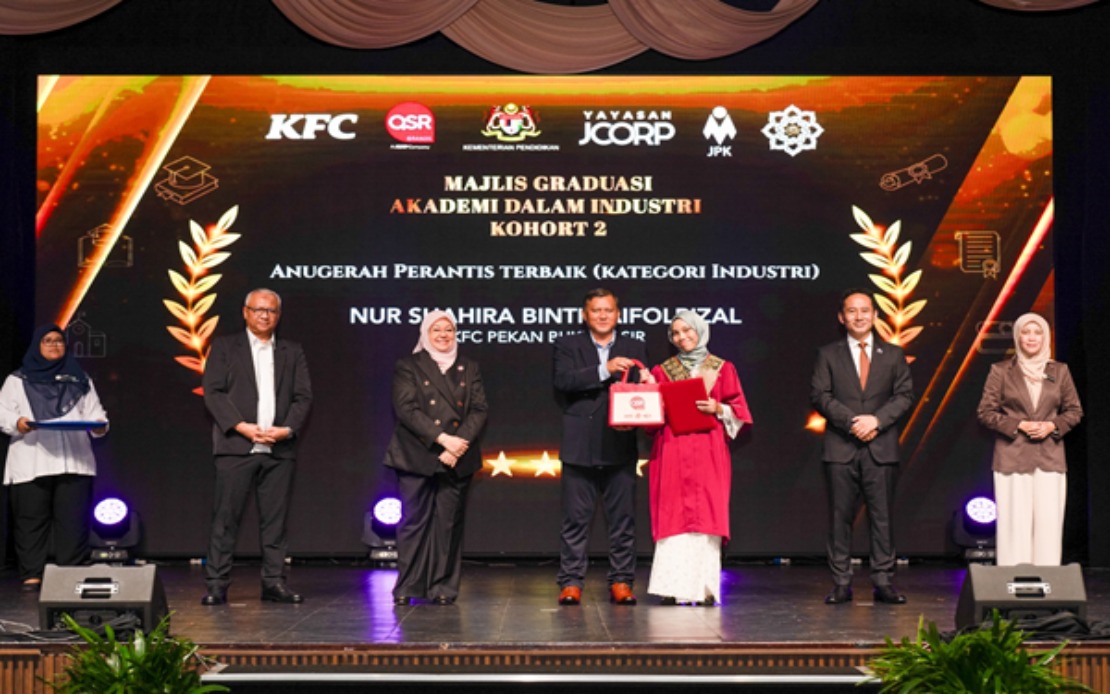
QSR Brands, operating KFC Malaysia, has marked another milestone by producing 37 vocational graduates through its Applied Dual Innovation (ADI) programme in partnership with Yayasan JCorp, a development that underscores the growing momentum of industry-education collaboration in Malaysia's workforce development ecosystem. The cohort, trained at KFC restaurants in Johor Bahru, represents the second intake of students to complete the initiative since its introduction three years ago, building upon the success of an inaugural group of 23 students who finished their industrial training earlier this year.
The ADI programme exemplifies a deliberate structural approach to addressing Malaysia's skills gap by embedding classroom learning within authentic workplace environments. Rather than relegating vocational training to theoretical instruction disconnected from industry realities, the initiative places students directly in KFC restaurant operations, where they gain hands-on exposure to fast food preparation, customer service protocols, and operational management across a range of shifts and scenarios. This model recognises that genuine competency development demands prolonged practical immersion alongside formal certification pathways.
According to Zulkernai Fauzi, the director of Technical and Vocational Education and Training (TVET) at the Ministry of Education, the programme serves as a benchmark for how industry and educational institutions should coordinate their efforts. His endorsement carries particular significance given the ministry's oversight of Malaysia's technical and vocational landscape, a sector that has historically struggled with fragmentation between employer needs and curriculum design. The incorporation of recognised certifications alongside real-world work experience represents the policy direction that Malaysia is pursuing to enhance the relevance and quality of TVET outcomes.
The second cohort's academic performance demonstrates robust outcomes across multiple qualification levels. Students achieved a 100 per cent pass rate in Vocational Stream Subjects (MPAK), the Malaysian Skills Certificate (SKM) at both Level 2 and Level 3, and a 95 per cent pass rate in the Sijil Pelajaran Malaysia (SPM) examination. Each graduate emerged with five distinct credentials: the Vocational SPM (SPMV), two levels of SKM certification, a programme completion certificate, and a certificate of appreciation from QSR Brands itself. This multi-credential approach provides graduates with portable qualifications that signal different levels of competency to potential employers within and beyond the quick-service restaurant sector.
Rozaini Mohd Sani, chairman of Yayasan JCorp, characterised the ADI programme as a mechanism for democratising access to quality vocational pathways. By removing traditional barriers that might prevent motivated young people from accessing training opportunities, the partnership creates avenues for individuals from diverse socioeconomic backgrounds to build professional confidence and acquire marketable skills. The emphasis on self-confidence development acknowledges that technical competency alone is insufficient for workplace success; graduates must also possess the interpersonal and psychological capacity to navigate professional environments effectively.
Dr Sharifah Musainah Syed Alwi, chief human resources officer at QSR Brands (M) Holdings Bhd, positioned the programme's achievements within a broader context of authentic skill development rather than credential accumulation. Her statement reflects a recognition that qualifications carry meaning only when they represent genuine mastery of functions performed in real operational contexts. The training curriculum encompassed restaurant operations management, customer service excellence, food safety and preparation protocols, and adherence to workplace standards and regulations, ensuring that graduates possess competencies immediately applicable upon employment.
The geographical concentration of training at Johor Bahru locations reflects both strategic business deployment and the potential for localised skills clustering. By anchoring the programme in Johor, QSR Brands and Yayasan JCorp have created sustained engagement with the state's educational institutions and labour market, potentially establishing Johor as a regional hub for fast-service sector training and employment. This approach contrasts with dispersed training models and creates opportunities for employer networks to develop around geographical concentrations of skilled workers.
Since the ADI programme's inception in June 2023, the collaboration has produced 60 graduates across two cohorts. This trajectory suggests the partnership has achieved operational viability and institutional stability, moving beyond pilot-phase experimentation. The consistency of output and the successful scaling from 23 to 37 graduates indicates that the initiative has overcome initial implementation challenges and established replicable processes. For Malaysia's broader vocational education ambitions, this consistency matters because it demonstrates that industry-education partnerships can operate at sustainable scale rather than remaining isolated experimental projects.
The programme emerged from strategic coordination between KFC Malaysia, the Department of Skills Development under the Ministry of Human Resources, and the Ministry of Education, representing a deliberate effort to align three institutional actors around shared workforce development objectives. This tripartite structure addresses a persistent fragmentation challenge within Malaysia's skills ecosystem, where employers, government training agencies, and education ministries have historically operated with insufficient coordination. The ability to maintain collaborative momentum across these institutional boundaries over three years suggests organisational maturity within the partnership.
The recognition of individual student achievement through specialised awards—including the Best Apprentice Award (Industry Category), the Best Apprentice Award (SPM Category), and the Best Apprenticeship Documentation Award—institutionalises excellence and creates aspirational models for future cohorts. These distinctions signal that the programme values not only functional competency but also exemplary performance and professional documentation practices, qualities that distinguish high-performing employees within service-sector employment.
For Malaysian policymakers focused on reducing youth unemployment and enhancing workforce readiness, the ADI model offers a replicable template that other major employers might adopt. The success metrics—high certification pass rates, strong SPM performance, and demonstrated workplace competency—provide evidence of effectiveness that could encourage expansion across the quick-service restaurant sector and potentially into other service industries facing similar skills challenges.
The initiative takes on additional significance within Malaysia's efforts to position itself competitively within the ASEAN labour market. As regional mobility increases and competition for skilled service-sector workers intensifies, nations that can credibly demonstrate commitment to workforce development gain advantages in attracting and retaining talent. The KFC Malaysia-Yayasan JCorp partnership contributes to a broader narrative of Malaysia's institutional capacity to bridge education and employment, a narrative that carries economic and demographic implications as automation pressures manufacturing sectors and service industries assume greater employment importance.
Moving forward, the evidence of success within the quick-service restaurant industry invites scrutiny of whether and how similar partnerships might be extended into related sectors or scaled within the existing partnership. Zulkernai Fauzi's suggestion that the model should be expanded further indicates official recognition that the current scope, while promising, remains limited relative to Malaysia's overall workforce development needs. The path from successful pilot to widespread institutional adoption, however, requires sustained commitment from both corporate partners and government agencies, alongside adequate resource allocation and policy incentives that recognise the value of employer investment in vocational training.

