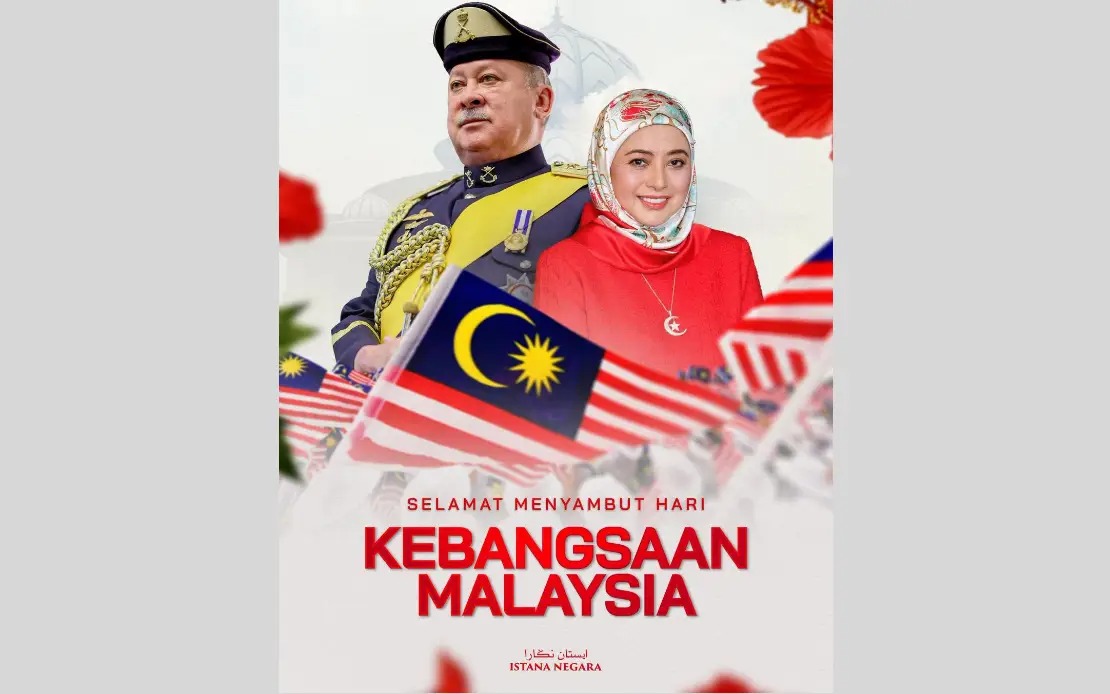
Sultan Ibrahim Sultan Iskandar and Raja Zarith Sofiah conveyed their 69th National Day wishes to Malaysians on August 31st through a message shared on the royal Facebook page, reaffirming the monarchy's connection to the nation during its annual celebration of independence and unity.
The royal couple's presence at the Putrajaya celebration underscored the ceremonial importance of the occasion, with Prime Minister Datuk Seri Anwar Ibrahim and his spouse Datuk Seri Dr. Wan Azizah Wan Ismail receiving Their Majesties at 8 am. Communications Minister Datuk Seri Fahmi Fadzil, who chairs the National Day and Malaysia Day (HKHM) 2026 Main Committee, was also present to welcome the royal guests, emphasising the coordination between the monarchy, executive branch, and event organisers in marking this significant national milestone.
The celebration carried the theme "Malaysia MADANI: Kesejahteraan Dinikmati", positioning the nation's development framework around citizen prosperity and inclusive growth. This thematic choice reflects the government's ongoing emphasis on ensuring that economic advancement and social programmes reach all segments of Malaysian society, from urban centres to rural communities, and across all ethnic and religious backgrounds.
The ceremonial programme opened with a formal military display, establishing the solemn tone befitting a national independence commemoration. Following this, the event transitioned into entertainment and pageantry designed to showcase Malaysia's cultural wealth and contemporary aspirations through music, dance, and visual spectacle.
The scale of participation highlighted the national mobilisation achieved for the celebration. A total of 10,819 participants marched across 76 distinct contingents, representing government agencies, civil society organisations, community groups, and uniformed services. The procession included contributions from 22 brass bands that provided musical accompaniment, while 11 specially decorated vehicles added visual narrative elements to the parade route through Putrajaya.
Beyond terrestrial displays, the celebration demonstrated comprehensive military and security presence through the participation of 328 land, sea and air assets. This extensive deployment showcased Malaysia's defence capabilities while serving ceremonial purposes, with aircraft flyovers and naval representations contributing to the spectacle. Additionally, 112 service animals participated, adding another dimension to the diverse representation of national institutions and capabilities.
A particularly striking feature was the inclusion of 22 electric vehicles in the parade, signalling Malaysia's commitment to environmental sustainability and clean energy transitions as part of its forward-looking national identity. This deliberate inclusion reflected contemporary policy priorities alongside traditional ceremonial elements.
The human graphic display organised on the Putrajaya terraces featured 26 distinct formations that collectively created a visual representation of Malaysia's multicultural fabric. This artistic element transformed the audience experience, as spectators witnessed the formation of patterns and symbols that embodied the nation's commitment to diversity, interfaith harmony, and social cohesion. Such displays have become increasingly sophisticated in recent years, using organised crowds to create kaleidoscopic effects visible to both on-ground observers and aerial cameras broadcasting the event nationally.
The logistics of assembling such a massive celebration required months of coordination among multiple government agencies, the military, local authorities, and community organisations. For Malaysian readers, particularly those in Putrajaya and surrounding states, the event represented a significant traffic and security undertaking, with road closures and enhanced police presence necessitated by the gathering of tens of thousands of participants and spectators.
From a regional perspective, Malaysia's National Day celebrations like this one serve as annual demonstrations of national unity and organisational capacity. Neighbouring countries and international observers monitor how Southeast Asia's most diverse major democracy manages symbolic national events, with particular attention to whether celebrations successfully incorporate all communities or highlight persistent social divisions.
The involvement of both the Yang di-Pertuan Agong and Raja Permaisuri Agong in National Day proceedings reinforces the constitutional monarchy's role as a unifying national institution above party politics. Their presence legitimises the celebration and the MADANI framework beyond partisan boundaries, even as the ruling government uses the occasion to communicate its policy vision.
The 69th National Day marked a milestone in Malaysia's post-colonial trajectory, occurring during a period of significant political transformation with a government led by an opposition party that emerged victorious in 2022. This context gave the national celebration additional resonance as an opportunity for national stocktaking and the articulation of shared aspirations transcending recent electoral divisions.
Looking forward, the elaborate planning evident in this year's celebration sets precedent for the 2026 National Day and Malaysia Day joint commemoration that Communications Minister Fahmi's committee oversees. The scale and sophistication of celebrations tend to expand incrementally, suggesting that future National Day events will likely feature even more technological integration, sustainability measures, and inclusive participation reflecting evolving Malaysian society.

