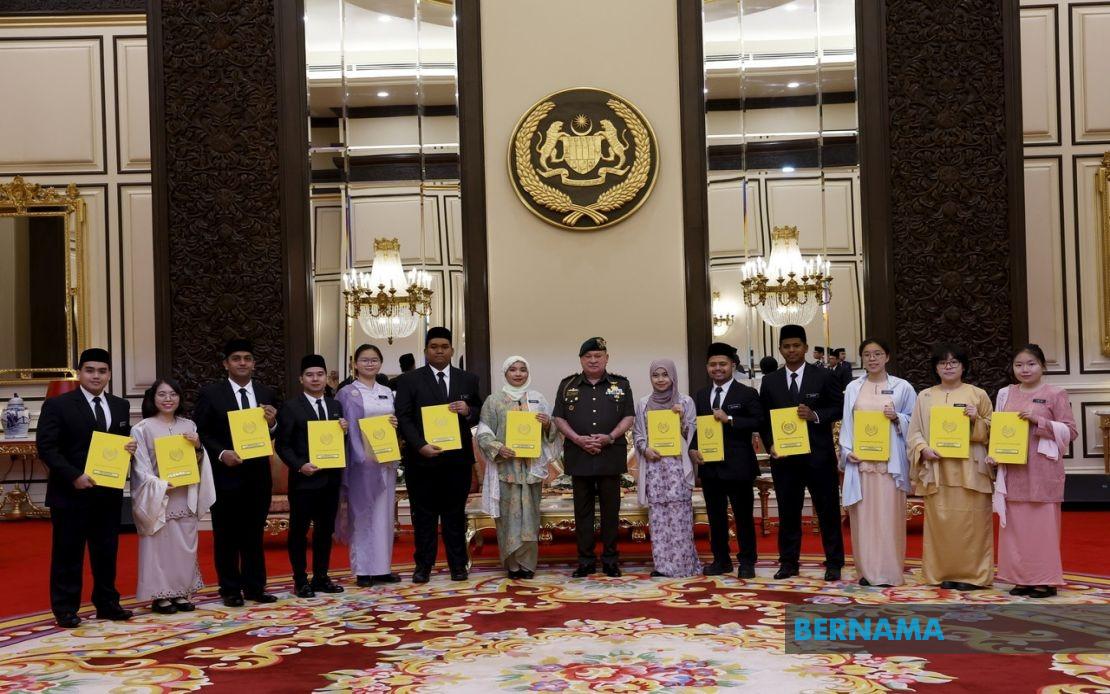
His Majesty Sultan Ibrahim, King of Malaysia, has formally presented the 2026 Yang di-Pertuan Agong Scholarships (BYDPA) to 14 accomplished recipients during a ceremonial gathering at Istana Negara in Kuala Lumpur. The occasion underscored the nation's commitment to nurturing advanced academic talent across critical research disciplines and bolstering Malaysia's knowledge economy through targeted investment in postgraduate education.
The scholarship distribution was evenly divided between two tiers of advanced study. Seven recipients have been selected to pursue doctoral programmes, representing the highest echelon of research qualification, while a parallel cohort of seven scholars will undertake Master's-level research studies. This balanced allocation reflects a deliberate strategy to develop expertise across both foundational and frontier research domains, ensuring a pipeline of knowledge leaders capable of driving innovation across Malaysia's public and private sectors.
Geographic distribution of the scholarship placements reveals a strategic balance between international and domestic academic pathways. Four recipients will undertake their postgraduate research at internationally recognised universities abroad, positioning them to acquire specialised knowledge at global research frontiers and establish networks within the international academic community. The remaining ten scholars will conduct their studies at Malaysia's premier research-intensive universities, a decision that strengthens local institutions and retains high-calibre talent within the national research ecosystem.
The BYDPA represents one of Malaysia's most distinguished scholarship schemes, enjoying prominence among government-sponsored educational funding mechanisms. According to Tan Sri Wan Ahmad Dahlan Abdul Aziz, Director-General of the Public Service, the scholarship programme stands apart for its exceptional financial generosity compared to competing government scholarship offerings. This positioning reflects the Malaysian government's strategic prioritisation of research capacity-building as essential infrastructure for long-term socioeconomic development and competitive advantage in knowledge-driven sectors.
The ceremony drew attendance from senior government officials overseeing Malaysia's civil service apparatus and royal institutional frameworks. Tan Sri Wan Ahmad Dahlan Abdul Aziz represented the public service administration, while Tan Sri Dr Azmi Rohani, Comptroller of the Royal Household at Istana Negara, participated in formalising the royal conferral. Their presence underscored the ceremonial significance of the occasion and the institutional weight placed upon advancing research talent development as a matter of national importance.
For Malaysia's research community and aspiring scholars, the BYDPA awards signal sustained governmental commitment to producing advanced research capacity despite competing budgetary pressures. The selection of 14 recipients from presumably a substantially larger applicant pool indicates rigorous competitive evaluation and suggests these recipients represent exceptional promise within their respective disciplines. Their future contributions to Malaysian research, particularly when the doctoral cohort reaches full scholarly maturity, will likely generate publications, technological innovations, and policy insights influencing national development trajectories.
The scholarship's emphasis on research-focused postgraduate training aligns with broader Southeast Asian trends toward deepening indigenous research capabilities. As regional economies transition toward higher-value manufacturing and knowledge services, nations including Malaysia recognise that dependence upon foreign research and development must progressively diminish. By cultivating homegrown expertise through schemes like BYDPA, Malaysia invests in reducing technological vulnerability and building competitive advantages in emerging domains from biotechnology to advanced manufacturing and sustainable energy solutions.
The decision to direct ten of fourteen recipients toward local universities reflects confidence in Malaysia's research infrastructure while acknowledging that selective international placement generates beneficial knowledge transfer and prestige effects. Recipients studying abroad will establish professional relationships with global research networks, potentially facilitating future collaborative projects, student exchanges, and technology partnerships that benefit Malaysian institutions indirectly. This complementary strategy balances domestic capacity-building with strategic international engagement.
For Malaysia's postgraduate education sector, BYDPA awards function as both immediate resource injections and longer-term talent investments. The scholars selected will join Malaysian universities as research students, contributing labour and intellectual capital to ongoing projects while themselves acquiring advanced methodological training. Upon completing their qualifications, they become potential recruits for academic positions, government research agencies, and private sector innovation functions, creating multiplier effects within Malaysia's knowledge ecosystem.
The timing of the 2026 BYDPA cycle occurs within a broader context of regional competition for research talent and funding. Nations across Southeast Asia vie to attract and retain advanced researchers as critical development assets. Malaysia's maintenance of competitive scholarship programmes positions it favourably within this regional talent competition, signalling continued capacity to support ambitious scholars who might otherwise relocate to higher-income jurisdictions offering superior research funding and professional advancement pathways.
Looking forward, the trajectory of these fourteen scholarship recipients will merit monitoring as they progress through their respective programmes. Their eventual research outputs, publications, and professional placements will provide empirical indicators of BYDPA programme effectiveness and may inform refinement of selection criteria or funding allocation in subsequent cycles. Success stories from the cohort would strengthen the scheme's reputation and potentially inspire increased applications from subsequent generations of high-potential researchers navigating postgraduate pathways.