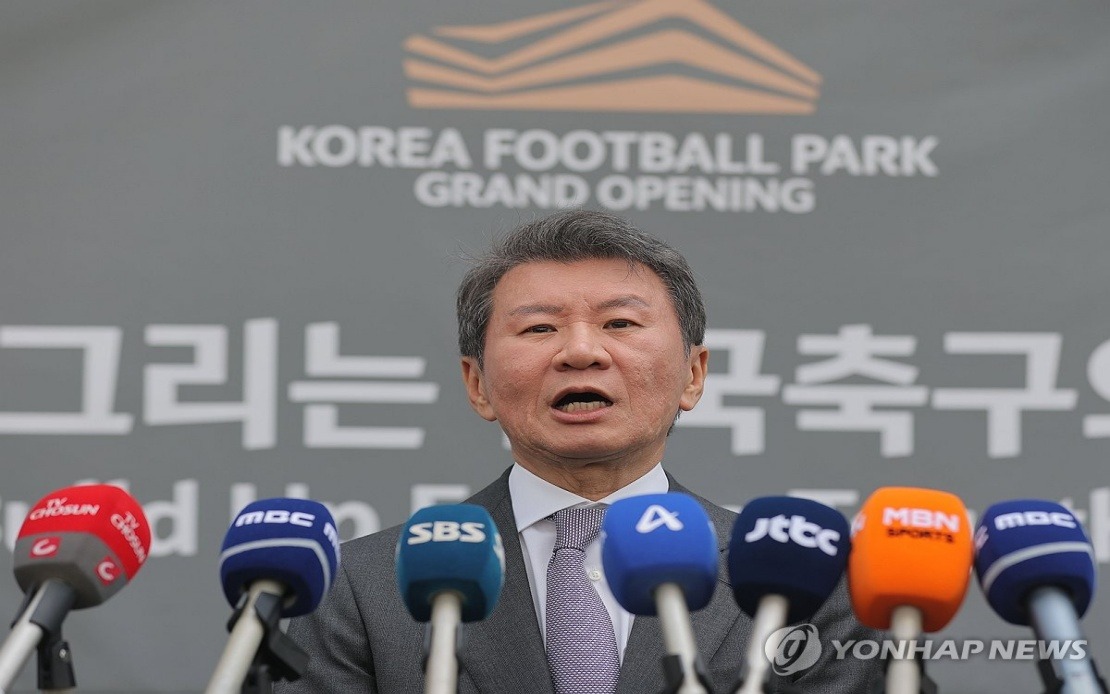
South Korea's football federation faced significant leadership upheaval on Monday when Korea Football Association president Chung Mong-Gyu formally submitted his resignation, stepping down approximately two weeks before the conclusion of the FIFA World Cup. The resignation was submitted during what Chung designated as his final executive meeting at the KFA headquarters in Cheonan, located roughly 90 kilometres south of Seoul.
Chung's departure accelerates a withdrawal he had previously announced in May, when he committed to leaving office after the World Cup tournament concluded on July 20. His decision to exit prematurely reflects the fallout from South Korea's disappointing performance in the competition. The national squad, managed by Hong Myung-bo, finished third in Group A with three points accumulated through a single victory offset by two defeats, falling short of advancement to the knockout stage. The stringent qualification criteria meant South Korea needed to rank among the eight best third-place finishers, a threshold the team failed to meet. Coach Hong tendered his resignation immediately following the team's mathematical elimination.
The KFA leadership has endured mounting scrutiny over governance practices and administrative decisions. Particularly contentious was the hiring methodology that brought Hong Myung-bo into the coaching position in July 2024. Multiple observers and critics questioned the transparency and rigor of the selection process. This controversy intensified when South Korea's Ministry of Culture, Sports and Tourism undertook a comprehensive examination of KFA operations. The ministry's investigation identified irregularities within the federation and recommended disciplinary measures against Chung and other senior KFA personnel, though the specific violations remain contested.
The tension between the government and the football association has escalated further, with both parties locked in legal disagreements. The ministry has indicated intentions to conduct additional audits into the KFA's affairs, capitalising on the World Cup exit as justification for heightened oversight. This adversarial dynamic reflects broader governance concerns that extend beyond sporting performance, touching on questions of institutional accountability and democratic processes within Korean sports administration.
Under KFA statutes, operational continuity will be maintained through interim leadership drawn from the federation's four vice presidents until a permanent successor is elected. The electoral framework demands that a replacement president be chosen within 60 days of Chung's departure, provided the outgoing leader possessed more than one year remaining on his contract. In this instance, Chung retained nearly three years of his fourth term, triggering the compressed timeline for successor selection.
The presidential election process involves an electoral college comprising representatives from regional football associations, K League club executives, professional players, coaches, and match officials. Participation in last year's election reached 183 from 192 eligible voters, demonstrating substantial engagement with the selection mechanism. However, the government has signalled dissatisfaction with existing electoral procedures. Culture, Sports and Tourism Minister Chae Hwi-young publicly acknowledged concerns about the KFA's presidential selection methodology, asserting that the federation must recognise the profound disappointment felt by the South Korean public in light of the World Cup outcome.
The government's implied pressure appears directed at encouraging the KFA to reconsider its electoral framework. Chae's comments were interpreted as suggesting that maintaining the current system may prove politically untenable given public sentiment. This external pressure has prompted movement on the technical level, with the Korean Sport and Olympic Committee, the apex body overseeing all national sports federations, preparing regulatory amendments for consideration at a general assembly scheduled for July 16. Discussion points at that meeting are expected to include extending the 60-day election window beyond its current duration and evaluating the adoption of direct voting mechanisms that would bypass the electoral college system.
The electoral reforms under consideration represent potentially significant structural changes to how South Korean football governance operates. A direct election system would democratise the selection process by allowing broader stakeholder participation, though implementing such a change during an active succession would present administrative complications. Conversely, extending the timeline for selecting a new president could allow for more deliberative candidate evaluation and campaign periods, potentially enhancing the legitimacy of whoever assumes the presidency.
In his formal departure statement, Chung acknowledged the complexity of his tenure and accepted responsibility for outcomes perceived as failures. His statement expressed gratitude to supporters while apologising for instances when his leadership disappointed the public. He characterised his presidency as dedicated exclusively to advancing Korean football's competitive standing and international reputation, recognising that both successes and failures accompanied his time in office. He attributed triumphs to players and supporters while accepting personal accountability for shortcomings.
Chung's concluding remarks projected confidence in Korean football's resilience and capacity for recovery. He emphasised his continued affection for the sport and expressed conviction that the national programme would ultimately surmount current adversities and achieve renewed heights, pointing to Korea's documented history of rebuilding after setbacks. This framing attempts to position his departure as a transitional moment within a longer institutional narrative rather than a definitive rupture.
The KFA succession process will unfold against a backdrop of heightened governmental interest and potential structural reform. The interim leadership period and upcoming presidential election will test whether the federation can satisfy government expectations regarding governance improvements while maintaining the technical focus necessary for rebuilding competitive performance. For Malaysian and Southeast Asian observers, the Korean situation illustrates how major tournament disappointments often trigger institutional reckoning and governance scrutiny within sports bodies, regardless of national context. The coming weeks will clarify whether the KFA emerges with reformed electoral structures and renewed legitimacy, or whether political and administrative conflicts continue dominating the federation's agenda.

