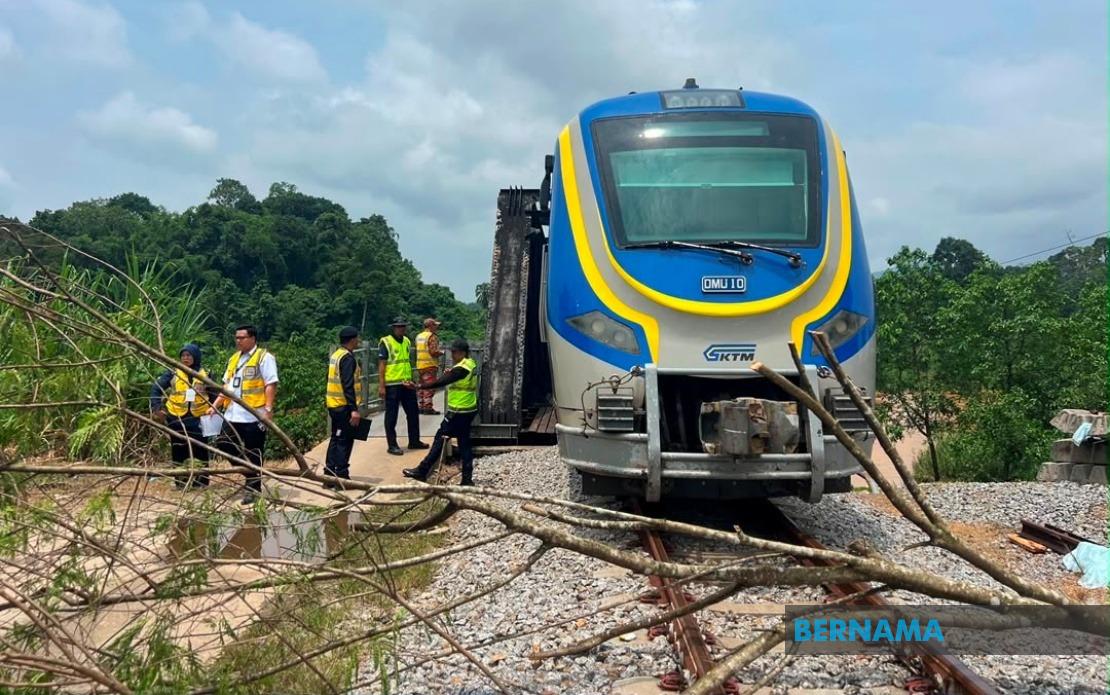
Malaysia's state railway operator Keretapi Tanah Melayu Berhad (KTMB) has conducted a large-scale emergency response training programme on the EX-Kemubu route in Kuala Krai, mobilising approximately 350 personnel from 11 agencies to test critical aspects of disaster management in one of the country's most geographically challenging railway corridors. The exercise represents a methodical approach to identifying gaps in coordination between KTMB and external emergency services, with particular emphasis on the practical difficulties posed by the region's remote location and limited road infrastructure.
According to Khairul Naim Johdi, KTMB's Occupational Safety, Health and Environment general manager, the training initiative addresses fundamental vulnerabilities that distinguish rural railway operations from urban counterparts. The remote setting of the EX-Kemubu line, combined with its proximity to river systems and distance from major highways, creates genuine obstacles for emergency responders attempting to reach accident sites quickly. Rather than treating these challenges as inevitable constraints, KTMB has designed the exercise to quantify response delays and identify systematic improvements that can compress reaction times when real incidents occur.
The evaluation framework encompasses three interconnected dimensions that reflect the hierarchy of emergency management priorities. Physical access represents the foundational layer—rescue teams cannot perform their function if they cannot reach the scene. Response time follows as the second consideration, measuring how rapidly equipped personnel mobilise after KTMB's operations control centre triggers the notification cascade. Information dissemination forms the third pillar, ensuring that accurate, timely communication flows both outward to emergency agencies and inward through feedback channels that allow continuous refinement of procedures. By isolating these variables during the controlled training environment, KTMB creates measurable benchmarks against which future performance can be assessed.
The selection of the EX-Kemubu corridor as the training location reflects deliberate strategic thinking about where vulnerabilities matter most. This particular route combines multiple risk factors—its distance from population centres, its interaction with natural waterways that could complicate both accident causation and rescue operations, and its operational characteristics as a semi-rural service. Rather than conducting routine drills in familiar settings where response patterns are well-established, KTMB has chosen to stress-test its systems in precisely the environments where failures would carry the highest consequences. This mirrors international best practices in emergency preparedness, where high-risk assets deliberately conduct exercises under worst-case assumptions.
The participating agencies span the full spectrum of Malaysia's emergency response infrastructure, including the Royal Malaysia Police, the Malaysian Fire and Rescue Department, the Ministry of Health, the Malaysian Civil Defense Force, and the Department of Social Welfare. This multi-agency composition ensures that the exercise reflects real-world coordination challenges rather than simulating a sanitised scenario where KTMB operates in isolation. When 350 personnel from 11 different organisations attempt to execute a coordinated response, friction emerges at institutional boundaries—communication protocols may conflict, understanding of roles may diverge, and command authority may remain ambiguous. These tensions, when exposed during training, can be resolved through refined procedures before they jeopardise actual emergency response.
The methodology incorporates structured post-exercise analysis that Khairul Naim describes as a 'post-mortem' process. This terminology, drawn from medical practice where autopsies determine precise causes of death, signals a serious investigative approach. Feedback from all participating agencies will be systematically collected and analysed, examining not merely whether objectives were achieved, but how efficiently resources moved through the system, where communication bottlenecks occurred, and which first-responder actions proved effective or counterproductive. This granular assessment converts the training exercise from a checkbox compliance activity into a genuine learning mechanism that generates actionable intelligence.
KTMB's commitment to annual large-scale emergency drills, rotating through the four operational regions and supplemented by smaller exercises throughout the year, establishes emergency preparedness as an ongoing institutional practice rather than an episodic requirement. This cadence reflects understanding that emergency response capabilities degrade without maintenance—personnel rotate, procedures become outdated, and complacency gradually erodes readiness unless deliberately countered through regular, sustained training. The rotation system also distributes learning across all regions, preventing the concentration of expertise in particular areas while ensuring that each operational zone receives tailored attention to its specific geographical and operational characteristics.
Khairul Naim's observation that rural areas present distinctive access challenges speaks to a dimension of railway safety that urban-focused discussions often overlook. When an accident occurs on the Port Klang or Sentral lines, emergency services converge within minutes because rescue stations are geographically proximate and road networks provide multiple approach routes. On the Dabong and Kemubu route that extends into the hinterland of Kelantan, the same incident response might require 30 minutes or more simply to establish initial access, during which time medical triage, passenger stabilisation, and hazard mitigation proceed under constraints imposed by geographic isolation. Training explicitly designed to confront this differential creates opportunities to develop compensatory strategies—pre-positioning medical supplies at critical junctures, ensuring that on-train personnel possess advanced first-aid certification, or establishing communication protocols that function with degraded external connectivity.
Internal coordination within KTMB itself emerges as a parallel critical concern. The command structure establishing the operations control centre as the initial notification hub creates a single point through which all information must flow before dispersal to external agencies. This architecture offers clarity of responsibility but introduces a potential bottleneck—if KTMB's internal systems fail to rapidly escalate information, external response cascades are automatically delayed. Training exercises that deliberately test this notification chain under time pressure reveal whether standard procedures function as designed or whether personnel tend to circumvent formalised pathways through informal channels. Identifying such tendencies during training allows corrections before they compromise a genuine emergency.
The passenger evacuation emphasis underscores that emergency response encompasses dimensions beyond rescue of injured persons. Orderly, safe movement of potentially several hundred passengers off a train, onto unfamiliar terrain, possibly in darkness or adverse weather, requires planning, rehearsal, and coordinated direction. KTMB staff responsible for passenger management must understand their authority, communication channels, and decision-making thresholds. Training ensures that evacuation procedures, while standardised, account for the specific terrain characteristics of the EX-Kemubu route—unlike urban evacuations where passengers move to parallel platforms or nearby shelter, rural route evacuations must address where 300 people will actually go and how they will be accounted for in an area potentially lacking immediate shelter or services.
The integration of multiple emergency systems—police securing scenes and managing traffic, fire and rescue providing extrication and hazardous materials response, health ministry delivering medical care and coordinating hospital admission, civil defence providing logistics and shelter if required, social welfare managing displaced persons—creates coordination demands that routinely exceed what individual agencies encounter in their regular operations. A police officer accustomed to managing individual traffic incidents must now function within a larger system where KTMB operations control provides initial information, where medical priorities might override traffic control considerations, and where civilian welfare obligations might constrain law enforcement activities. Training in such complex environments builds organisational muscle memory that cannot develop through lectures or desktop simulations.
For Malaysian readers, the significance of this exercise extends beyond KTMB's immediate operational requirements. The railway network connects major economic nodes and development corridors while increasingly serving semi-urbanised areas where rural populations depend on rail services for access to healthcare, education, and employment in urban centres. An accident on a remote route could theoretically trap passengers who have limited options for alternative transport, while simultaneous rescue challenges could overwhelm local medical facilities unaccustomed to handling mass casualty incidents. KTMB's systematic approach to emergency preparedness represents institutional responsibility toward the travelling public, particularly those in regions where geographic isolation historically meant that emergencies received delayed response. The training programme demonstrates that even as Malaysia develops its transport infrastructure, recognising and addressing the safety implications of geography remains essential to genuine progress.

