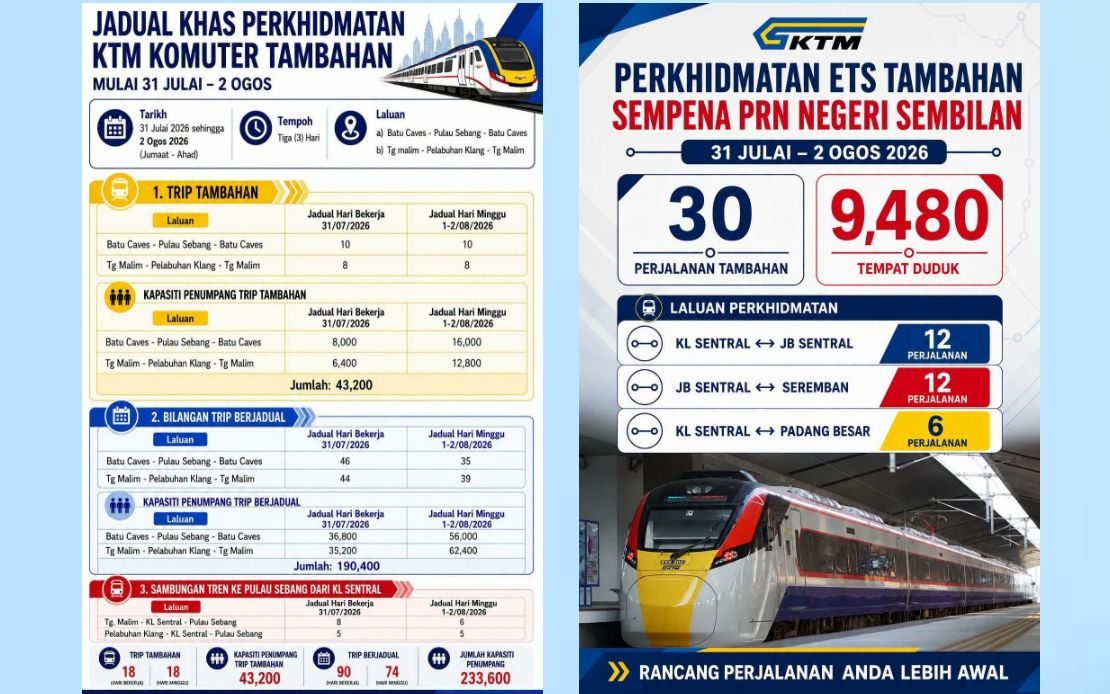
Keretapi Tanah Melayu Berhad (KTMB) is mobilizing substantial additional rail capacity across its network to facilitate voter movement ahead of the Negeri Sembilan state election, announcing an expanded service schedule spanning July 31 through August 2, 2026. The initiative underscores growing recognition among transport authorities that major electoral events require coordinated infrastructure planning, particularly to serve dispersed populations returning to their constituencies. With election day scheduled for August 1, KTMB's announcement reflects practical expectations that commuter and intercity rail will experience elevated demand as eligible voters journey from urban centers back to their home constituencies across the peninsular rail network.
The expanded KTM Komuter service will deploy 18 additional trains daily maintaining weekday scheduling patterns on Friday, then shift to another 18 supplementary trains operating on weekend frequencies through Saturday and Sunday. This two-tier approach acknowledges differing travel patterns across the period, with Friday serving working professionals and Saturday-Sunday accommodating family groups and those with greater schedule flexibility. The Batu Caves to Pulau Sebang corridor receives 10 of these additional trips, while the Tanjung Malim to Port Klang route accounts for the remaining eight, targeting the two primary commuter arteries serving the broader Selangor and Negeri Sembilan catchment areas.
Collectively, KTMB projects the three-day enhancement will deliver 233,600 passenger seats across all services, comprising 190,400 through existing scheduled operations and an additional 43,200 through newly allocated trains. This calculation demonstrates deliberate capacity modeling, suggesting KTMB anticipated specific demand thresholds that existing timetables could not accommodate during the election period. For Malaysian voters accustomed to occasional transport bottlenecks during holiday periods, this proactive expansion represents the rail sector's attempt to prevent congestion-related obstacles to electoral participation, a consideration that carries particular weight in a federal system where voters must return to designated polling districts.
The Electric Train Service component involves 30 supplementary trips distributed across three primary corridors serving different regional markets. The Johor Bahru Sentral to Seremban route receives 12 additional trains, a strategic allocation reflecting Negeri Sembilan's geographic position as a natural destination for voters from Selangor and Kuala Lumpur while accommodating return journeys from southern peninsular locations. The Johor Bahru Sentral to Kuala Lumpur Sentral line gets another 12 trains, ensuring adequate capacity on the most heavily trafficked intercity ETS corridor. The Kuala Lumpur Sentral to Padang Besar route receives six supplementary trains, serving voters from the northern states who may require longer transfer journeys to reach Negeri Sembilan polling stations.
Detailed scheduling reveals KTMB's granular approach to managing election-period demand. On the Johor Bahru to Seremban route, trains EP9636 and EP9637 operate afternoon and early evening departures, capturing the final working hours when voters might depart their employment locations. Morning options through trains EP9630 and EP9633 serve those with greater schedule flexibility or overnight travel requirements. Similarly, the expanded Johor Bahru to Kuala Lumpur service includes early morning departures via train EX9572 at 7:00 am, accommodating overnight travelers or those commencing lengthy journeys at dawn, alongside evening options at 5:30 pm serving those prioritizing daytime work commitments.
The coordination with ongoing infrastructure development demonstrates how electoral periods necessitate temporary adjustment of development schedules. KTMB suspended works under the Klang Valley Electric Double Track Infrastructure Facilities Upgrading Project Phase 2 for the three-day period, prioritizing train safety and reliability over construction progress. This pause reflects pragmatic project management recognizing that election periods represent unique circumstances warranting temporary operational adjustments. For Malaysian commuters familiar with periodic service disruptions from ongoing rail modernization initiatives, such suspension windows are increasingly familiar, though their alignment with electoral events provides tangible demonstration of political significance attached to transportation infrastructure.
Integration across routes requires passenger awareness of connection points, particularly for Tanjung Malim to Port Klang users who must interchange at Kuala Lumpur Sentral Station to continue journeys toward Seremban and Pulau Sebang destinations. This bottleneck requirement highlights geographical constraints within Malaysia's rail network, where major urban terminals serve as unavoidable transfer hubs despite extensive route expansion. KTMB's explicit advisory about interchange procedures suggests experience managing passenger confusion during high-demand periods, reflecting lessons learned from previous holiday surges and special event transportation.
The capacity projection of 9,480 additional ETS seats across 30 supplementary trains establishes clear expectations about demand intensity, suggesting KTMB anticipates this will constitute meaningful but not unprecedented expansion. Comparative to standard ETS formations, this represents managed growth rather than emergency measures, implying the operator has confidence in its ability to sustain service quality while accommodating increased volumes. For Southeast Asian observers, Malaysia's rail sector demonstrates growing sophistication in anticipatory demand management, contrasting with past election periods where transport capacity constraints sometimes hindered voter participation.
The advance notification strategy reflects evolving transport communication practices, with KTMB explicitly advising the public to plan journeys ahead and verify latest timetables through official channels. This transparency approach reduces last-minute confusion and distributes booking loads across the three-day window rather than concentrating demand on election day itself. For Malaysian transport users accustomed to real-time information seeking, availability of current schedules via official KTMB platforms provides essential planning tools, though digital access disparities may still disadvantage rural and older voters less connected to online information systems.
The election-period transport expansion highlights Malaysia's transition toward treating electoral infrastructure as a whole-of-government consideration extending beyond polling administration. Coordinating rail capacity with voting necessities signals recognition that participation in democratic processes depends on removing practical barriers, an approach increasingly evident across mature electoral systems. For Negeri Sembilan voters specifically, this service expansion removes transportation excuse-making while potentially increasing participation rates among geographically dispersed populations, contributing to electoral competitiveness in constituencies where residential mobility affects vote distribution.
Beyond immediate electoral utility, KTMB's expansion demonstrates network capacity headroom within existing infrastructure, suggesting that franchise utilization patterns during election periods may inform future service frequency decisions. If elevated demand materializes as projected, data collected during this three-day window could justify permanent service increases on high-demand routes, transforming temporary accommodation into structural expansion. This approach transforms electoral events from disruptions into planning opportunities, where captured demand patterns inform long-term network development benefiting ordinary commuters throughout election cycles.
The logistics coordination across multiple train operators and route segments required for this expansion illustrates the operational complexity underlying seemingly straightforward service increases. Depot scheduling, crew assignment, electrical supply allocation, and platform coordination across Kuala Lumpur's central stations demand precise orchestration, making such announcements evidence of advance planning rather than improvised responses. For Malaysian transport observers, this level of operational detail suggests KTMB has developed institutional capacity for surge event management, a capability likely to benefit other major transportation demands beyond electoral cycles.

