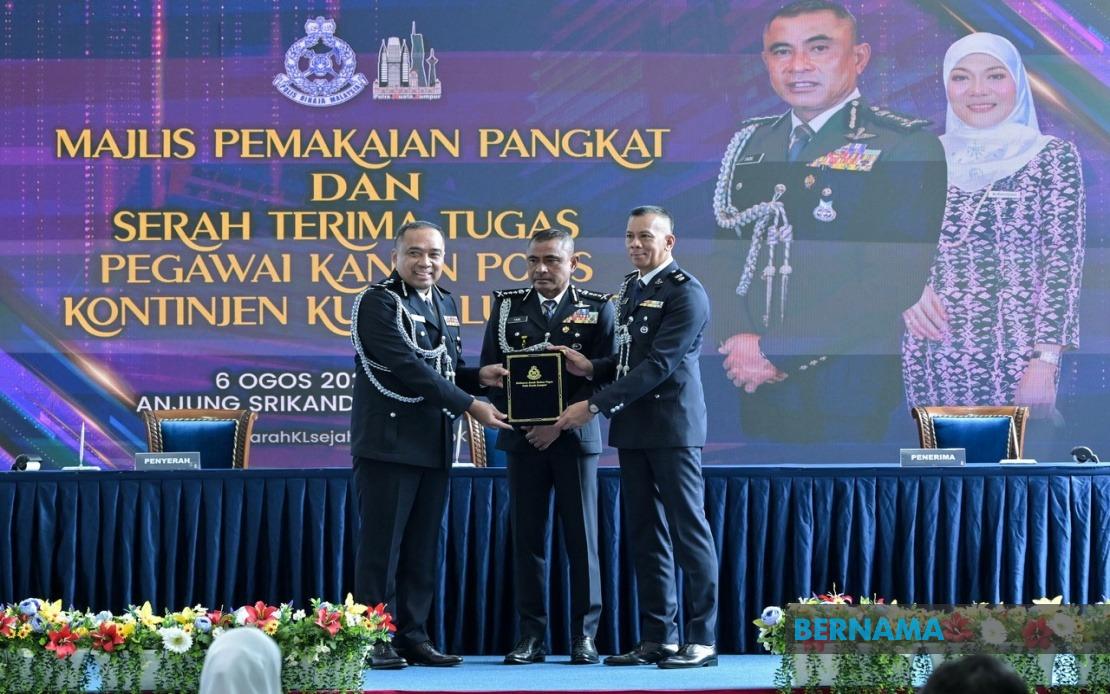
Kuala Lumpur police chief Datuk Fadil Marsus presided over a formal handover ceremony at police contingent headquarters on Wednesday, marking a substantial reorganisation of senior management across multiple critical departments. The restructuring involved six key positions spanning investigation, narcotics enforcement, district governance, and intelligence operations—reflecting the force's commitment to refreshing leadership while maintaining operational continuity amid mounting security demands.
The Criminal Investigation Department experienced a change in command as SAC Zulkarnain Samsudin relinquished his duties to SAC Sazlee Adam, signalling a transition in how the department will approach major crime investigation and case management. This shift carries particular significance given the CID's central role in addressing serious offences within the federal territory. Simultaneously, the Narcotics Crime Investigation Department saw ACP Kee Hang Kee assume leadership from SAC Haslah Bachok, a transition occurring as drug trafficking and abuse remain persistent challenges requiring sustained investigative focus across Malaysia's capital.
District-level administration underwent parallel changes with the appointment of fresh commanders to both Dang Wangi and Sentul divisions. Supt Nuzulan Mohd Din took command of Dang Wangi district, assuming responsibility from SAC Sazlee Adam, while Supt Jasni Zolpa moved into the Sentul district chief role previously held by SAC Basri Sagoni. These district postings are crucial for community policing efforts and frontline crime prevention, directly affecting public safety perceptions across neighbourhoods in Malaysia's largest metropolitan area.
Intelligence and specialised operations functions also underwent restructuring. The Special Branch deputy chief position for intelligence and operations transferred from SAC Kamaruzaman Md Alib to ACP Saefuddin @ Mohd Fitri Abdul Rahman, while the CID's intelligence and operations deputy chief role passed from SAC Zulkarnain Samsudin to Supt Ong Seng Keong. These changes suggest an institutional emphasis on refreshing approaches to counterintelligence and tactical operations planning amid an evolving threat landscape.
Kuala Lumpur deputy police chief Datuk Mohd Azani Omar attended the proceedings, underlining the significance the command structure attached to the ceremony. Such high-level participation signals that these appointments reflect broader strategic priorities rather than routine administrative shuffles, indicating deliberate architectural choices about departmental direction and capabilities.
In addressing assembled personnel, Fadil characterised promotions as recognition extending beyond individual achievement to represent augmented institutional confidence in officers' capacity to shoulder expanded responsibilities. He emphasised that advancement within the Royal Malaysia Police must be coupled with demonstrated integrity, professional excellence, and genuine commitment to service—setting clear expectations that rank progression carries corresponding accountability.
The police chief articulated that leadership transitions represent more than procedural necessity; they constitute a mechanism for ensuring organisational vitality. By rotating experienced commanders into fresh roles, the force deliberately introduces diverse experiences and perspectives while preventing institutional stagnation. Fadil noted that such changes protect public service delivery by preventing any disruption during management transitions, a concern particularly acute in policing where operational continuity directly impacts citizen security.
Fadil's remarks acknowledged the increasingly intricate security environment confronting Kuala Lumpur, characterised by sophisticated criminal methodologies, transnational threats, and evolving public safety demands. He called for renewed dedication to core policing functions including violent crime prevention, drug enforcement, investigative competency enhancement, and operational preparedness. Equally important in his emphasis was community engagement—recognition that sustainable public security requires partnership between police and residents.
The restructuring reflects broader patterns observable across Southeast Asian law enforcement, where police forces periodically recalibrate leadership to maintain institutional effectiveness. Malaysia's focus on intelligence operations, narcotics enforcement, and district-level community policing mirrors regional priorities as countries grapple with transnational criminal networks and evolving security challenges. For Malaysian readers, these changes at the federal territory level often presage similar restructuring at state contingents, suggesting a coordinated approach across the national police hierarchy.
The emphasis on investigation capabilities deserves particular attention given Malaysia's ongoing challenges with organised crime, human trafficking, and complex financial crimes. By rotating senior investigators between units and promoting those with demonstrable track records, the police appear to be consolidating institutional knowledge while positioning the CID to handle increasingly sophisticated casework. The narcotics leadership change similarly reflects continued prioritisation of drug interdiction, an area where police statistics and public concern consistently intersect.
These appointments also reflect Malaysia's broader governance philosophy regarding meritocratic advancement within the civil service. By publicly celebrating competent officers and their progression, the government signals commitment to professional standards and suggests that advancement depends on demonstrated capability rather than patronage—a message particularly important for morale and recruitment within uniformed services.

