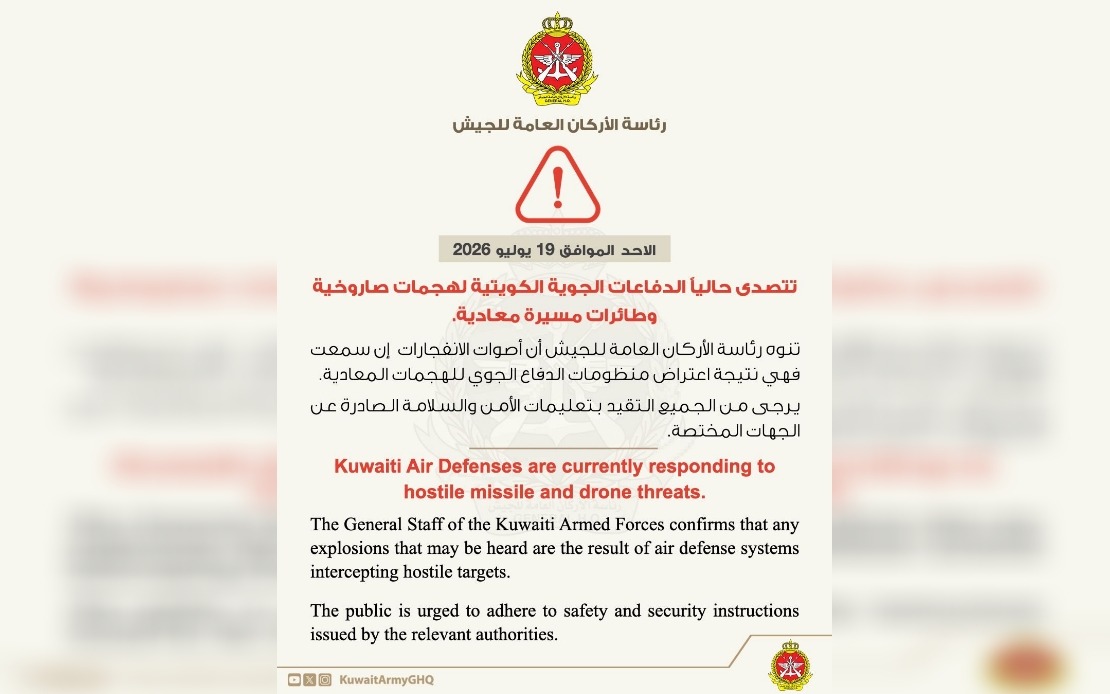
Kuwait's military announced on Sunday that its armed forces were actively defending against incoming missile and drone attacks, marking an intensification of regional security threats that have reverberated across the Middle East. The Kuwaiti army confirmed through social media that explosive sounds residents might hear were the result of air defence systems engaging hostile targets, while simultaneously urging the public to adhere to all security directives issued by government authorities.
The deployment of Kuwait's air defences represents the latest chapter in a rapidly escalating cycle of military strikes between the United States and Iran that has drawn multiple regional countries into the crossfire. For nearly a week preceding the announcement, Washington had launched successive waves of military operations targeting Iranian positions, prompting Tehran to respond with strikes against what it characterizes as American military installations and assets distributed across several countries in the region, with Kuwait serving as a significant staging area for US military operations.
The geographic proximity of Kuwait to these broader US-Iran tensions places the small Gulf nation in a precarious position. Situated between Iraq and Saudi Arabia with a coastline along the Persian Gulf, Kuwait hosts substantial American military infrastructure and personnel, making it an inevitable target as the two major powers continue their military confrontation. The presence of US Central Command facilities and forward-deployed American forces means Kuwait inevitably becomes entangled in any direct military exchange between Washington and Tehran.
This escalation unfolds despite diplomatic efforts undertaken by Pakistan in June, when both nations agreed to a memorandum of understanding with the explicit goal of terminating their ongoing conflict and establishing a durable peace framework. The apparent failure of that agreement to prevent further violence underscores the fragility of attempts to de-escalate tensions in a region where military competition and strategic competition have deep historical roots. The continued hostile actions suggest that underlying grievances and mutual suspicions run too deep for informal agreements to contain.
For Malaysia and other Southeast Asian nations, the deterioration of stability in the Persian Gulf carries significant economic and security implications. The region remains crucial for global oil supplies, and any prolonged military conflict threatens to disrupt energy markets that Southeast Asian economies depend upon. Malaysian shipping interests operating through the Strait of Hormuz face heightened risks from military incidents, while defence planners must consider how regional instability might affect broader Indo-Pacific security dynamics.
The pattern of escalation—American strikes followed by Iranian retaliation—suggests a spiral of mutual recrimination that may be difficult to arrest without third-party intervention or fundamental shifts in either party's strategic calculus. Each action triggers a reaction, creating momentum that makes de-escalation increasingly complicated. The involvement of multiple countries as hosts to American military facilities also multiplies the opportunities for miscalculation or unintended expansion of the conflict.
Kuwait's civilian population faces immediate practical challenges from the security situation, with authorities implementing protective measures and issuing emergency instructions. The psychological impact of active air defence operations cannot be underestimated, as residents must contend with the sounds and aftermath of military engagements conducted in their airspace. The government's appeals for compliance with security protocols reflect official concern that panic or non-cooperation could undermine defence effectiveness.
The broader strategic context reveals how proxy tensions have evolved into more direct military confrontation. Iran's willingness to launch missiles and drones across international borders represents a significant escalation from earlier phases of regional competition. This demonstrates Tehran's assessment that it possesses sufficient capability to strike back at American interests despite the technological superiority of the United States military.
From a regional perspective, the continuing cycle raises questions about the sustainability of the current security arrangement. Kuwait, despite hosting American forces, maintains diplomatic relations with Iran and has historically attempted to balance between the two regional powers. The current conflict places this balancing act under severe strain, as Kuwaiti territory becomes an active battlefield in an undeclared war.
The international community's response to the escalation remains muted, with few major powers intervening to demand an immediate cessation of hostilities. This absence of pressure suggests either resignation to the current trajectory or calculation that further intervention would prove counterproductive. For smaller states like Kuwait and Malaysia's trading partners in the region, the lack of international pressure for de-escalation is concerning.
Looking ahead, the sustainability of this security situation depends largely on whether either party perceives sufficient benefit to continue hostilities or whether exhaustion and cost considerations prompt renewed diplomatic engagement. The failure of the Pakistan-brokered agreement suggests that formal memoranda alone cannot bridge the fundamental strategic competition between these two powers. More substantial frameworks addressing underlying security concerns would be necessary to achieve lasting peace.

