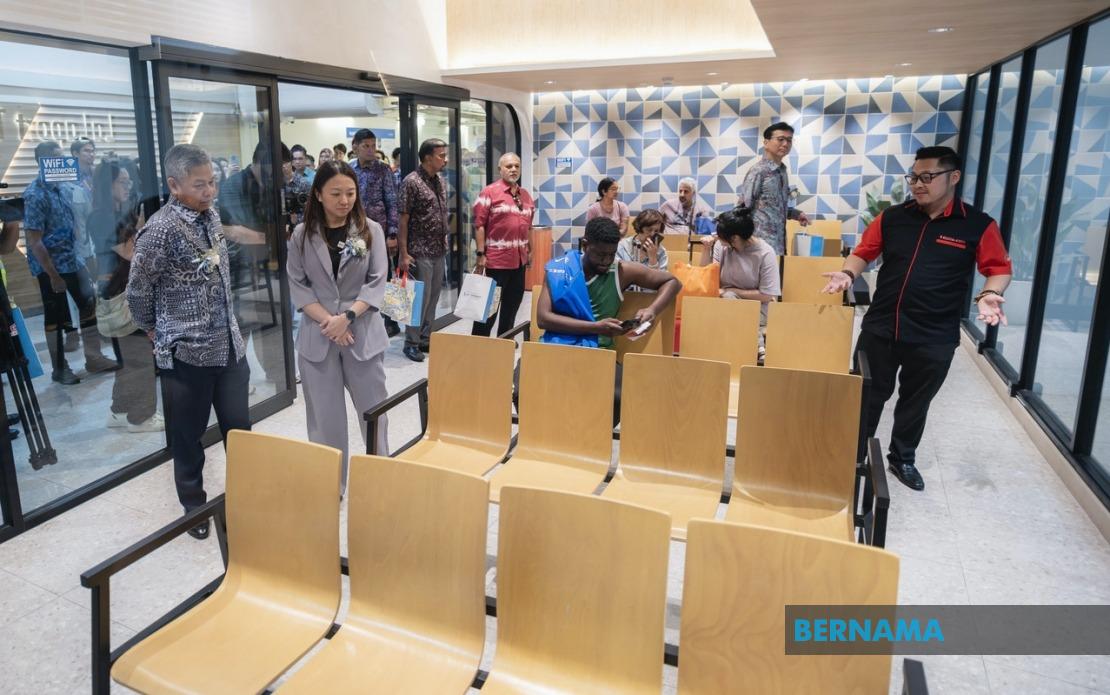
Kuala Lumpur has taken a significant step toward modernising its urban transport ecosystem with the opening of the LaLaport Transportation Hub, an integrated facility positioned to reshape how commuters and travellers move through the city. Located at the Hang Tuah LRT and Monorail interchange, the new hub promises to process up to 10,000 passengers daily by consolidating rail services, express buses, e-hailing platforms, taxis, and shared mobility solutions under a single covered pedestrian walkway. The launch, overseen by Hannah Yeoh, Minister in the Prime Minister's Department (Federal Territories), signals a deliberate pivot toward seamless multimodal transport connectivity in Malaysia's capital.
The hub's creation addresses a pressing logistical challenge facing Kuala Lumpur. The city experiences daily inflows and outflows of 1.2 million people, with approximately 5.5 million journeys recorded every twenty-four hours. This staggering volume underscores why incremental improvements to transport infrastructure remain critical for managing congestion, reducing travel times, and enhancing the city's appeal to both residents and visitors. By providing a licensed, purpose-built terminal with professional standards, the LaLaport hub removes friction points that previously scattered passenger boarding, drop-off, and connection points across disparate locations.
The facility's physical design reflects contemporary thinking about passenger comfort and operational efficiency. Situated on the LG1 level of the East Atrium, the hub incorporates eleven dedicated bus parking bays, climate-controlled waiting areas, staffed service counters, automated ticketing kiosks, and a real-time Passenger Information Display System that keeps travellers informed of schedules and platform assignments. These amenities represent a departure from informal or minimalist transport interchanges, establishing a baseline of safety, accessibility, and user experience that Malaysian commuters have long awaited in the city centre.
Operator Asia Success Resource Sdn Bhd, led by chief executive officer Aaron Chuah, projects that approximately 150 bus trips will depart from the hub each day, with particular emphasis on the round-the-clock express service between Kuala Lumpur and Singapore. This cross-border route carries strategic importance, as it captures a lucrative market of business travellers, tourists, and migrant workers who require reliable, frequent connectivity between Malaysia's capital and the island nation. Around thirty bus operators have committed to using the LaLaport hub as their primary city-centre transit point, consolidating what were previously scattered departure points and reducing confusion among passengers.
Beyond intercity services, the hub functions as a distribution hub for local and airport-bound travellers. The Boleh-Boleh Ride on-demand van shuttle service provides flexible connections to key destinations across the city centre, catering to passengers whose final destinations do not align with fixed-route bus services. Equally significant are the dedicated airport shuttle services linking the hub to Kuala Lumpur International Airport's Terminals 1 and 2, streamlining the journey from the city centre to the nation's premier aviation gateway. For business executives, tourists, and frequent flyers, this integration reduces transit friction and establishes Kuala Lumpur's city centre as a genuine transport hub rather than merely a residential or commercial district.
The policy environment surrounding the hub reflects evolving governance approaches to transport regulation. Dewan Bandaraya Kuala Lumpur (DBKL) has transitioned from annual operating licence renewals to three-year permits, providing operators with greater planning certainty and incentivising long-term investment in facility quality and service standards. This administrative reform acknowledges that transport operators require stable regulatory conditions to justify capital expenditure and service improvements. By extending the licence period, the city council simultaneously reduces bureaucratic churn and signals confidence in operators who meet approved standards.
Safety and accessibility enhancements accompany the hub's opening. DBKL is deploying approximately 10,000 operational closed-circuit television cameras across the city, with the transport hub benefiting from this broader surveillance infrastructure. The investment responds to public concerns about personal security in crowded transport nodes, particularly during off-peak hours. Enhanced lighting, emergency communication systems, and visible security presence throughout the facility aim to create an environment where passengers feel protected while awaiting or boarding services.
The international dimension of the hub's launch should not be overlooked. Japanese Ambassador to Malaysia Noriyuki Shikata's presence at the opening ceremony reflects sustained cooperation between Malaysia and Japan on urban infrastructure and sustainable development initiatives. The timing coincides with Prime Minister Datuk Seri Anwar Ibrahim's recent visit to Japan, during which both nations reaffirmed commitments to closer bilateral ties spanning energy security, technology transfer, and infrastructure partnerships. The two countries will commemorate their seventy-fifth year of diplomatic relations next year, making collaborations on urban mobility increasingly symbolic of deepening strategic alignment.
For Malaysian business and civil society, the LaLaport Transportation Hub embodies practical responses to urban congestion and passenger fragmentation. Rather than pursuing speculative megaprojects, the approach focuses on optimising existing corridors—the Hang Tuah interchange already commanded significant daily traffic—through thoughtful consolidation and service integration. This pragmatic strategy offers lessons beyond Kuala Lumpur. Cities throughout Southeast Asia facing rapid urbanisation might reference the LaLaport model as a cost-effective pathway to improving multimodal connectivity without requiring entirely new transport infrastructure.
The hub's operational success will ultimately depend on sustained adoption by transport operators and passenger confidence in the facility's convenience and reliability. Meeting the projected 10,000 daily passenger figure demands consistent service quality, real-time information accuracy, and responsive management to operational disruptions. If the facility achieves these benchmarks, it may catalyse similar integrated terminal projects in secondary Malaysian cities such as George Town, Johor Bahru, and Kota Kinabalu, where transport fragmentation similarly constrains mobility and economic activity.
In broader perspective, the LaLaport Transportation Hub represents an incremental yet meaningful evolution in Kuala Lumpur's transport governance. By consolidating services, improving passenger information systems, and establishing operational standards, the hub addresses immediate connectivity challenges while laying groundwork for more ambitious multimodal integration across the city. As Malaysian urbanisation accelerates and populations continue concentrating in metropolitan areas, projects of this character—focused, professionally operated, and passenger-centric—offer practical solutions to mobility challenges that constrain economic dynamism and quality of life.

