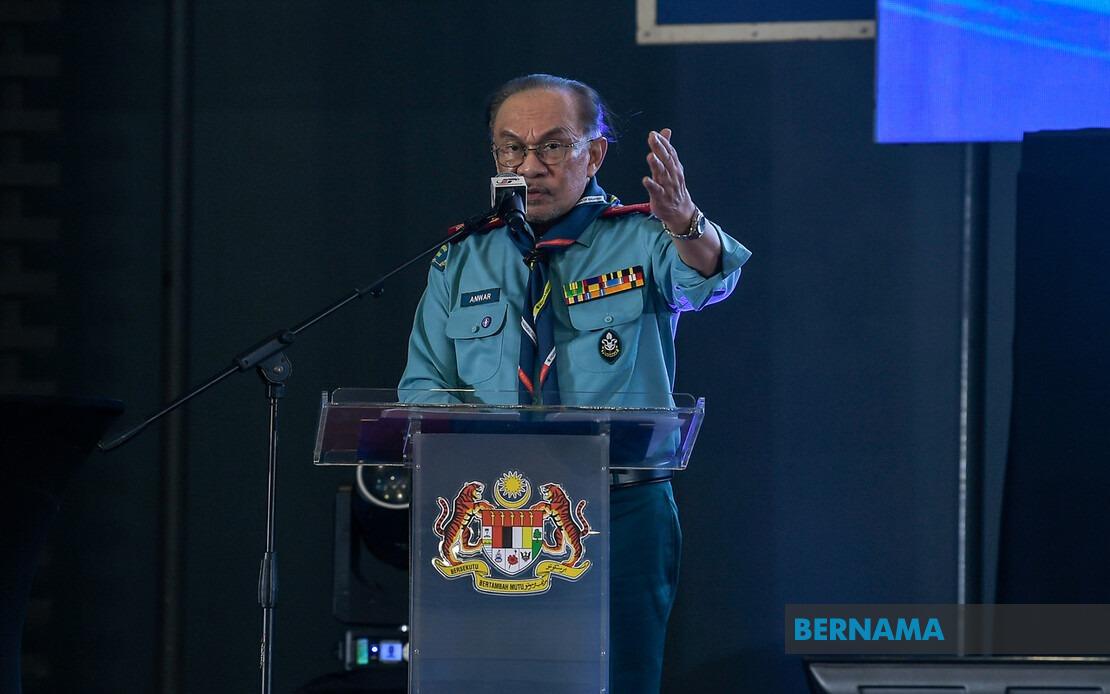
Prime Minister Datuk Seri Anwar Ibrahim has moved to clarify a persistent tension in Malaysia's language debate, asserting that strengthening the national language does not require weakening citizens' command of other tongues. Speaking at a programme marking the approach of the nation's independence anniversary at Universiti Teknologi MARA (UiTM) Permatang Pauh, Anwar presented a vision of linguistic pluralism as foundational to individual prosperity and national competitiveness rather than as conflicting imperatives.
The Prime Minister's intervention addresses longstanding anxieties within Malaysia's multicultural society, where debates over language policy frequently become proxies for deeper concerns about cultural and economic inclusion. Anwar's framing rejects the zero-sum narrative that has periodically surfaced in public discourse—the notion that advancing Malay necessarily diminishes opportunities or recognition for other languages. This distinction matters significantly in a nation where English proficiency correlates with employment prospects, where Mandarin opens access to regional economic networks, and where Tamil remains integral to the heritage of a substantial population segment.
Anwar emphasised that every Malaysian, regardless of ethnicity, bears responsibility for acquiring solid competency in the official language. This expectation reflects constitutional principles enshrined since independence, yet the Prime Minister coupled it with an equally explicit endorsement of linguistic diversity. English, he noted, has evolved into an indispensable global medium that Malaysia's education system must accommodate and cultivate rather than resist. His argument strategically positions English not as a rival to Malay but as a complementary asset that extends Malaysian students' reach into international intellectual and commercial spheres.
The economic dimension of Anwar's address carries particular resonance for Southeast Asian readers observing China's growing influence throughout the region. Mandarin's rising importance as a regional business language reflects demographic and economic realities that no Malaysian strategist can ignore. By explicitly encouraging proficiency in Mandarin—provided that Malay remains secure as a foundational competency—Anwar acknowledges that Malaysia's future economic vitality depends partly on citizens' capacity to participate in Chinese-language commercial and intellectual networks. This represents a pragmatic recognition that regional integration increasingly requires such capabilities.
Anwar's comments on Tamil proficiency signal awareness that linguistic minorities require concrete affirmation of their cultural legitimacy within the national project. Tamil-speaking Malaysians, predominantly of Indian descent, have periodically voiced concerns about the status and teaching of their heritage language. The Prime Minister's willingness to highlight Tamil alongside Mandarin and English suggests an understanding that inclusive nation-building requires acknowledging the linguistic heritage of all major communities rather than concentrating solely on Malay and the two languages dominating international commerce and diplomacy.
The Prime Minister rejected characterisations of language development as a competitive undertaking, insisting instead that multilingual capability expands individual opportunity without necessitating sacrifice. This reframing carries important implications for education policy, where resource allocation decisions might otherwise pit language programmes against one another. Anwar's vision suggests that schools should simultaneously strengthen Malay instruction, expand English provision, and sustain heritage language teaching—a more resource-intensive but arguably more equitable approach than forcing hierarchical choices.
Beyond the technical question of language policy, Anwar's address touches on deeper questions of national unity and social cohesion. He cautioned against permitting linguistic or cultural grievances to fracture the social fabric, emphasising that Malaysia's harmony represents an ongoing achievement requiring deliberate preservation rather than a permanent condition. This warning reflects experiences in other multilingual societies where language controversies have occasionally escalated into broader communal tensions. The Prime Minister's appeal for citizens to resist sowing discord among ethnic groups frames linguistic inclusion not merely as an educational matter but as essential to maintaining the consensual foundations of the Malaysian state.
Anwar's insistence on a culture of mutual support and shared benefit across racial lines connects language policy to broader governance philosophy. The call for inclusive development that allows all citizens to participate meaningfully in national progress positions linguistic competency as one element within a larger framework of equitable opportunity. This suggests that language policy alone cannot resolve structural inequalities, yet it remains relevant to how communities experience their place within the national project and whether they perceive institutions as respecting their identities and aspirations.
The timing and venue of these remarks carry significance. Delivering this message at UiTM, an institution historically associated with Bumiputera interests and national language promotion, allows Anwar to address audiences potentially concerned about shifts in language emphasis without abandoning core commitments. His simultaneous endorsement of Malay's primacy and other languages' legitimacy attempts to navigate the political sensitivities surrounding these questions while advocating for educational approaches that serve all Malaysians' economic and social aspirations. Whether such nuanced positioning can influence actual policy implementation—particularly regarding resource allocation and curriculum design—remains an open question as Malaysia continues negotiating its multilingual future.

