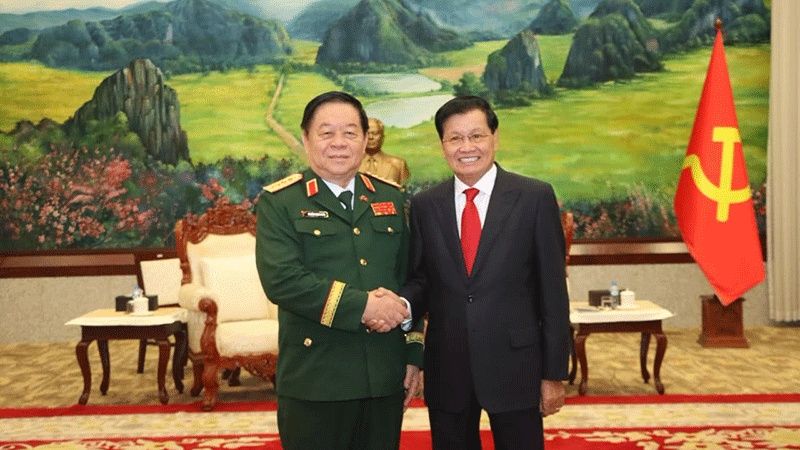
Laos and Vietnam have reinforced their longstanding military alliance through a series of high-level defence discussions this week, signalling renewed determination to deepen cooperation across multiple security domains. The visit by General Nguyen Trong Nghia, who heads the General Department of Politics of the Vietnam People's Army, culminated in separate meetings with Lao President Thongloun Sisoulith and senior defence officials in Vientiane on Thursday. The timing and tenor of these engagements reflect broader regional efforts by both nations to strengthen bilateral ties amid shifting geopolitical dynamics in Southeast Asia.
President Thongloun greeted the Vietnamese military delegation with considerable warmth, emphasising how the visit represented a concrete manifestation of the special bond binding the two nations at multiple institutional levels. In his remarks, the Lao leader characterised the defence talks as a logical continuation of efforts to deepen friendship and strategic coordination, describing the discussions as another chapter in a relationship encompassing political parties, state governments, armed forces, and civilian populations. This multi-layered framing underscores how Laos views its military partnership with Vietnam not merely as tactical defence cooperation but as an expression of comprehensive state-to-state integration.
The substantive outcomes of the military discussions addressed several interconnected areas that collectively map the architecture of bilateral defence cooperation. Officials from both nations agreed to expand practical collaboration rooted in political education initiatives, enhanced military-to-military exchanges, and refined border management protocols. Additionally, both sides committed to strengthening personnel training programmes, suggesting an intent to build institutional capacity and interoperability across defence establishments. These specific focal points reflect recognitions that robust defence ties require multifaceted engagement extending beyond equipment procurement or joint operations.
General Nguyen Trong Nghia held separate conversations with key Lao defence figures, including Deputy Prime Minister and Defence Minister General Khamlieng Outhakaisone, as well as Lieutenant General Vongsone Inpanphim, who serves as Deputy Minister of National Defence and director of the Lao People's Army's political department. These parallel engagements at different governmental levels ensured comprehensive coverage of defence priorities and facilitated dialogue between officials responsible for distinct portfolios within their respective security establishments. The breadth of consultation suggests systematic rather than ceremonial engagement, with each meeting addressing specific institutional concerns alongside overarching strategic objectives.
For Malaysia and the broader Southeast Asian region, the Lao-Vietnamese defence consolidation carries implications worth monitoring. As larger regional powers compete for influence throughout the region, smaller nations like Laos navigate complex positioning choices. Laos's decision to visibly strengthen its military relationship with Vietnam reflects confidence in that partnership whilst potentially signalling its own strategic calculations regarding regional balance. The emphasis on border management cooperation and political education suggests that both countries view their relationship as sufficiently developed to address potentially sensitive topics, including historical narratives and territorial administration.
The defence talks explicitly privileged what both nations term their "special relationship" and "special solidarity"—diplomatic language denoting historical bonds and preferential treatment that distinguishes the Laos-Vietnam partnership from their respective relationships with other regional actors. Vietnam has historically positioned itself as Laos's closest ally, a legacy rooted in Cold War dynamics and reinforced through subsequent decades of integration. The current visit reaffirms this bilateral primacy and suggests that despite Vietnam's broader engagement with numerous countries, its commitment to strengthening ties with Laos remains a significant priority.
The inclusion of political education and historical awareness initiatives within defence cooperation frameworks reveals important dimensions of how smaller nations approach military relationships. Rather than focusing narrowly on hardware or operational capabilities, Lao and Vietnamese officials identified the cultivation of shared understanding among younger military personnel as a strategic imperative. This emphasis acknowledges that durable defence partnerships require generational continuity and that succeeding cohorts of officers must inherit and perpetuate institutional knowledge regarding bilateral relations and mutual strategic interests.
General Nguyen Trong Nghia's visit spanned three days, from August 5 through 7, providing adequate opportunity for substantive rather than merely symbolic engagement. The deliberate scheduling and multi-stop itinerary suggest careful planning intended to maximise bilateral contact and ensure that all relevant defence constituencies received appropriate high-level attention. Such methodical approaches to official visits typically reflect prior coordination between defence establishments and signal mutual investment in the success of the engagement.
The characterisation of defence cooperation as a "key pillar" of the broader Laos-Vietnam "comprehensive strategic partnership" positions military coordination within a wider framework encompassing economic, political, and cultural dimensions. This hierarchical framing suggests that defence ties serve as both independent priorities and constituents of holistic bilateral relationships. For Laos, maintaining robust defence alignment with Vietnam may facilitate pursuit of other cooperation objectives, whilst Vietnam likely views military partnership with Laos as essential to its own regional security architecture and strategic influence throughout the Indochinese peninsula.
The discussions highlighted mutual commitment to "preserving and promoting" the special relationship, language suggesting that both nations perceive their partnership as requiring active cultivation and protection rather than something naturally sustained by historical momentum alone. This implies awareness that changing regional circumstances, generational turnover, and evolving priorities could potentially weaken ties if deliberately maintained institutional mechanisms were allowed to atrophy. The emphasis on exchanges, training, and political education thus represents strategic investment in preventing such deterioration.
Border management cooperation merits particular attention given that Laos and Vietnam share an extended frontier with complex territorial history. Agreement to deepen cooperation in this domain signals confidence in managing potential friction points collaboratively and reflects institutional maturation enabling frank discussion of potentially sensitive issues. For Southeast Asia more broadly, examples of neighbouring nations successfully addressing border questions through cooperative frameworks carry relevance as regional states grapple with maritime and terrestrial boundary challenges.
The visit's conclusion with reaffirmations of commitment to the comprehensive strategic partnership confirms that neither nation views the discussions as isolated events but rather as contributions to sustained, long-term institutional development. Both sides emerged from the talks positioned to report success to their respective domestic audiences and to international observers interested in regional developments. For Laos particularly, the visibility of Vietnam's high-level attention reinforces perceptions of the nation's strategic importance and its continued relevance within regional dynamics, even as larger powers vie for influence across Southeast Asia.

