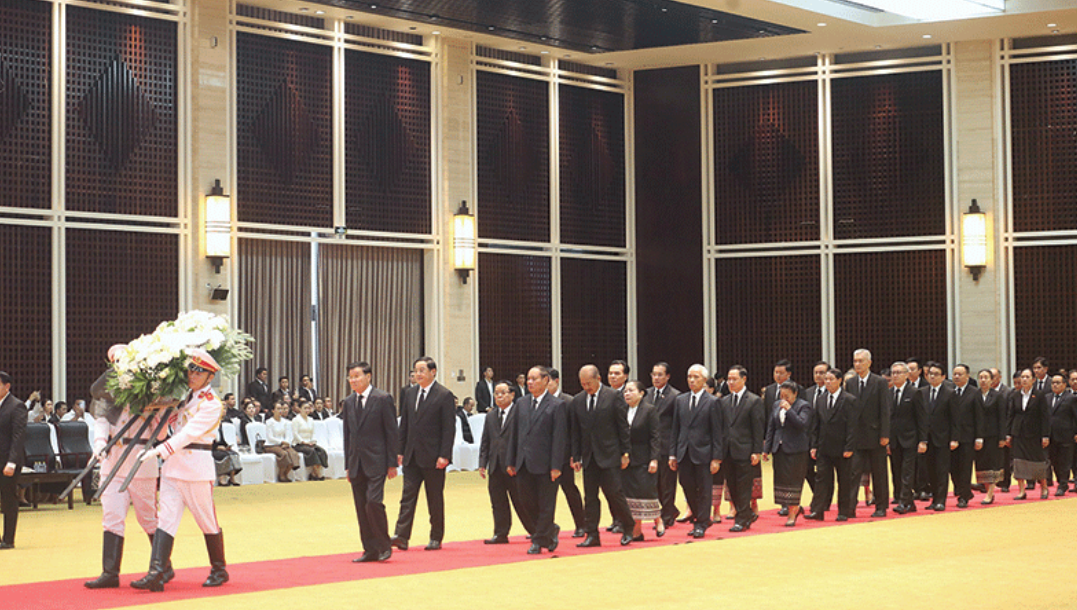
Laos bid farewell to one of its most senior political figures on Sunday when Party Secretary General and President Thongloun Sisoulith led the nation's top leadership in paying their final respects to National Assembly President Xaysomphone Phomvihane at the National Convention Hall in Vientiane. The prominent state funeral ceremony brought together the country's political establishment to honour the veteran administrator, who passed away the previous day after decades devoted to serving the Party and State. The solemn gathering underscored the significant standing Xaysomphone held within Laos's single-party political system and the depth of influence his family maintained across the nation's governing structures.
The wreath-laying ceremony drew the nation's most powerful figures across multiple institutional domains. President Thongloun Sisoulith led the first delegation representing the Central Committee of the Lao People's Revolutionary Party, establishing the symbolic primacy of Party apparatus in the state observance. The standing order of delegations reflected the hierarchical nature of Lao governance, with Prime Minister Dr Sonexay Siphandone representing the Government, while the National Assembly's Standing Committee sent a delegation led by Vice President Sounthone Xayachack. This carefully choreographed succession of tributes revealed not merely personal respect for the deceased but also the formal protocols through which Laos acknowledges the passing of elite figures within its closed political circle.
Xaysomphone's career positioned him at the intersection of legislative authority and revolutionary Party legitimacy. As a member of the Politburo of the Lao People's Revolutionary Party Central Committee and president of the National Assembly, he embodied the institutional fusion characteristic of single-party states in Southeast Asia. His decades within the legislative body had been marked by efforts to strengthen parliamentary functioning while maintaining alignment with the Party's strategic objectives. The significance attributed to his death by state institutions reflected recognition that his departure created not simply a vacant office but a loss of accumulated political influence accumulated through long service in the country's power structures.
The ceremonies extended across multiple days, reflecting the formal respect accorded to deceased high-ranking officials. Wreath-laying continued through August 11, enabling Party and State officials, organisational representatives, foreign diplomats and ordinary citizens to participate in the observance. This extended timeline provided opportunity for different constituencies to demonstrate their connection to the departed leader and, by extension, their commitment to the political order he represented. Government ministries, provincial authorities, and representatives of business interests sent delegations, each paying homage in their turn and underscoring the pervasive reach of Party and State influence across Lao society.
The participation of Vietnamese officials signified the deep bilateral relationship between the two communist neighbours and reflected Laos's position within a broader regional security and ideological framework. A delegation from the Vietnamese National Assembly, led by Tran Thanh Man, a Politburo member and Chairman of Vietnam's legislative body, attended the ceremony, accompanied by representatives from the Vietnamese Ministry of Public Security and Ministry of National Defence. This coordinated Vietnamese presence transformed the Lao state funeral into a diplomatic event reinforcing the special relationship between Hanoi and Vientiane. Vietnam's declaration of two days of national mourning on August 10-11 represented formal recognition of Xaysomphone's standing within the communist movement extending across the region.
The family dimensions of Lao governance became evident through the complex choreography of family delegations at the ceremony. Xaysomphone was one of six sons of former President Kaysone Phomvihane, making him part of a family whose influence permeated multiple levels of the Lao state apparatus. His brother Santiphab Phomvihane holds senior position as Deputy Prime Minister and Minister of Finance, exemplifying the concentration of high office within particular family networks characteristic of Lao politics. The presence of delegations representing the Phomvihane, Sisoulith, Siphandone and other interconnected elite families illustrated how Laos's political system remained substantially organised around kinship networks and generational succession within a restricted ruling circle.
The biographical details released following his death provided insight into the institutional positioning of senior revolutionary figures in Laos. Born on December 12, 1956, Xaysomphone came of age during Laos's transition to communist governance under his father's stewardship. His ascent to the National Assembly presidency represented a natural progression for someone from his family background within a system where revolutionary credentials combined with family prominence facilitated advancement. Yet his role as National Assembly president positioned him within an institution that, in Laos's political structure, functioned primarily as a mechanism for ratifying decisions made within Party channels rather than as an independent legislative body exercising genuine scrutiny over executive authority.
The scale and solemnity of the state funeral reflected official assessment of Xaysomphone's contribution to national development and political governance. The Lao Front for National Development, a mass organisation operating within Party parameters, sent a delegation led by Politburo member Kikeo Khaykhamphithoune, while the Commission for Information and Education of the Party Central Committee participated under the leadership of Khamphan Pheuyavong. These delegations from subsidiary Party organisations ensured comprehensive participation from state institutions and ideological apparatus in the ceremony, transforming the funeral into a demonstration of national unity and collective mourning orchestrated through formal channels.
The planned cremation at the That Luang esplanade on August 12, to commence at 1pm, would employ full honours protocols normally reserved for high-ranking revolutionary figures. This location held profound symbolic significance within Lao Buddhism and national identity, with the That Luang stupa representing a focal point for religious and patriotic observance. The decision to conduct the cremation at this sacred site elevated Xaysomphone's send-off beyond ordinary state ceremony into a nationally resonant event that merged revolutionary governance with Lao cultural and spiritual traditions. The five-day period of national mourning declared by the Party Central Committee, National Assembly, Government and Lao Front for National Development demonstrated the institutional weight accorded to his passing.
For Malaysia and other Southeast Asian nations observing Lao politics, Xaysomphone's death illuminated the nature of succession and continuity within communist single-party systems in the region. The degree to which his passing prompted coordinated bilateral observance from Vietnam underscored the integrated security and political frameworks binding Laos into a broader regional structure oriented toward Hanoi's strategic interests. The concentration of high office within elite families and the seamless orchestration of state ceremony revealed how, despite rhetorical commitments to revolutionary ideology, Lao governance operated through established networks of personal and family connection. As the nation moved through its mourning period, attention would likely turn to questions regarding succession within the National Assembly and broader implications for the factional relationships that characterised the Lao leadership structure.

