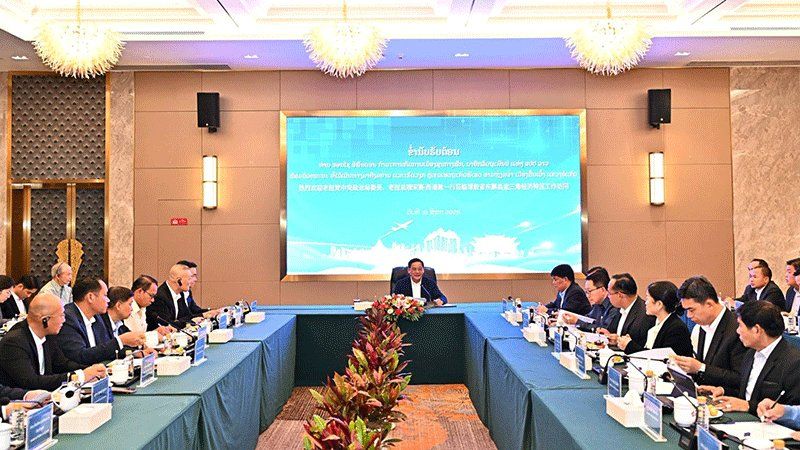
Prime Minister Sonexay Siphandone has called for substantially stronger regulation and oversight of the Golden Triangle Special Economic Zone, signalling concern about accountability in one of Laos's most significant foreign investment projects. The warning, delivered during an official visit to the zone in Bokeo province's Tonpheung district on 18 August, reflects growing pressure to ensure that the US$10 billion invested since the zone's inception in 2007 translates into meaningful economic and social benefits for the nation.
The Golden Triangle SEZ sprawls across 10,000 hectares along the Mekong River at the convergence of Laos, Myanmar, Thailand and China, making it a strategically vital but administratively complex hub. Nearly two decades of operation have attracted businesses across manufacturing, real estate, hospitality, financial services, tourism and trade. Yet the zone faces a significant credibility challenge: only 60 per cent of the activities promised in investment contracts have been realised to date. This performance gap underscores systemic management weaknesses that the Prime Minister has now moved to address directly.
Dr Sonexay's intervention reflects broader concerns within Southeast Asian governments about special economic zones becoming havens for unaccountable operations. The zone currently hosts more than 10,000 registered workers alongside roughly 10,000 additional investors, business operators, residents and tourists, creating a dense ecosystem that demands robust administrative capacity. The presence of 400 government officials across multiple sectors indicates substantial state presence, yet evidently insufficient coordination or enforcement power. The Prime Minister's call for tighter regulation suggests these officials lack either the authority or tools to ensure compliance with existing agreements.
A central focus of his directive was financial discipline. Dr Sonexay specifically instructed authorities to require all transactions—including trade agreements, investments, wage payments and service charges—to flow through the formal Lao banking system. This move addresses potential capital leakage and tax avoidance in a zone where cross-border mobility creates obvious opportunities for financial opacity. By channelling transactions through regulated banks, the government aims to improve visibility into economic activity and prevent the zone from becoming an extraction point for wealth that bypasses national treasuries.
Improving the investment environment itself formed another pillar of the Prime Minister's strategy. Rather than simply imposing restrictions, he emphasised streamlining the one-stop-service system—a single-window approval mechanism intended to reduce bureaucratic friction. This dual approach—simultaneous deregulation for compliant investors and stronger enforcement against non-compliant ones—reflects sophisticated policy thinking about how to balance attracting fresh capital while protecting public interests. The emphasis on enhancing services rather than merely cracking down suggests recognition that the zone's underperformance may partly reflect operational inefficiencies on the government's side.
Sectoral priorities revealed in the Prime Minister's guidance indicate a pivot toward higher-value economic activities. Tourism, manufacturing with processing capabilities, transport infrastructure, education and public health were singled out as requiring accelerated development. This selection suggests a deliberate strategy to move beyond extractive or low-skill industries toward sectors generating employment, technology transfer and human capital development. The focus on education and health is particularly noteworthy, indicating awareness that special economic zones can either drain resources from surrounding regions or contribute to broader development.
Border management emerged as a critical concern for the Prime Minister. He called for stricter controls over entry and exit within the zone, reflecting anxiety about human trafficking, undocumented migration and smuggling activities that have plagued border regions across Southeast Asia. The requirement for enhanced cooperation with Myanmar and Thailand, including expanded airline connections, suggests plans to formalise and legitimise cross-border movement rather than simply restrict it. This approach acknowledges that the zone's value depends on labour mobility while preventing the uncontrolled trafficking that has raised human rights concerns in comparable zones elsewhere in the region.
The instruction to improve the zone's concession agreement in line with existing legislation addresses a longstanding governance challenge in Laos and across Southeast Asia: special economic zones often operate under frameworks that either predate relevant laws or contain provisions inconsistent with national requirements. By harmonising concession terms with current legislation, the Prime Minister aims to create a more defensible legal foundation and reduce disputes between zone management, private investors and the state. This alignment is particularly important given Laos's need to maintain investor confidence while strengthening domestic institutional credibility.
Enhancing the effectiveness of the Zone's Management and Administration Committee reflects recognition that governance structures themselves require upgrading. A committee struggling to enforce contracts or coordinate across government agencies is unlikely to manage a complex, multinational zone effectively. Strengthening this body would require providing clearer mandates, adequate resources and, potentially, stronger penalties for non-compliance by both private operators and government officials. Without such structural reforms, the Prime Minister's calls for improved regulation risk remaining rhetorical rather than transformative.
The strategic location of the Golden Triangle SEZ—providing investors access to consumer and labour markets across four neighbouring countries—explains both its attractiveness and governance challenges. Companies can source labour from Myanmar or Thailand and sell products to Chinese markets, but this cross-border advantage creates overlapping jurisdictions and enforcement gaps. The Prime Minister's emphasis on regional cooperation signals recognition that unilateral Lao measures have limited effectiveness; genuine tighter regulation requires buy-in from neighbouring governments on shared border management and labour standards.
For Malaysia and other Southeast Asian economies, Laos's experience offers instructive lessons about managing special economic zones. Despite massive capital inflows, underperformance in achieving contracted activities suggests that investment attraction alone is insufficient. Without clear performance metrics, strong enforcement mechanisms and alignment between zone operations and national development priorities, SEZs risk becoming economically significant yet institutionally problematic. Dr Sonexay's intervention indicates belated recognition of these risks and an attempt to course-correct, though whether the administrative apparatus can deliver on stricter oversight remains uncertain.
The Prime Minister's call ultimately reflects the tension inherent in special economic zones across Southeast Asia: how to attract international capital while maintaining national sovereignty, developmental benefits and social protections. The Golden Triangle SEZ, with its massive investment and multinational character, exemplifies both the potential and perils of this model. Success in implementing Dr Sonexay's guidance—particularly enforcing financial discipline, improving border controls and reorienting development toward higher-value sectors—could position the zone as a model for responsible SEZ management in the region. Failure would further demonstrate why many Southeast Asian governments increasingly scrutinise these zones rather than simply promoting them.

