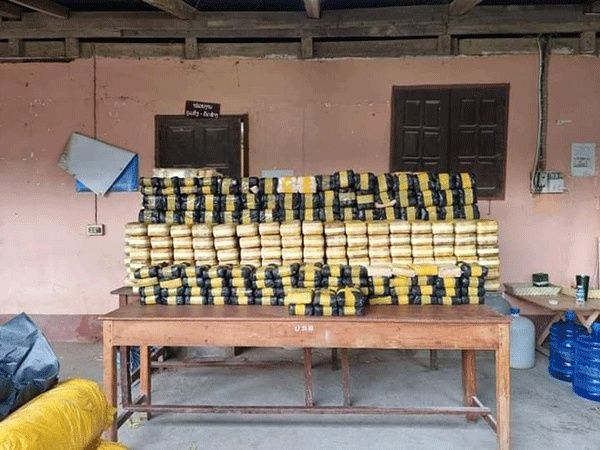
Xaysomboun Province in Laos is confronting a severe drug problem, with narcotics-related crimes constituting nearly half of all criminal cases registered during the first six months of 2024. Of 54 offences documented by the provincial security apparatus, 24 involved drugs, compelling officials to call for intensified law enforcement measures across the region. The statistics underscore how profoundly illicit substances have infiltrated the province's criminal landscape, transforming drug trafficking from a peripheral concern into a defining security challenge that commands immediate governmental attention.
The scope of ongoing investigations reveals the complexity facing local police. Among the 24 drug cases identified, only two had progressed to the stage where prosecutors could review them for potential legal action, while the remaining 22 continued under active investigation. This backlog suggests resource constraints and the time-consuming nature of building prosecutable cases. Across the entire crime portfolio, investigators managed to formally resolve 15 cases, settle six others through alternative means, and advance four to prosecution, leaving 29 matters still pending examination. The distribution of outcomes indicates that Xaysomboun's security forces remain stretched across multiple investigative fronts whilst simultaneously managing an expanding caseload.
The provincial leadership articulated these findings to a visiting high-ranking national official, Police Lieutenant General Vanthong Kongmany, the nation's Minister of Public Security, during his August 7 inspection tour. Police Brigadier General Ouday Insouvanh, commanding the Xaysomboun Provincial Public Security Force, presented the data alongside assertions that his officers had maintained relative political stability and preserved social order throughout the period. However, the stark prevalence of drug-related incidents suggests that maintaining order does not necessarily mean solving underlying criminogenic problems. The commander emphasized surveillance activities and information gathering as cornerstones of provincial security work, yet the overwhelming drug case load raises questions about whether traditional monitoring suffices against contemporary trafficking networks.
The minister's response went beyond acknowledging the drug problem, encompassing a broader security agenda that reflects Vientiane's evolving threat assessment. Police Lieutenant General Vanthong directed the provincial command to intensify countermeasures targeting narcotics trafficking and emerging synthetic drugs, simultaneously demanding stricter enforcement against smuggling rings, human trafficking syndicates, theft operations, illegal mining enterprises, and underground gambling establishments. This multifaceted emphasis suggests that Laos's security establishment recognizes crime as increasingly diversified and interconnected. The minister explicitly highlighted the necessity for police to adapt tactics to match evolving criminal methodologies, cautioning that failure to do so risks escalation and proliferation of such activities across the province and potentially beyond its borders.
Xaysomboun's drug crisis reflects a national pattern that has absorbed governmental energy for five years. Prime Minister Sonexay Siphandone reported to the National Assembly in recent weeks that authorities nationwide had processed 1,786 drug cases during the first half of 2024, resulting in 4,025 arrests encompassing 93 foreign nationals. Substantial quantities of narcotics and related paraphernalia were confiscated alongside vehicles used in distribution operations. These figures position drug enforcement as a centrepiece of Laos's law and order agenda, particularly given the country's geographical location along trafficking corridors connecting Southeast Asia's major drug-producing regions with consumption markets. The prominence of foreign nationals among suspects indicates the transnational dimension of Xaysomboun's drug troubles, suggesting that local criminal networks operate within international supply chains rather than functioning in isolation.
Beyond narcotics, Xaysomboun confronts a constellation of public safety challenges that extend into the digital realm. The minister instructed provincial authorities to strengthen supervision of social media activity and address cybercrime consistent with central ministry directives. This instruction reflects growing recognition across Southeast Asia that criminal enterprises exploit online platforms for coordination, recruitment, and money laundering. The expansion of security priorities to encompass cybercrime represents an acknowledgment that contemporary policing must address threats originating in virtual spaces, not merely physical locations. For a province seeking to modernize its enforcement capabilities, integrating digital crime investigation requires training, resources, and institutional restructuring that may strain already-stretched provincial budgets.
Road safety emerged as an additional preoccupation during the ministerial visit, with provincial records documenting 60 traffic accidents across the six-month period. These incidents resulted in four fatalities, 80 injuries, and damage to 109 vehicles, generating losses exceeding 2.56 billion kip. The monetary cost alone demonstrates how traffic accidents impose substantial economic burdens on families and communities beyond the human toll. The figure suggests either inadequate road infrastructure, insufficient traffic law enforcement, poor driving practices, or a combination thereof. For Malaysian readers familiar with Southeast Asia's persistent road safety challenges, Xaysomboun's statistics exemplify how developing provinces across the region struggle to balance economic development with improved transportation safety standards.
Immigration management and foreign national supervision constitute additional security functions occupying provincial resources. During the January-June period, officers inspected 1,698 tourists, among whom 396 were foreign nationals. This monitoring reflects Xaysomboun's role as a tourism destination and its strategic position requiring oversight of cross-border movements. The emphasis on professional, expertise-based management of foreign nationals and immigration procedures underscores central government concern about border security and counterterrorism imperatives. For a landlocked province situated within Laos's interior, tourism revenue and foreign exchange generated by visitors coexist with security anxieties regarding unauthorized transit and transnational criminal movement.
The minister's closing remarks addressed internal police discipline and operational culture. Police Lieutenant General Vanthong called upon provincial commanders to reinvigorate political and ideological education among rank-and-file personnel, ensuring alignment with Party directives, statutory requirements, and force discipline codes. He urged officers to acknowledge organisational shortcomings rather than passively await hierarchical instruction, advocating instead for proactive responsibility and results-oriented accountability. This rhetorical emphasis suggests that central leadership perceives operational deficiencies stemming not merely from inadequate resources but from institutional attitudes requiring attitudinal correction. The minister's insistence upon professional expertise in personnel assignment and adherence to legal procedures during investigations, detention, and rehabilitation activities indicates concerns about transparency and rule-of-law compliance within provincial security apparatus.
The Xaysomboun security situation encapsulates challenges confronting law enforcement across Southeast Asia's developing regions. Drug trafficking, human smuggling, cybercrime, and deficient road safety coexist within institutional frameworks struggling to modernize enforcement methodologies whilst managing constrained budgets. For Malaysian observers, Xaysomboun's trajectory offers comparative perspective on how neighbouring jurisdictions navigate similar pressures. The province's experience suggests that sustained governmental attention, high-level ministerial involvement, and resource allocation toward drug enforcement represent regional policy consensus regarding narcotics as the paramount security threat. Yet the persistence of drug crimes despite five years of national campaign emphasis indicates that chemical dependencies and profit-driven trafficking networks adapt faster than institutional enforcement capacity, a dynamic likely to characterise Xaysomboun and other regional jurisdictions for years ahead.

