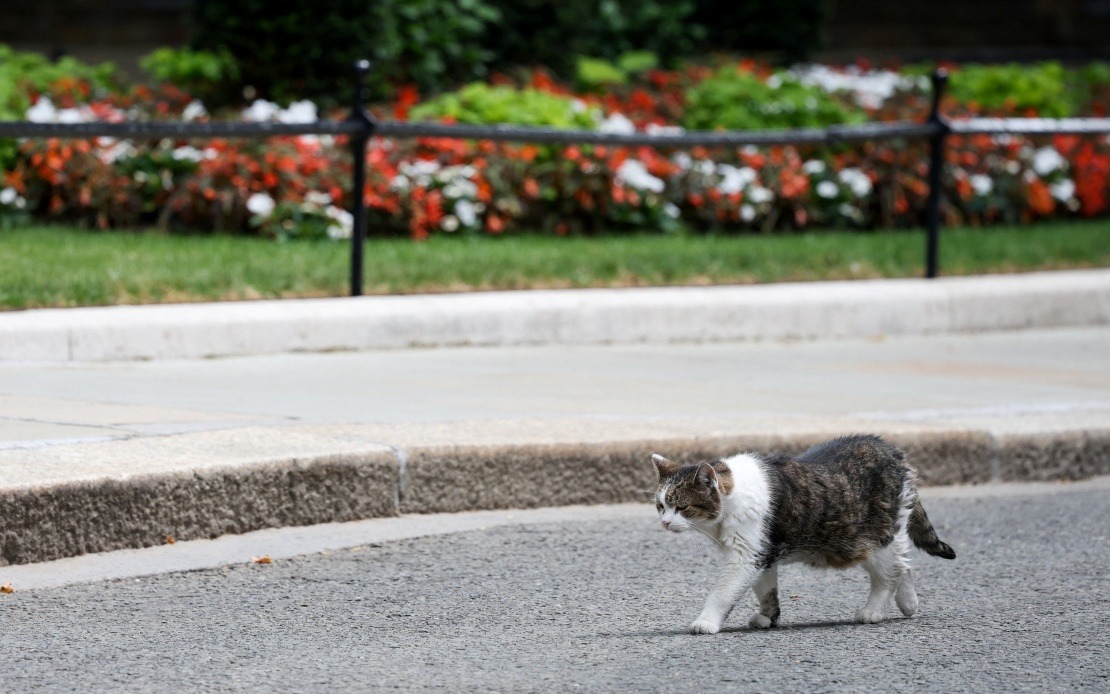
Larry, the celebrated feline resident of 10 Downing Street, has become something of a fixture in British political life, having outlasted six successive prime ministers during his tenure at the iconic London address. The cat was observed wandering outside the official residence on July 21 as Britain's newly appointed Prime Minister Andy Burnham convened his inaugural Cabinet meeting following his assumption of office.
The presence of Larry prowling the grounds while high-level government discussions took place inside underscores the cat's remarkable staying power within one of the world's most important political institutions. Unlike the politicians who come and go with electoral cycles and party fortunes, Larry has managed to transcend the volatility of Westminster politics through sheer feline persistence and, presumably, the affection of successive administrations.
For Malaysian and Southeast Asian observers, the enduring presence of Larry at Downing Street offers a curious cultural window into British institutional continuity. While Malaysia has seen its own share of political transitions and leadership changes, particularly in recent years, the image of a cat remaining constant across multiple governments speaks to how even the most powerful political addresses maintain their own internal rhythms and traditions separate from the machinations of power.
The symbolic weight of Larry's longevity cannot be overlooked. In an era when political careers often prove remarkably brief—with UK prime ministers serving increasingly shorter terms—a cat that has witnessed the coming and going of six different heads of government becomes an inadvertent commentator on the instability of contemporary politics. Larry has experienced ministerial reshuffles, policy reversals, and complete changes in governmental philosophy without apparent concern.
The cat's presence at Downing Street represents a continuity that transcends partisan politics. Regardless of which party holds power or which individual occupies the Prime Minister's residence, Larry remains a constant presence. This institutional stability, embodied in the form of a domestic animal, reflects a deeper British tradition of maintaining continuity within institutions even as political leadership transforms.
For those watching British politics from the region, Larry's tenure serves as a reminder that formal institutions often possess resilience that outlasts individual leaders. The cat's mundane existence—simply roaming the grounds and pursuing domestic cat activities—contrasts sharply with the high-stakes deliberations happening within the building. This juxtaposition highlights how governmental institutions function through multiple layers of continuity, both human and animal.
The appointment of Andy Burnham as Prime Minister represents another transition that Larry will navigate with characteristic indifference. While the new administration settles into its routines and establishes its priorities, the cat continues his existence according to patterns established long before and likely to persist long after. His first appearance during Burnham's inaugural Cabinet meeting is simply the latest chapter in an extended story of institutional permanence.
Larry's story also reflects the British preference for preserving traditions and institutional memory, even in trivial forms. The decision to maintain a cat at Downing Street, and the apparent affection various prime ministers have shown for the animal, demonstrates how even the most serious political institutions retain elements of normalcy and domestic life. For countries like Malaysia, where institutional traditions and ceremonial aspects of government hold considerable cultural importance, this aspect of British governance may resonate particularly strongly.
The cat's longevity at the heart of power raises broader questions about institutional resilience and the nature of political change. While prime ministers arrive with grand ambitions and governing philosophies that often prove ephemeral, Larry persists in his simple existence. This endurance suggests that institutions contain forces that operate independently of individual leadership, a lesson relevant to understanding how government functions across different political systems and contexts.
As Britain navigates another transition in leadership, with Andy Burnham charting his own course as Prime Minister, Larry's continued presence serves as a tangible link to the institution's past. The cat embodies a form of institutional memory that transcends documentation or formal records. His simple act of wandering outside during the new Prime Minister's first Cabinet meeting carries an inadvertent philosophical weight—a reminder that while political leadership changes with regularity, the institutions themselves persist through deeper, quieter forms of continuity.

