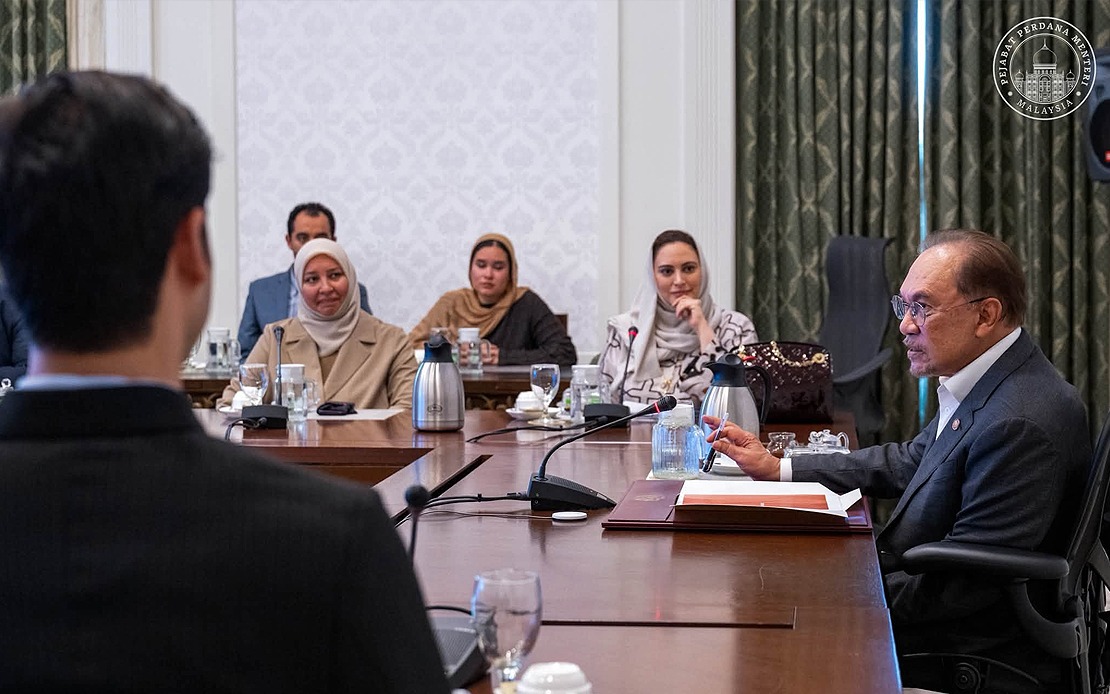
Prime Minister Datuk Seri Anwar Ibrahim has articulated a central challenge facing contemporary leaders: the need to evolve strategically without abandoning the foundational principles that sustain credibility and social cohesion. Speaking to young emerging leaders gathered in Putrajaya for the AZM Global Leaders Kuala Lumpur Summit 2026, Anwar stressed that navigating an increasingly complex world demands both intellectual flexibility and moral consistency, a balance many find difficult to achieve in practice.
The gathering brought together 22 promising young leaders representing 12 different nations, reflecting the summit's ambition to build transnational networks among the next generation of decision-makers. By hosting this diverse cohort in Malaysia's administrative capital, the country positions itself as a convening hub for cross-cultural leadership dialogue at a time when regional and global tensions often overshadow collaboration. Anwar's presence and engagement signal the government's commitment to nurturing international relationships through mentorship and idea exchange rather than formal diplomatic channels alone.
In addressing the assembled group, Anwar emphasised that effective stewardship in culturally and ideologically diverse environments requires more than tactical adaptability. Rather, he highlighted the indispensable role of wisdom, sound judgement, and patience—qualities that allow leaders to assess novel challenges while remaining anchored to core commitments around trust and integrity. This framing reflects a particular philosophy of governance that sees moral anchors not as obstacles to progress but as essential stabilisers that prevent well-intentioned reforms from drifting into authoritarianism or cynical pragmatism.
The tension Anwar identifies resonates deeply across Southeast Asia, where rapid technological, economic, and social change often outpaces institutional adaptation and ethical frameworks. Malaysia itself exemplifies this dynamic: a nation modernising its governance structures while simultaneously contending with inherited systems and values that not all citizens embrace equally. For young leaders developing their political philosophies, the PM's message offers a middle path between revolutionary disruption and stagnant conservatism, suggesting instead that principled evolution remains possible.
Muna AbuSulayman, the founder of the AZM initiative, has positioned this project as a vehicle for building what Anwar characterised as "cross-border networks across different backgrounds for mutual benefit." The underlying premise—that sustained global cooperation depends on leadership cohorts that understand and respect cultural diversity while sharing commitment to common values—reflects growing recognition that traditional state-to-state diplomacy often fails to address transnational challenges from climate change to pandemics to digital governance. By investing in peer networks among younger leaders now, the initiative aims to create pathways for collaborative problem-solving that transcend current political rivalries.
Anwar's articulation of this vision also carries implications for Malaysia's regional role. As the country seeks to strengthen ties with neighbouring nations and maintain its position as a voice for the Global South in international forums, demonstrating that Muslim-majority leadership embraces both principled modernisation and intercultural dialogue becomes strategically valuable. The summit's location in Malaysia, combined with the Prime Minister's direct engagement, underscores this positioning.
The emphasis on patience and sound judgement deserves particular attention. In an era of rapid social media discourse and policy cycles compressed by electoral pressures, Anwar's invocation of patience suggests a philosophy at odds with contemporary incentives for quick, headline-grabbing decisions. For young leaders accustomed to accelerated change, cultivating the discipline to think deeply before acting—and to accept that some problems resist rapid solutions—represents a counter-intuitive but necessary lesson. This is especially relevant in Malaysia, where demographic shifts, urbanisation, and generational changes in values create constant pressure on traditional institutions.
The inclusive framing of the summit, with participants from a dozen nations, also reflects a strategic choice by both the Malaysian government and the AZM foundation to avoid positioning leadership development as something imposed by Western institutions or regional hegemonies. Instead, by drawing from diverse contexts and emphasising locally-grounded wisdom traditions alongside contemporary best practice, the initiative models a form of leadership training that respects agency and cultural particularity while still expecting participants to engage with universal ethical principles around integrity and trust.
For Malaysian audiences, Anwar's remarks carry resonance beyond the specific summit context. The country's own recent political history—marked by transitions in power, judicial processes, and contested narratives about integrity and governance—makes his emphasis on moral fundamentals both timely and slightly ironic. By positioning himself as a mentor figure articulating timeless principles, the Prime Minister simultaneously addresses immediate credibility concerns and appeals to a broader vision of Malaysian leadership as something grounded in values beyond momentary political advantage.
The timing of these remarks, as Malaysia navigates complex regional dynamics and prepares for its own generational leadership transitions, suggests that government thinking increasingly focuses on legacy and institutional robustness rather than short-term tactical gains. Whether the AZM Summit produces the practical cross-border networks Anwar envisions, or whether it remains principally a symbolic gesture, will depend on follow-through mechanisms and the genuine commitment of participant nations to sustained collaboration despite shifting domestic political priorities.

