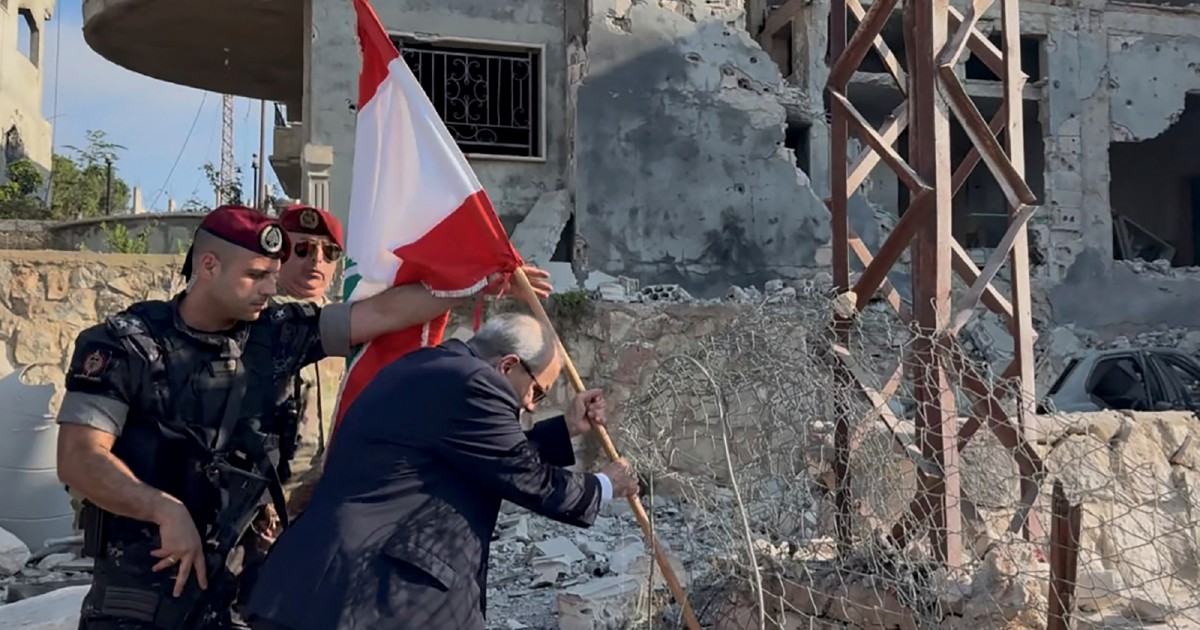
Lebanese Prime Minister Nawaf Salam declared on Wednesday that his government remains committed to achieving a "complete Israeli withdrawal" from all territories under Israeli occupation, remarks he made while visiting Zawtar Al-Gharbiyah, a southern village where Lebanese armed forces have recently moved in to establish military control.
Salam's statement underscores the centrepiece of his administration's policy agenda regarding the long-contested southern border region. The positioning of Lebanese army units in previously contested areas represents a significant shift in territorial governance, a development watched closely by international observers and regional powers invested in the outcome of Lebanon's internal security arrangements.
The village visit carries symbolic weight within Lebanese domestic politics. Salam's presence in Zawtar Al-Gharbiyah signals that the government is actively reasserting state authority in the south, a region that has been subject to competing influences and control for decades. The deployment of formal military units rather than irregular forces represents an attempt by Beirut to establish conventional state sovereignty over areas that have historically existed in a grey zone of contested governance.
For Malaysian and Southeast Asian observers, Lebanon's efforts to consolidate state authority hold lessons about the challenges facing post-conflict societies attempting to rebuild institutional capacity. The region's experience mirrors some dynamics in other conflict-affected areas, where establishing genuine state control requires more than military presence—it demands the creation of functional governance structures and economic opportunity.
Salam's emphasis on a "complete" withdrawal carries negotiating importance. By framing the objective as total rather than partial Israeli departure, the Lebanese government signals it will not accept incremental or temporary arrangements. This positioning reflects domestic political pressure, as any agreement perceived as compromising Lebanese territorial integrity could face significant opposition from various political factions within the country.
The timing of these remarks coincides with ongoing discussions about Lebanon's security situation. The country has experienced cycles of tension and relative calm along its border, with various diplomatic initiatives attempting to establish lasting arrangements. The current government's explicit commitment to full withdrawal suggests Beirut is negotiating from a position emphasizing its maximalist demands rather than seeking middle-ground solutions.
For regional stability in the Levant and the broader Middle East, how this dispute is resolved carries significance. Lebanon's capacity to maintain territorial integrity and establish effective governance directly influences the broader regional balance. International actors, including major powers with interests in Middle Eastern stability, monitor these developments as indicators of whether border disputes can be resolved peacefully or whether they will remain flashpoints for future instability.
The deployment of Lebanese army units represents an institutional choice with long-term implications. Rather than relying on militia forces or allowing the region to remain under external control, the government is attempting to embed state military structures in previously contested areas. This approach, if sustained, could gradually establish the legitimacy and physical presence necessary for durable state authority.
However, implementing this strategy presents substantial challenges. Lebanon's military institutions require resources, training, and international support to effectively govern expanded territories. The country's economic difficulties and historical sectarian divisions complicate efforts to build unified, professional armed forces capable of operating without external support. These institutional weaknesses mean that declarations of intent, however forcefully stated, may not automatically translate into on-the-ground reality.
Salam's comments also reflect broader questions about Lebanon's future political trajectory. A government that successfully reasserts control over its entire territory, including previously contested zones, would represent a significant consolidation of state capacity. Conversely, if external forces maintain de facto control despite formal declarations, Lebanon's actual sovereignty would remain constrained regardless of official rhetoric.
The broader international dimension remains crucial. How major regional and global powers respond to these Lebanese initiatives will substantially influence their success. Diplomatic support, combined with security guarantees and economic assistance, could strengthen Beirut's hand in achieving its stated objectives. Conversely, if international actors prioritize other interests over Lebanese state consolidation, Salam's announcements may amount to aspiration rather than accomplished fact.
Looking forward, the success of Lebanon's approach depends on translating military deployments into genuine governance capacity. The presence of army units in Zawtar Al-Gharbiyah is a beginning, but sustained progress requires establishing services, economic activity, and civilian administration that convince residents that state control offers tangible benefits compared to previous arrangements.

