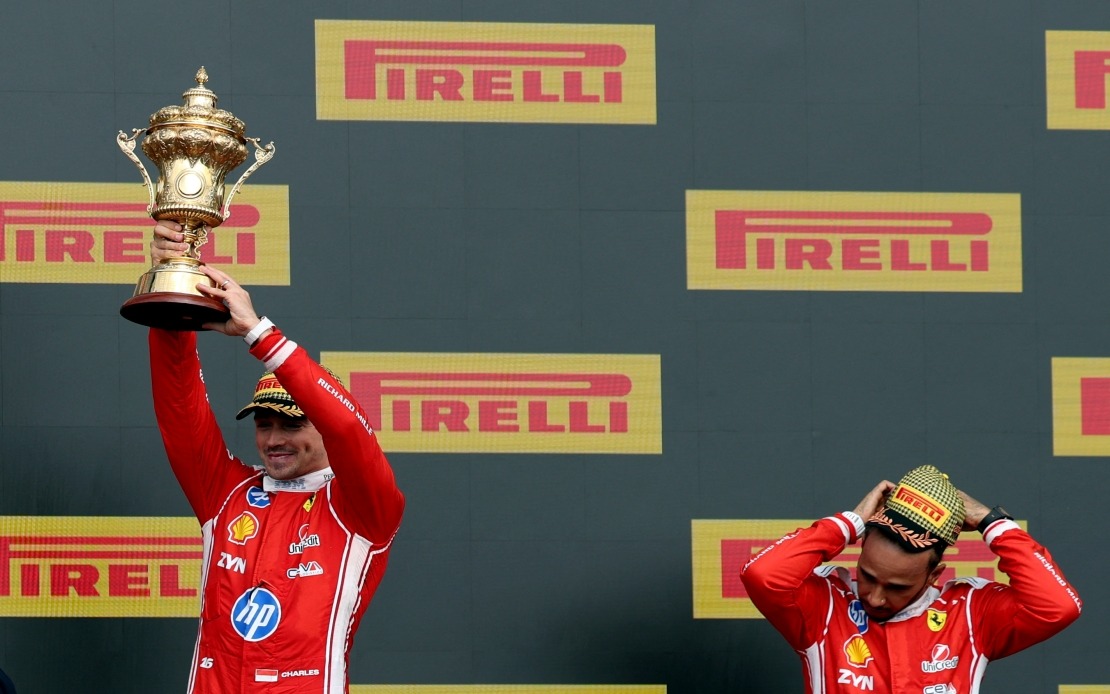
Charles Leclerc delivered a dominant performance at Silverstone on Sunday, clinching the British Grand Prix in circumstances that dramatically reshaped the Formula One championship battle. The Ferrari driver's victory came after a mechanical failure devastated the title hopes of Mercedes' Kimi Antonelli, whose bid to extend an already formidable championship lead collapsed in the race's closing stages. The dramatic finale, punctuated by a controversial Safety Car decision that compressed the field and shuffled the podium positions, left spectators frustrated but confirmed Leclerc's resurgence after a difficult spell in recent rounds.
Leclerc's commanding performance began at the opening corner, where he executed a textbook launch from second on the grid to seize the lead from pole-sitter Antonelli. Lewis Hamilton, starting from third, also benefited from Antonelli's sluggish getaway to move into second position, setting the tone for a race that would see the Ferrari driver control proceedings for much of the afternoon. As Leclerc methodically extended his advantage, the 26-year-old Monegasque appeared set for a comfortable victory, having built a margin exceeding four seconds before the pit-stop cycles began to reshape the running order.
Antonelli's competitive predicament appeared manageable in the opening phase. Though he surrendered the lead, the 19-year-old championship leader possessed a significant advantage in tire degradation management, having started on the prime compound whilst others committed to the softer alternative. When he swept past Hamilton at Copse on lap 11, Antonelli appeared to be executing Mercedes' planned strategy flawlessly. The Mercedes squad's decision to extend Antonelli's first stint by ten additional laps compared to Leclerc's stop on lap 25 was calculated to provide the young British driver with substantially fresher rubber during the race's critical closing phase.
The strategy appeared vindicated as Antonelli rejoined the circuit just over seven seconds adrift but visibly gaining momentum. His fresher tires and Mercedes' superior straight-line efficiency created a genuine threat to Leclerc's position. With eleven laps remaining, Antonelli had compressed the gap to under three seconds, positioning himself to complete what would have been a masterful recovery. The possibility of wrestling control from Ferrari seemed imminent as Antonelli's pace advantage became increasingly apparent. However, the unfolding drama was about to take a decisive turn that would alter not just this race, but potentially the championship trajectory.
Disaster struck when Antonelli ran over the curbs at Copse during a seemingly routine lap, the contact triggering an immediate structural failure. What appeared to be minor kerb abuse suddenly revealed a critical weakness as the front-left wheel shield fractured, a component apparently compromised by cumulative damage from earlier aggressive driving. Antonelli's initial radio call to the Mercedes pit wall suggested front-wing damage, but telemetry analysis quickly identified the true culprit. The broken wheel shield dramatically compromised the car's aerodynamic balance and steering geometry, forcing the team into an unscheduled second stop to remove the damaged component.
The damage mitigation effort proved insufficient to restore full functionality. Even after the shield's removal, Antonelli reported ongoing steering difficulties, describing how he was forced to negotiate the kerbs with extreme caution for the remainder of the race. His comments to the team and subsequent post-race interview revealed the frustration of a driver who possessed genuine winning pace but was rendered unable to capitalize on it through mechanical circumstances beyond his control. Antonelli's determination to extract maximum points from an increasingly compromised situation demonstrated his commitment, though repeated excursions beyond the track limits as he battled to maintain control testified to the severity of the problem.
As Antonelli's challenge dissolved, Leclerc methodically nursed his position toward what appeared to be a commanding victory margin. However, the race's conclusion would not belong to straightforward Ferrari dominance. With four laps remaining, Max Verstappen's Red Bull spun into the gravel at Stowe, triggering a Safety Car deployment and bunching the field dramatically. This intervention compressed a 30-second Ferrari cushion into a single-digit gap, fundamentally altering the dynamics of the final laps. Leclerc's comfortable margin suddenly evaporated, and the race returned from a processional affair to genuine contention.
The Safety Car period prompted contrasting strategic responses from the competing teams. Ferrari elected to bring Leclerc's closest pursuer, George Russell, into the pit lane for fresh soft tires, seemingly positioning the Mercedes driver for a final assault on the Ferrari. Meanwhile, Mercedes made the counterintuitive decision to leave Russell on track, preserving his tires and track position rather than pursuing the perceived aggressive option. This gambit proved decisive when the racing director opted to conduct the restart behind the Safety Car rather than unleashing the drivers for a planned single-lap sprint to the finish.
The decision to complete the race behind the Safety Car, subsequently attributed to a software error that had sent an incorrect message suggesting racing would resume, provoked audible boos from Silverstone spectators. The crowd's frustration was understandable—spectators had anticipated a thrilling one-lap showdown where Hamilton's fresher rubber might have enabled a final assault on Russell. Instead, the race concluded in anticlimactic fashion with the field locked behind the slow-moving Safety Car, leaving Russell to inherit second place and Hamilton relegated to third. The FIA's later acknowledgment of the software malfunction provided explanation but little consolation to those who felt robbed of a climactic finish.
Leclerc's victory, his first since the 2024 United States Grand Prix, represented far more than merely breaking a personal drought. The result underscored Ferrari's ongoing recovery following a difficult mid-season spell, with Hamilton's victory in Spain representing the only interruption to Ferrari's recent momentum. Leclerc's post-race commentary acknowledged the team's meticulous work to rediscover the car's handling characteristics, suggesting that the developments implemented ahead of the weekend had successfully addressed the balance issues that plagued recent performances.
The championship implications of this result cannot be understated for Malaysian Formula One enthusiasts and regional fans tracking the title battle. Antonelli's failure to score significant points, combined with Leclerc's full haul, has fundamentally altered the competitive landscape. Where Antonelli had accumulated a commanding 66-point advantage following five consecutive victories through Monaco, this race has narrowed that cushion substantially. The collision of mechanical misfortune with strategic gambles has transformed championship perception from apparent certainty into contested territory. For Ferrari and Leclerc, confidence will be regenerated; for Mercedes and Antonelli, questions will inevitably arise regarding reliability and pit-stop decision-making under pressure.
Russell's second-place finish deserves acknowledgment as the principal beneficiary of the Safety Car reshuffling. The British driver had endured his own technical challenges throughout the afternoon, wrestling with reported gearbox issues early in the race before being informed of a slow right-rear puncture necessitating an additional stop. Despite these setbacks, Russell's strategic positioning and Mercedes' calculated risk in leaving him on track during the Safety Car period proved spectacularly prescient, delivering a podium finish that might easily have eluded him absent the safety intervention.
Hamilton's third-place result, while respectable given his earlier penalty for a false start and the subsequent tire disadvantage, represented a subdued performance for the seven-time world champion. The five-second penalty served during his first pit stop proved costly, removing him from position to challenge for victory and ensuring he remained in the chase group behind Russell. His inability to challenge Russell in the closing laps, attributable both to tire degradation and the Safety Car's premature conclusion, will contribute to what many observers will perceive as a missed opportunity at a circuit where Mercedes has traditionally demonstrated competitive superiority. For Malaysian readers following the championship, this result represents a significant turn in the season's narrative arc.

