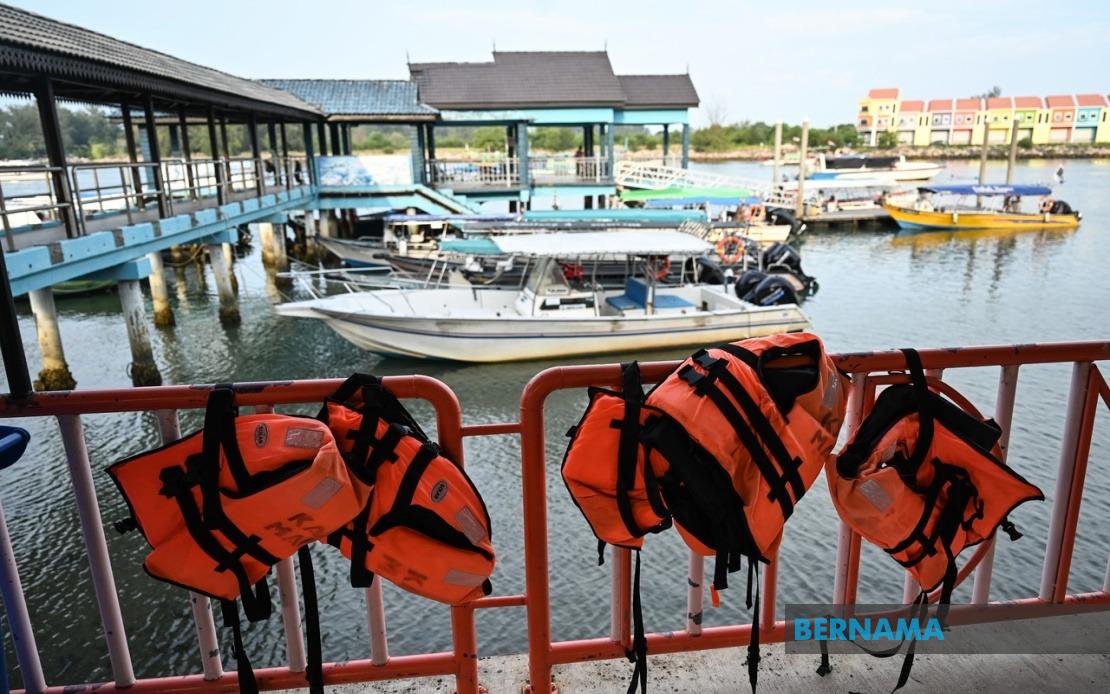
A fatal boat capsize off the coast of Kuala Nerus has reignited calls for stricter maritime safety compliance in Terengganu, with state authorities emphasising that life jacket usage must never be compromised, even during rest periods aboard vessels. The incident, which occurred approximately nine nautical miles from Dataran Kuala Nerus last night, resulted in one death and multiple injuries among squid jigging participants, prompting urgent reminders about water safety protocols from government officials.
Datuk Razali Idris, chairman of the Terengganu State Tourism, Culture, Environment and Climate Change Committee, has delivered an unequivocal message to all maritime operators and participants: life jackets represent non-negotiable safety equipment that must remain secured throughout every moment spent aboard a vessel. Speaking to media, he rejected the notion that life jacket removal during rest or sleep periods constitutes acceptable practice, arguing that fatal accidents often occur unpredictably and that complacency during seemingly calm moments has contributed to numerous tragedies at sea.
The state official's intervention goes beyond simple advisory recommendations, positioning safety compliance as a moral and legal responsibility shared between boat operators and passengers. Razali stressed that every commercial vessel carrying passengers must be equipped not only with life jackets but also with fire extinguishers and comprehensive emergency equipment suitable to the vessel type and passenger capacity. This holistic approach to maritime safety reflects international best practices increasingly adopted across Southeast Asian waters, where tourism-related maritime activities continue expanding without corresponding investment in systematic safety culture.
Razali articulated particular emphasis on the role of boat skippers in establishing safety standards before departure. He recommended that skippers conduct formal safety briefings covering weather conditions, sea state assessments, trip duration, and proper life jacket deployment techniques. This measure mirrors protocols already implemented by established tourist operators operating island ferry services from Kuala Terengganu, demonstrating that such procedures remain compatible with commercial viability and operational efficiency. The exco member acknowledged that skippers possess critical knowledge about actual sea conditions and remain best positioned to make informed decisions about trip viability.
Regarding the specific incident that prompted these statements, officials indicated that the vessel involved appeared to be in satisfactory condition and was skippered by an experienced operator, suggesting that neither equipment failure nor operator incompetence necessarily caused the capsizing. Instead, investigations point toward water ingress into the engine compartment as the probable contributing factor during rough sea conditions. Significantly, all passengers aboard the ill-fated vessel were reportedly wearing life jackets at the time of capsize, which Razali cited as evidence that such equipment directly contributes to survival rates and should therefore never be voluntarily removed.
The casualty list from last night's incident included Ahmad Nasaruddin Mohmad Jalil, a 37-year-old boat crew member who perished, while three squid jigging participants—Faris Ibrahim, 33, Ahmad Danial Iman, 24, and Fatin Fariesya Rohaizan, 26—sustained injuries. Two injured individuals received outpatient treatment at Hospital Sultanah Nur Zahirah, while the third remained under ongoing medical observation. Eight additional persons were successfully rescued from the water, underscoring the protective value of life jacket usage during maritime emergencies.
When questioned about potential regulatory changes, Razali indicated that Terengganu's government does not intend to revise existing standard operating procedures governing squid jigging activities. He characterized current guidelines as fundamentally adequate, redirecting attention instead toward compliance with extant safety measures. This position reflects pragmatic governance recognising that regulatory frameworks already exist; the challenge lies in consistent implementation rather than perpetual regulatory expansion. However, the distinction between adequacy of rules and adequacy of enforcement remains critical for authorities seeking to prevent future tragedies.
An important jurisdictional consideration affects the scope of Terengganu's regulatory authority. Razali clarified that boat licensing and operational approval decisions fall under Malaysia Marine Department jurisdiction rather than state government control. Consequently, state authorities can only issue advisories and recommendations, while the Marine Department maintains responsibility for assessing vessel seaworthiness, skipper qualifications, and weather-related operating restrictions. This institutional division creates potential implementation challenges, particularly when state-level safety advocates identify compliance gaps that require federal-level intervention.
Razali specifically reminded squid jigging operators and participants to respect warnings issued by the Malaysia Marine Department, particularly regarding prohibition of maritime operations during adverse weather conditions. He noted that most Terengganu boat skippers represent responsible operators willing to offer full refunds rather than proceed with trips during unsafe conditions. This characterisation suggests that cultural attitudes toward maritime safety among Terengganu operators may be more receptive to safety prioritisation than perceived in some other Malaysian coastal regions.
The broader context of this incident reflects ongoing tensions within Malaysia's tourism-dependent coastal economies between commercial imperatives and safety imperatives. Squid jigging represents an established recreational activity generating meaningful income for boat operators and associated service providers throughout peninsular Malaysia's east coast. Yet the activity inherently involves exposure to relatively unpredictable sea conditions and operates under commercial pressure to accommodate participants regardless of sea state variability. Enhanced safety culture requires sustained education, consistent enforcement, and cultural normalisation of safety practices among both operators and participants.
For Malaysian maritime safety advocates and regional observers, the Terengganu incident demonstrates that even experienced operators aboard well-maintained vessels cannot guarantee immunity from maritime accidents. The convergence of rough sea conditions, mechanical failures, and unexpected water ingress created circumstances that tested survival systems. The fact that life jacket usage contributed materially to rescue outcomes provides empirical validation for consistent safety advocacy. Moving forward, effectiveness will depend less on new regulations than on rigorous monitoring of existing compliance, improved skipper training standardisation, and cultivation of maritime safety consciousness among recreational water activity participants.

