The Malaysian Fisheries Development Authority (LKIM) is stepping up efforts to modernise the nation's fishing infrastructure, having dedicated RM2 million since last year to repair, upgrade and build fish landing jetties in locations nationwide. The initiative reflects a broader recognition that adequate landing facilities are fundamental to supporting the economic viability and competitiveness of Malaysia's fishing sector, particularly for smallholder and artisanal operators who form the backbone of many coastal communities.
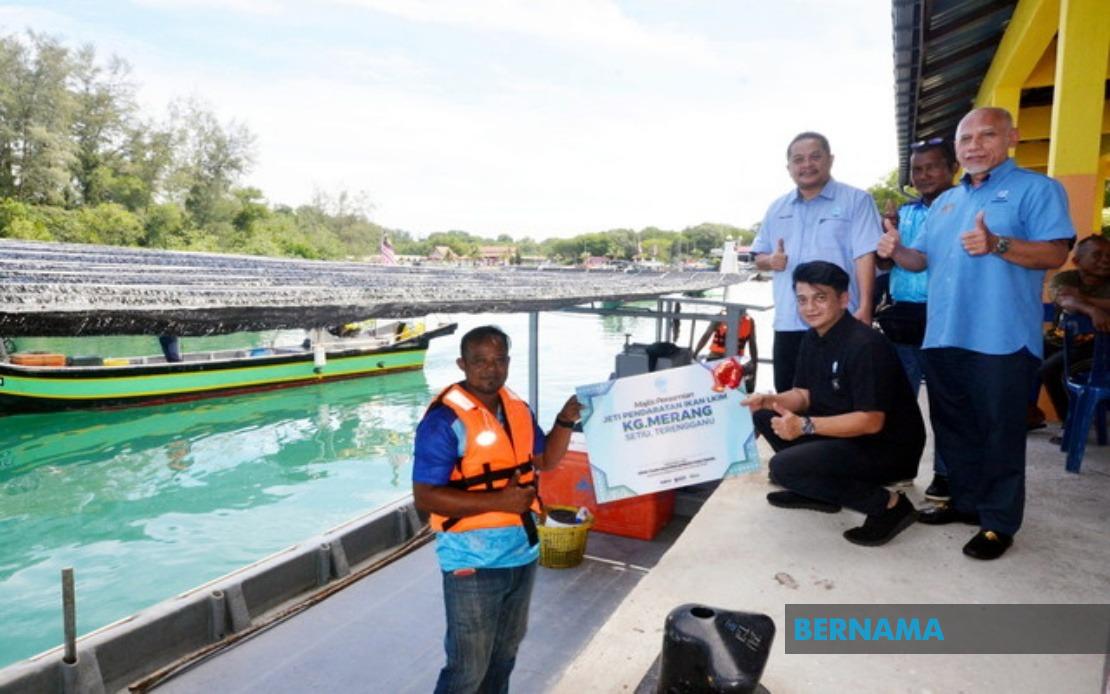
Muhammad Faiz Fadzil, LKIM's chairman, outlined the agency's progress during the official handover of the newly constructed Kampung Merang Fish Landing Jetty in Bandar Permaisuri on June 30. He revealed that one new jetty was completed in Merang this year, with two further projects in Perak and Labuan currently advancing through documentation and tender procurement phases. The measured pace of development underscores both the scale of Malaysia's fishing infrastructure challenge and the complexity of coordinating construction across multiple states and federal territories.
The Kampung Merang facility, built at a cost of RM500,000, represents a substantial upgrading for the locality. The new concrete structure replaces an aging installation constructed by villagers themselves, which had deteriorated to the point where it no longer met safety standards or operational requirements for modern fishing activities. The handover ceremony marked the formal commencement of operations, opening access to this improved infrastructure for approximately 124 local fishermen operating 68 boats from the village. For these operators, the facility eliminates a critical operational bottleneck that previously constrained their ability to land, process and market their catch efficiently.
Currently, LKIM oversees a nationwide network of 372 fish landing jetties alongside 48 fisheries complexes and ports. This extensive portfolio demonstrates the authority's substantial responsibility for maintaining and enhancing the infrastructure upon which Malaysia's fishing industry depends. However, Muhammad Faiz emphasised that existing budgetary allocations remain insufficient to address accumulated maintenance backlogs and the persistent need for new facilities in underserved fishing communities. He has accordingly urged the government to consider substantially increased funding allocations in forthcoming annual budgets, arguing that expanded resources would enable more jetty development projects to proceed across the country.
The investment in Merang specifically targets an area with demonstrated commercial fishing activity. Local fish landing records indicate that Setiu district currently generates approximately 243 metric tonnes of annual catch. LKIM officials project that this volume will increase materially once fishermen have fully adapted their operations to utilise the new facility's superior capabilities. Enhanced landing infrastructure typically generates measurable productivity gains, as modern facilities reduce damage to catch, minimise spoilage, accelerate transaction processes and provide safer working conditions.
For Malaysia's fishing communities, the implications of improved landing infrastructure extend well beyond convenience. Better facilities directly translate into economic benefits by reducing the operational friction that currently constrains profitability. When fishermen must work with deteriorating jetties, they face unnecessary delays in offloading their catch, higher risks of product degradation, and limited ability to negotiate favourable prices with buyers. Modern landing facilities streamline these processes, enabling faster turnover and more efficient market access. Muhammad Faiz articulated this connection explicitly, noting that enhanced landing infrastructure facilitates the entire commercial chain from catch to consumer, ultimately contributing to higher incomes for fishing families who depend entirely on their maritime harvests.
The regional context for this initiative is significant. Southeast Asia's fishing sector faces mounting pressure from resource depletion, competition from industrial operations, climate-related impacts, and the ongoing need to maintain coastal community viability. Malaysia's approach of systematically upgrading landing infrastructure addresses one variable within this complex equation. By ensuring that fishermen possess modern facilities for landing and initial processing, the government removes one category of operational constraint that smaller operators cannot easily overcome independently. This targeted infrastructure investment thus serves as a form of economic support for artisanal fishing communities.
The broader challenge facing LKIM and the government is coordinating development across a geographically dispersed network. Malaysia's coastline spans multiple states with varying infrastructure needs, population densities and economic conditions. Prioritising investments requires balancing competing demands: supporting existing fishing communities in established centers, enabling emerging fishing areas to develop capacity, and replacing obsolete facilities that pose safety risks. The current RM2 million allocation, while meaningful, necessarily implies a staged approach rather than comprehensive nationwide upgrading.
The Merang project also illustrates how infrastructure improvements can unlock development potential in specific communities. The facility's capacity to serve 124 fishermen with 68 boats represents the human scale at which these investments operate. Unlike mega-projects that transform regional landscapes, fishing jetty development directly improves conditions for identifiable populations whose economic survival depends on sea-based livelihoods. This targeted approach has particular relevance for Malaysia's coastal regions, where fishing communities have historically occupied somewhat peripheral positions within broader economic development narratives.
Looking ahead, LKIM's appeal for expanded government funding reflects the reality that infrastructure maintenance and development require sustained financial commitment. Fish landing jetties, like all maritime infrastructure, face constant pressure from salt-water corrosion, weather impacts and heavy operational use. Current available resources must be distributed across maintenance of existing facilities, repairs addressing safety issues, and construction of genuinely new capacity. Increasing this budget allocation would enable the authority to accelerate the development timeline and address more of the identified needs simultaneously.
The investment in improved fishing infrastructure also connects to broader food security considerations. Malaysia's domestic fish supply depends significantly on local catches rather than imports. Efficient landing facilities help ensure that fish destined for local consumption reaches markets quickly and in optimal condition, supporting food safety and consumer welfare alongside fisher livelihoods. This multifaceted benefit reinforces the case for sustained public investment in sector-supporting infrastructure.

