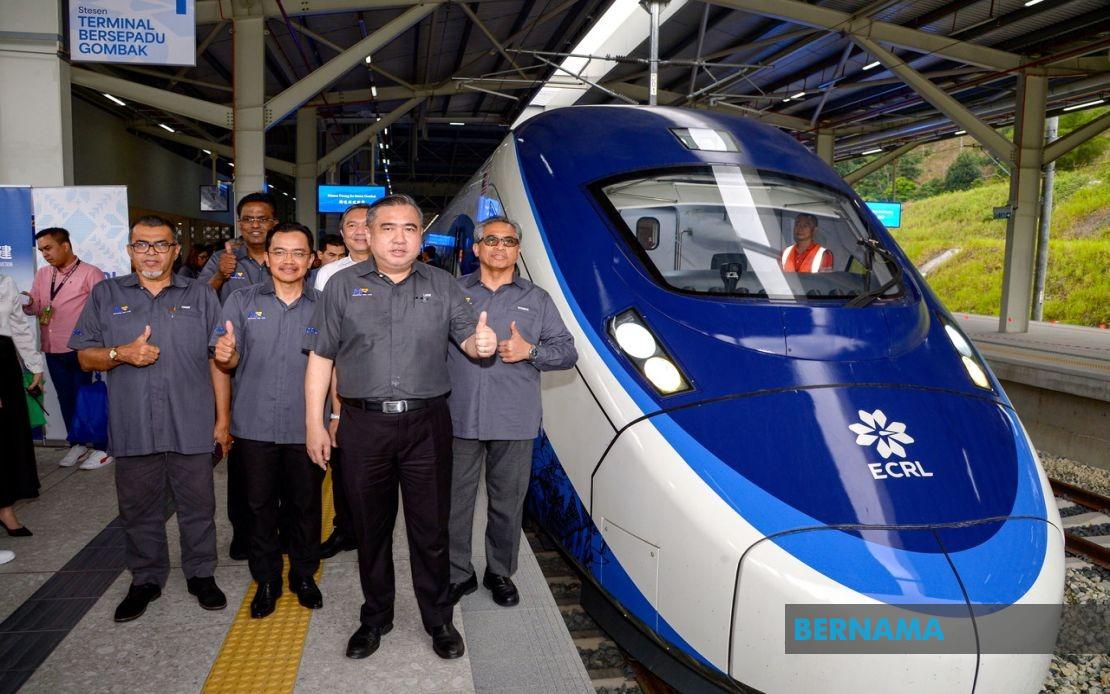
Transport Minister Anthony Loke Siew Fook has set an ambitious December operational target for the Kota Bharu-Gombak segment of the East Coast Rail Link, representing a significant acceleration from the originally planned January 2027 commencement date. The minister unveiled this timeline during the launch of the Comprehensive Inspection Train and the formal start of System Integration Testing at the Gombak Integrated Terminal Station, signalling the government's determination to deliver one of Southeast Asia's most significant rail infrastructure projects ahead of its conventional schedule.
The acceleration hinges fundamentally on the successful completion of critical testing protocols without any relaxation of safety standards, according to Loke's statements at the event. Malaysia Rail Link Sdn Bhd, in coordination with main contractor China Communications Construction Company Ltd, must navigate a compressed timeframe encompassing System Integration Testing scheduled for this month and Fault-Free Run trials beginning in September. The minister emphasised that this compressed schedule represents a refinement of timelines rather than a compromise on operational rigour, a distinction that carries particular weight given Malaysia's historical experience with major infrastructure projects.
The acceleration strategy appears grounded in the preliminary testing work already completed by manufacturers in China prior to train shipment to Malaysia. By leveraging factory-conducted trials and initial assessments, project stakeholders believe they can compress what typically represents two to three months of certification and testing protocols. Loke indicated that the Land Public Transport Agency is being engaged to facilitate administrative and regulatory pathways, potentially streamlining approval processes without circumventing essential safety validation.
The Fault-Free Run process itself represents a substantial undertaking, requiring each train set and electric locomotive to traverse 8,000 kilometres under real operational conditions while remaining unpopulated by passengers. This critical phase allows engineers to validate that systems perform reliably under authentic track conditions rather than laboratory environments. The FFR must occur only after all antecedent testing stages have been completed and independently approved, creating a sequential dependency that cannot be artificially compressed without introducing unacceptable risks.
Loke's public insistence on safety prioritisation—stating that project leadership is "more afraid than you" of potential operational hazards—reflects awareness of public concern surrounding a major Chinese-built transport infrastructure project. The minister's repeated emphasis on safety considerations serves both to reassure Malaysian commuters and to establish clear accountability should any incidents occur. This rhetorical positioning suggests that officials recognise the political stakes inherent in the ECRL's successful and safe operation.
The Phase 1 project currently stands at 95.08 per cent completion as of July, indicating that the physical infrastructure—track, stations, signalling systems, electrical networks—is substantially ready for operational integration. This advanced progress provides legitimate foundation for the December target, distinguishing this accelerated timeline from purely aspirational scheduling. The remaining gap represents primarily the validation and integration of systems rather than fundamental construction deficiencies.
Beyond Phase 1, the broader ECRL programme continues on a staggered implementation schedule. Phase 2, extending from Gombak to Port Klang, is projected for completion by December 2027 with operations beginning in January 2028. This phased approach allows lessons learned during Phase 1 operations to inform Phase 2 deployment, potentially improving execution efficiency across the full 665-kilometre network.
The ECRL represents a transformative development for Malaysia's transport infrastructure and regional connectivity. The Kota Bharu-Gombak corridor will directly link Kelantan's east coast position with the Selangor-Kuala Lumpur economic hub, reducing travel times and enabling integration with existing Klang Valley transit networks. For Malaysian businesses and commuters, the completion timeline carries immediate implications for supply chain logistics, workforce mobility, and urban economic geography.
Regionally, the ECRL's successful launch will consolidate Malaysia's position within broader Southeast Asian rail infrastructure development. The project demonstrates Malaysia's capacity to execute megaprojects in partnership with Chinese entities while maintaining operational autonomy and safety standards. This model carries relevance for other regional nations considering similar Belt and Road Initiative infrastructure partnerships, particularly regarding governance frameworks and technology transfer arrangements.
The high-level participation in the launch event—including Chief Secretary Tan Sri Shamsul Azri Abu Bakar, Chinese Ambassador Ouyang Yujing, and CCCC President Zhang Bingnan—underscores the project's strategic importance to both Malaysian domestic policy and Malaysia-China bilateral relations. Infrastructure delivery carries political weight, and the December acceleration target becomes a tangible measure against which government effectiveness will be publicly assessed.
For Malaysian rail commuters accustomed to previous delays affecting major transport projects, the December target presents both genuine opportunity and warranted scepticism. The compression of certification timelines, while justified by preliminary testing results, remains aggressive relative to international norms for comparable rail systems. The coming months will reveal whether the accelerated schedule proves achievable without requiring subsequent deferrals.

