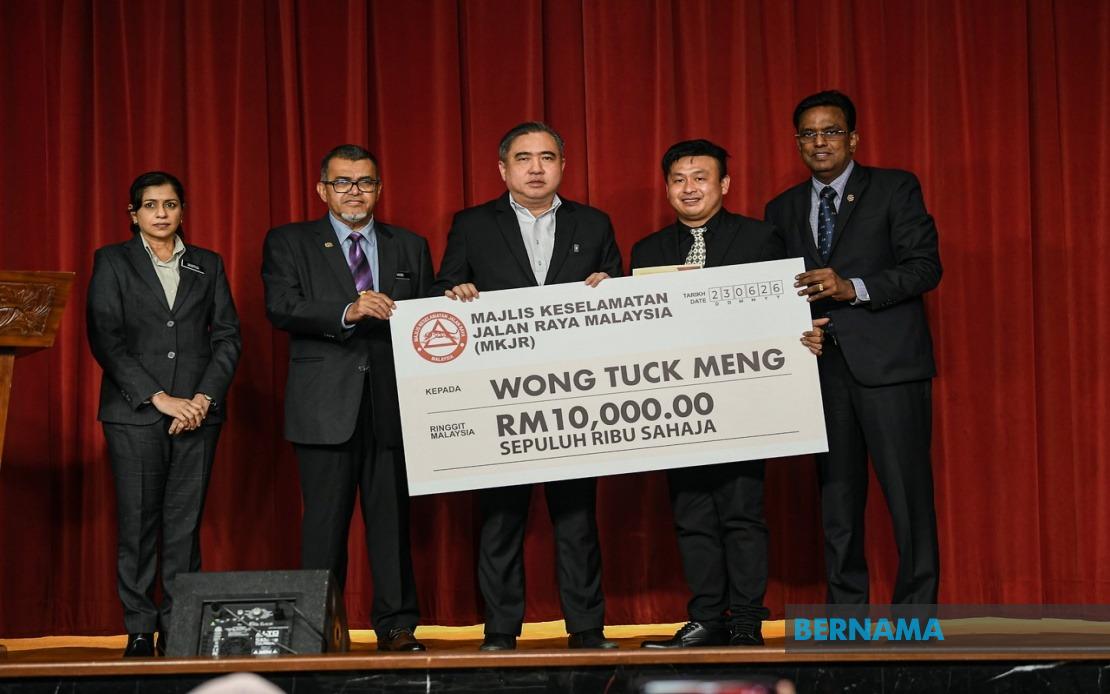
Wong Tak Ming, a lorry driver whose split-second decision-making prevented a disaster on a busy Malaysian highway, was recognised by the government today with a Special Certificate of Appreciation and RM10,000 in recognition of his bravery. The award ceremony, held at the Parliament building in Kuala Lumpur, highlighted an incident on June 15 when Wong's quick thinking helped avert a potential tragedy involving an express bus and 21 passengers near the Menora Tunnel in Perak. The recognition, funded by the Malaysian Road Safety Council (MKJR), underscores the government's commitment to honouring individuals who demonstrate exceptional courage in preventing road accidents.
Transport Minister Anthony Loke presided over the ceremony and praised Wong's actions as exemplary conduct that deserves national recognition. Loke described the lorry driver as a hero whose bravery transcended the immediate danger he himself faced during the incident. The minister emphasised that Wong's intervention prevented what could easily have been a catastrophic accident with potentially fatal consequences for the passengers aboard the express service, which was en route from Kedah to Kuala Lumpur.
The incident itself unfolded when the express bus encountered a technical malfunction while descending a steep section of highway near the Menora Tunnel. Unable to maintain control, the bus drifted across the roadway and made contact with the rear of Wong's lorry. Rather than simply reacting to the collision, Wong demonstrated remarkable presence of mind by recognising the critical situation and taking decisive action to mitigate the danger. He used his vehicle as a buffer, allowing the momentum of the bus to be gradually dissipated rather than resulting in a violent impact. By carefully manoeuvring his lorry closer to the guardrail while maintaining control, Wong successfully brought both vehicles to a controlled stop, preventing either vehicle from careening further down the incline or crossing into oncoming traffic.
When asked about his actions, Wong revealed that his instincts were driven by a singular focus on preventing loss of life and giving other motorists crucial time to react. He explained that his immediate concern was to alert vehicles ahead of the unfolding emergency so they could vacate the danger zone. Wong's calm assessment of the situation allowed him to use his horn effectively as a warning system, buying precious seconds for other road users to move to safety. This measured response, despite the obvious peril he faced, demonstrated the kind of situational awareness and moral clarity that characterises truly heroic action.
The incident gained significant public attention when footage of the emergency circulated widely across social media platforms. The video captured Wong's swift reactions and careful vehicle handling, which resonated with viewers nationwide and generated widespread admiration for his composure under extreme pressure. This digital dissemination of the incident transformed what could have remained a localised news story into a national conversation about road safety and exemplary civilian conduct.
Parliament itself formally recognised Wong's contributions to road safety during today's proceedings. Deputy Speaker Datuk Dr Ramli Mohd Nor conveyed the Parliament's collective gratitude to Wong following Transport Minister Loke's tabling of the Road Transport (Amendment) Bill 2025 for its second reading. This parliamentary acknowledgement elevates Wong's actions beyond a simple administrative award, embedding his heroism into the official record of Malaysia's legislative body and signalling the importance that elected representatives place on civilian contributions to public safety.
The recognition of Wong's actions carries broader significance for Malaysia's road safety discourse. His actions exemplify the reality that highway accidents often occur within milliseconds, leaving little time for deliberation. Yet Wong's instinctive response demonstrates that adequate training, mental preparedness, and a strong sense of social responsibility can enable drivers to make life-saving decisions even in chaotic circumstances. The government's decision to formally honour him sends a powerful message to the millions of Malaysian road users that individual actions matter and that society values those who prioritise the safety of others.
The incident also highlights the critical importance of vehicle maintenance and the dangers posed by buses operating on challenging terrain without adequate safety systems. The technical problem that caused the express bus to lose control raises questions about maintenance protocols and inspection regimes for public transport vehicles. Wong's intervention, while heroic, ultimately represents a lucky outcome that depended on chance positioning and driver capability. A more systematic approach involving rigorous maintenance standards and potentially enhanced safety features on public transport could reduce reliance on such fortuitous circumstances.
For lorry drivers and commercial vehicle operators across Southeast Asia, Wong's recognition carries particular relevance. Commercial drivers often operate under tight schedules and economic pressures that can compromise safety, yet Wong's example demonstrates that responsible driving and concern for fellow motorists transcend job descriptions and financial incentives. His award may serve as an inspiration for the broader transport industry to prioritise safety culture and mutual responsibility on increasingly congested regional highways.
The RM10,000 award, while modest in monetary terms, represents formal governmental validation of Wong's character and choices. More significantly, the publicity surrounding this award may encourage other drivers to adopt similarly vigilant and responsible attitudes toward road safety. In a region where fatal traffic accidents remain a persistent public health challenge, celebrating and rewarding exceptional road conduct creates positive cultural reinforcement for safety-conscious behaviour.
Looking forward, Wong's story offers lessons applicable across Malaysia's transport sector. His actions remind policymakers that while infrastructure, technology, and regulations form the foundation of road safety, ultimately the individual decisions of millions of drivers determine whether highways remain dangerous or become safer. The government's recognition of Wong Tak Ming represents not merely a tribute to one man's bravery, but an affirmation of the value that society places on vigilance, responsibility, and the willingness to risk personal safety for the collective good.