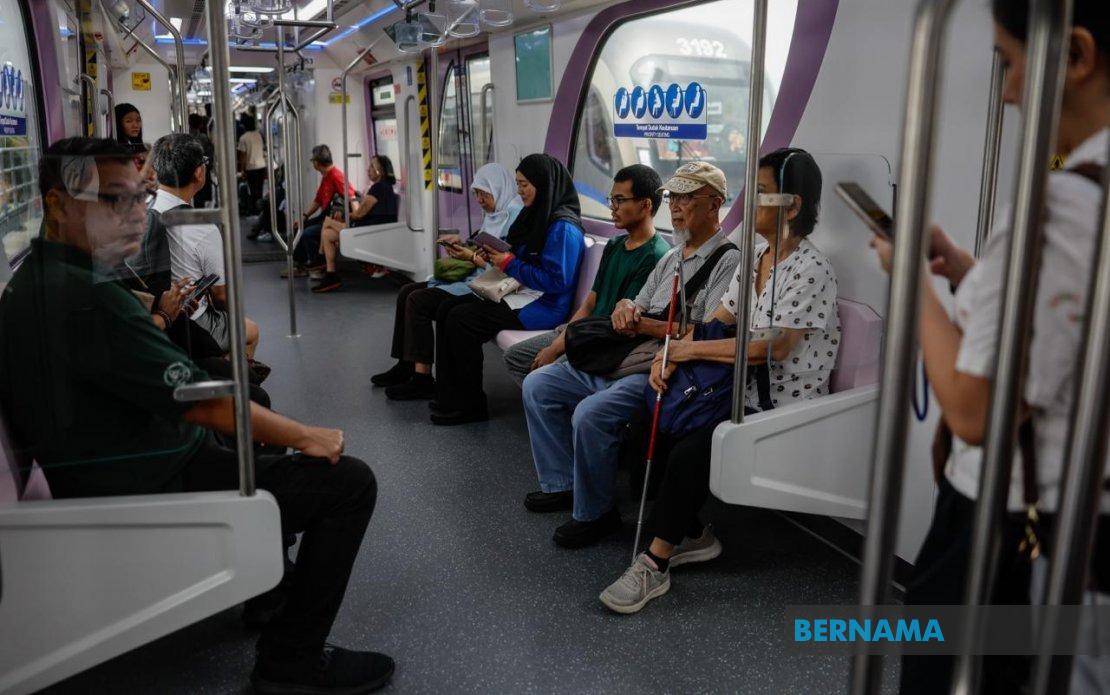
The LRT3 Shah Alam Line commenced operations on June 29 to a wave of encouraging feedback from commuters who praised its comfort, efficiency and role in streamlining travel across the Klang Valley. Yet alongside this enthusiasm, both accessibility advocates and ordinary passengers have flagged specific enhancements needed to make the RM16.63 billion infrastructure investment serve all Malaysians equitably. The balance between celebration and constructive criticism characterises the line's maiden day, revealing both the government's progress on inclusive public transport and the work that remains.
Visually impaired commuter Razlan Ibrahim, 40, epitomised this measured optimism. After travelling from Kajang to Glenmarie 2 station, he acknowledged meaningful strides in disability accommodation while identifying concrete gaps. The tactile pathways at stations such as Bandar Utama impressed him significantly, as these guiding surfaces directly connect users to facilities including accessible toilets, prayer rooms for both male and female passengers, and lifts. Such physical infrastructure represents a substantial shift toward genuine inclusion, moving beyond merely theoretical accessibility.
Yet Razlan's feedback illuminates a critical shortfall: the absence of comprehensive Braille signage at pivotal locations throughout the network. Without clear directional information rendered in Braille at toilets designated for persons with disabilities, prayer facilities, and lift locations, visually impaired travellers must rely on other means to navigate independently. Information accessibility—not merely physical accessibility—remains foundational to true transport inclusion. Razlan articulated this limitation diplomatically, stating that while tactile pathways work effectively, information access requires substantial enhancement.
The broader passenger experience has generated strong endorsement from commuters seeking to integrate the new route into their daily routines. Samantha Fong, a 26-year-old private sector employee, emphasised that the LRT3 eliminates the friction of multiple interchanges, enabling direct journeys between Bandar Utama and Glenmarie 2. This efficiency gain addresses a persistent complaint in Malaysia's public transport ecosystem: the fragmentation that forces commuters onto convoluted routes involving frequent transfers. For workers balancing demanding schedules, such streamlining translates into genuine quality-of-life improvement and time reclaimed from transit.
Fong introduced another dimension of passenger concern: the absence of women-only coaches. This suggestion reflects international best practice in cities ranging from Tokyo to Mexico City, where designated women's spaces have become standard features of rapid transit systems. In the Malaysian context, where commuter surveys consistently identify safety concerns and harassment as deterrents to public transport usage, particularly among women, this infrastructure gap warrants urgent attention from Prasarana and government stakeholders. The omission is especially notable given the government's stated commitment to inclusive development.
Another commuter, Rainchie Lee, 26, highlighted a different dimension of the line's value: its role as a trial mechanism for establishing sustainable transport habits. The government's decision to offer free fares throughout July provides a month-long opportunity for students, workers, and other potential regular users to evaluate whether the LRT3 genuinely addresses their mobility needs. This trial period transforms the launch from mere spectacle into a practical assessment tool. Lee's perspective suggests that commuters are thinking strategically about whether new infrastructure will durably alter their behaviour, rather than treating it as novelty.
Prime Minister Datuk Seri Anwar Ibrahim's announcement of complimentary travel through July, extended to feeder bus services operated by Prasarana, represents a deliberate policy choice to maximise early adoption. Free transit removes financial barriers that might otherwise deter price-sensitive commuters from testing unfamiliar routes. For students and entry-level workers—demographic groups whose transport choices shape decade-long patterns—this subsidy may prove transformative, embedding the LRT3 into commute expectations and routines.
The LRT3 Shah Alam Line sits within Malaysia's broader strategy to strengthen metropolitan infrastructure and reduce vehicle congestion. As the Klang Valley continues rapid urbanisation, fixed-rail transit offers alternatives to increasingly gridlocked highways. The 39-station network represents a significant expansion of the light rail footprint, connecting peripheral areas such as Shah Alam directly to established commercial nodes. From a regional perspective, Malaysia's sustained investment in modern transit infrastructure positions it competitively against other Southeast Asian capitals managing similar congestion crises.
Yet the commuter feedback underscores a lesson repeatedly demonstrated across transport projects globally: infrastructure excellence requires attention to detail across multiple dimensions simultaneously. Smooth operations and reduced journey times represent baseline expectations. True transport equity emerges when systems accommodate visually impaired users with Braille signage, when women feel secure in designated spaces, and when passengers with diverse mobility requirements navigate stations with confidence. Malaysia's RM16.63 billion investment demands scrutiny on these finer points.
Prasarana and the transport ministry should treat early user suggestions not as minor peripheral observations but as essential data for continuous improvement. Razlan Ibrahim's specific recommendations regarding Braille signage expansion, Samantha Fong's proposal for women-only coaches, and Rainchie Lee's broader concerns about long-term viability deserve systematic evaluation and response. Transparent communication about which suggestions the operator will implement, and timelines for implementation, would demonstrate genuine commitment to user-centred design.
The LRT3 Shah Alam Line's successful inaugural operations provide genuine cause for optimism about Malaysia's transport trajectory. Commuters perceive genuine utility, convenience and potential. However, the gap between current accessibility and genuine inclusion remains bridgeable only through deliberate action responding to informed user feedback. The coming weeks of trial operation present an ideal window for identifying additional refinements. Malaysian transport planning has consistently improved when agencies listen closely to how actual users experience their systems, rather than relying solely on design specifications. The challenge ahead is transforming inaugural praise into sustained excellence.

