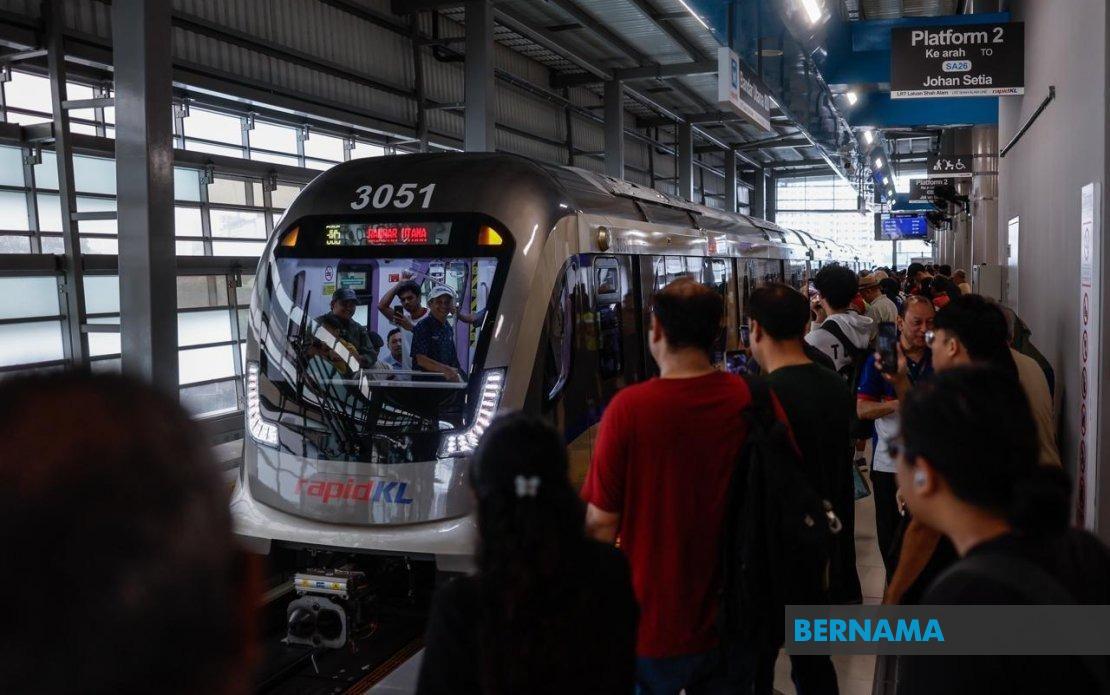
The Light Rail Transit 3 Shah Alam Line commenced operations today, marking a significant expansion of the Klang Valley's public transportation network. Prasarana Malaysia Berhad projected that between 5,000 and 10,000 passengers would board the line on its opening day, with services beginning at 6 am across all designated stations. The launch generated considerable enthusiasm among commuters, with reports of excited early adopters and widespread positive social media engagement as residents tested the new rail connection for the first time.
Prasarana president and chief executive officer Amir Hamdan outlined an ambitious growth trajectory for the line, anticipating that daily ridership would climb to approximately 67,000 passengers within the first year of operations. This projection assumes a gradual adoption curve as commuters integrate the new line into their regular travel routines. Amir acknowledged that new rail services typically experience a lag between opening and reaching steady-state capacity, as public behaviour and awareness take time to shift from established patterns. The timeline reflects both realistic expectations and the operator's confidence in eventual strong demand.
Early feedback from passengers revealed a clear appreciation for alternatives to private vehicle use. Many commuters expressed satisfaction with the opportunity to reach their workplaces comfortably without confronting the notorious congestion that characterises the Shah Alam and Klang Valley corridors. This sentiment underscores a growing appetite in Malaysia's urban centres for viable mass transit options, particularly among office workers seeking to reclaim time lost to traffic and reduce transport costs. The positive reception suggests that once awareness spreads beyond early adopters, demand could potentially exceed current projections.
Operationally, the line has performed smoothly during its inaugural hours. Train frequency during peak periods was maintained at approximately eight-minute intervals, a standard that Prasarana indicated as manageable given current passenger volumes. All ticketing infrastructure, automatic gate systems, and station facilities functioned without reported disruptions. This operational stability on day one is noteworthy given the complexity of launching integrated rail services and the potential for teething problems that often accompany new transport infrastructure.
The LRT3 Shah Alam Line incorporates strategic interchange connectivity that could significantly influence its ridership trajectory. Two key junction points—Glenmarie 2 station, which connects to the existing Kelana Jaya Line, and Bandar Utama station, linking to the Kajang Line—position the new line as an important node within the broader rapid transit network. These interchanges facilitate multimodal journeys and expand the geographic catchment area from which passengers can access the line, potentially driving higher-than-expected utilisation as commuters recognise time and cost efficiencies in combining rail services.
Prasarana's immediate strategic focus centres on optimising user experience rather than maximising capacity. The operator is conducting detailed assessments of passenger flows, ticketing processes, and gate usage patterns to identify friction points and opportunities for improvement. This customer-centric approach during the launch phase contrasts with infrastructure-centric planning, reflecting a recognition that adoption barriers often relate to convenience and perceived ease of use rather than theoretical capacity. The data being collected will inform subsequent operational refinements and capital decisions.
The operator indicated flexibility in capacity expansion should demand warrant it. Prasarana signalled readiness to increase train frequency beyond current eight-minute intervals and to strategically position standby trains along the route during peak periods. This measured approach allows the operator to match supply with demand as it materialises, avoiding overinvestment while remaining responsive to growth. The possibility of positioning spare rolling stock to address bottlenecks represents a pragmatic interim strategy pending any major capacity upgrades.
A notable decision taken at launch involves the absence of women-only coaches, a feature present on several other KL rapid transit lines. Rather than imposing such facilities from the outset, Prasarana committed to evaluating the need based on accumulated ridership data and passenger feedback. This evidence-based approach avoids unnecessary operational complexity while remaining open to introduction if safety concerns or usage patterns justify dedicated seating. The willingness to adjust policies based on actual user behaviour demonstrates adaptive management philosophy.
Prime Minister Datuk Seri Anwar Ibrahim announced a month-long promotional fare structure, with free rides for all passengers using the LRT3 Shah Alam Line and its associated feeder bus services through July 31. This subsidy strategy aims to accelerate awareness and trial adoption during the critical early weeks, removing financial barriers that might otherwise delay habit formation. By July 31, the cumulative ridership experience and established user patterns should provide clearer signals regarding the line's underlying demand elasticity and sustainable revenue levels post-promotion.
The opening of the LRT3 Shah Alam Line represents a tangible response to long-standing infrastructure deficits in the Selangor corridor. The route addresses connectivity gaps and offers commuters a faster, more predictable alternative to congested road networks. For the broader region, the line exemplifies Malaysia's continued investment in metropolitan rapid transit despite cost pressures, signalling commitment to urban livability improvements. Success of this line will likely influence policy discussions regarding future transit expansion and public transport financing across other Malaysian urban centres.
The coming months will prove decisive in determining whether initial projections prove conservative or optimistic. Consumer acceptance, promotional effectiveness, and the integration of the line into commuter consciousness will collectively establish whether Prasarana's 67,000 daily target by year-end represents an achievable milestone or aspirational planning. The line's performance will also provide data relevant to evaluating the return on capital invested in the project and informing future transport infrastructure decisions.

