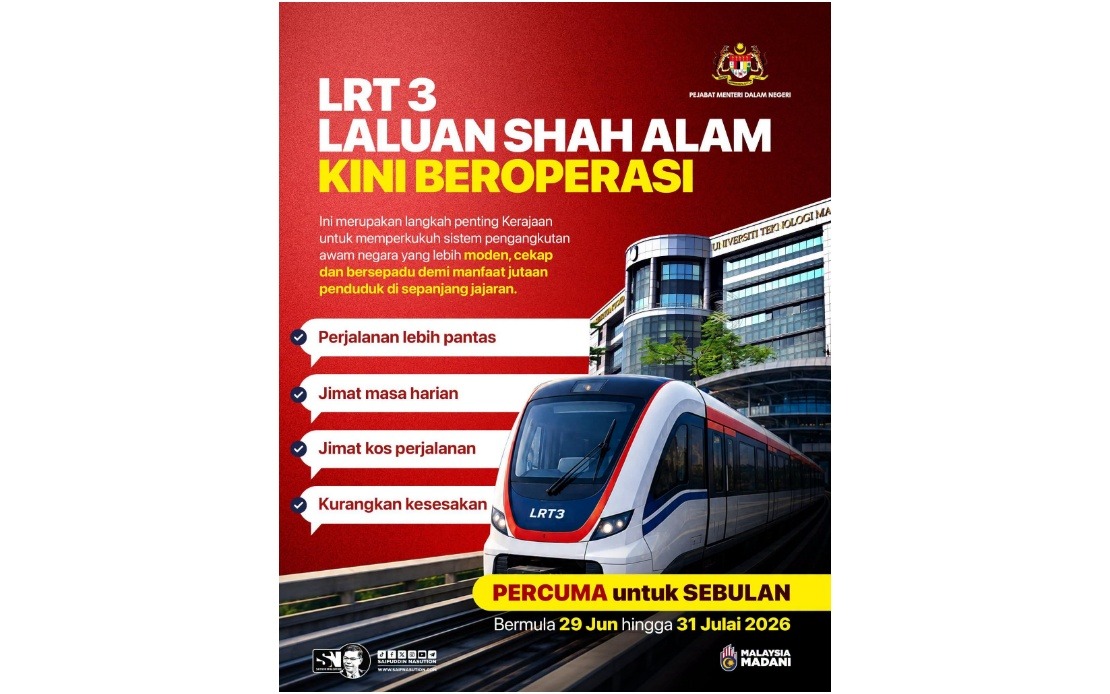
The inauguration of the Shah Alam Line LRT3 represents a significant milestone for the MADANI Government's broader agenda to reshape Malaysia's urban mobility landscape, according to Home Minister Datuk Seri Saifuddin Nasution Ismail. Speaking in the aftermath of the line's operational launch, Saifuddin framed the new rail corridor as a tangible demonstration of the administration's commitment to delivering modern, efficient, and interconnected transportation systems that meaningfully enhance quality of life across the nation's most congested metropolitan regions.
Operating along one of the Klang Valley's most heavily trafficked transport arteries, the Shah Alam Line LRT3 addresses a persistent infrastructure gap that has long constrained commuter options in the region. The corridor connects Shah Alam, Klang, Subang and surrounding areas, serving populations that have historically relied on private vehicles or older bus networks. By introducing a modern rapid transit alternative, the government aims to create genuine competition for car travel, particularly during peak commuting hours when congestion routinely paralyses major routes.
The transportation benefits extend well beyond simply adding another transit option. According to the Home Minister's assessment, the LRT3 addresses multiple interconnected challenges that plague daily commutes throughout the Klang Valley. Reduced traffic congestion naturally flows from increased public transport adoption, creating positive externalities that benefit all road users. Simultaneously, passengers switching to rail experience dramatically shortened travel times compared to sitting in bumper-to-bumper traffic, while the elimination of fuel costs and vehicle maintenance expenses produces meaningful monthly savings for working professionals, students, and individuals conducting routine errands.
Prime Minister Datuk Seri Anwar Ibrahim announced a promotional strategy designed to accelerate public acceptance and ridership during the critical early operational phase. Beginning June 29 and extending through July 31, all passengers enjoy completely free travel on the Shah Alam Line LRT3 and its complementary Prasarana Malaysia Bhd feeder bus network. This extended complimentary period removes the primary barrier preventing trial usage among hesitant commuters, allowing residents to experience the service quality, convenience, and reliability before committing to regular fare payments.
Saifuddin Nasution specifically urged residents of Shah Alam, Klang, Subang and communities positioned along the LRT3 corridor to capitalize on this limited-time opportunity. His messaging emphasized that the free-travel window represents an unprecedented chance for communities to fundamentally reassess their daily commute patterns without financial risk. By temporarily removing the cost barrier, the initiative enables commuters to conduct genuine comparative analysis between their existing transportation arrangements and what the modern rail network offers.
The promotional campaign reflects sophisticated understanding of behavioural economics and modal shift psychology. Research consistently demonstrates that once individuals experience convenient, reliable public transport, many voluntarily abandon private vehicle dependency even after subsidies expire. The thirty-day free trial period provides sufficient exposure time for commuters to integrate the LRT3 into their mental maps of available options and develop genuine preferences rooted in actual experience rather than theoretical assumptions about rail transit quality.
Within Malaysia's broader policy context, the LRT3 investment exemplifies the MADANI Government's prioritization of strategic infrastructure spending as a mechanism for improving citizen welfare. Rather than dispersing limited capital across marginal improvements, the administration has concentrated resources on addressing critical mobility bottlenecks affecting hundreds of thousands of daily commuters. This targeted approach reflects recognition that transportation infrastructure fundamentally shapes economic productivity, social equity, and environmental sustainability across metropolitan regions.
The Klang Valley, as Malaysia's economic heartland, generates disproportionate national economic output but has historically suffered from infrastructure investments lagging behind actual demand. The growing working-age population, continuing urbanization, and expansion of commercial and educational institutions have consistently outpaced transit capacity expansion. The LRT3 represents partial correction of this imbalance, though complete resolution of the region's mobility challenges will require sustained, multi-modal investment spanning rail, bus rapid transit, and last-mile connectivity solutions.
For commuters evaluating the LRT3's practical utility, the feeder bus integration deserves particular emphasis. Modern rapid transit systems succeed or fail based on first-last mile connectivity, and the coordinated Prasarana bus network addresses a traditional weakness in Malaysian rail transit implementation. By seamlessly connecting residential neighborhoods and dispersed destinations to main rail corridors, integrated feeder services dramatically expand the potential ridership base beyond populations living in immediate proximity to stations.
Saifuddin's exhortation to temporarily abandon private vehicles reflects the psychological challenge facing public transit advocates throughout Southeast Asia. Personal automotive ownership has become deeply embedded in aspirational middle-class identity and daily practice, even as congestion and environmental consequences mount. The Home Minister's appeal functions simultaneously as practical encouragement and subtle cultural commentary, inviting commuters to reconsider transportation choices as expressions of civic responsibility alongside personal convenience.
The LRT3 launch occurs within a competitive regional context as other Southeast Asian cities simultaneously upgrade rail infrastructure. Singapore's mature, highly efficient transit network has long established regional benchmarks, while Bangkok, Jakarta, and other major metropolitan areas have undertaken ambitious rapid transit expansion projects. Malaysia's LRT3 represents an opportunity to demonstrate that the country can deliver world-standard infrastructure and service quality, potentially attracting multinational investment and talented professionals who place high priority on urban livability.
Looking forward, the LRT3's success will substantially depend on operational performance during the initial critical months. Service reliability, cleanliness, safety perception, and fare affordability once the promotional period concludes will determine whether temporary trial users transition into sustained commuters. The government's decision to offer extended free travel through July provides crucial data collection and performance optimization period before implementing standard fare structures.
Ultimately, the Shah Alam Line LRT3 represents both tangible infrastructure achievement and symbolic commitment to prioritizing citizen welfare over alternative spending approaches. Whether the new rail corridor achieves its full potential for transforming Klang Valley mobility patterns will emerge only through actual operational experience, but the initial policy framework and promotional strategy suggest thoughtful implementation focused on removing barriers to public transport adoption.

