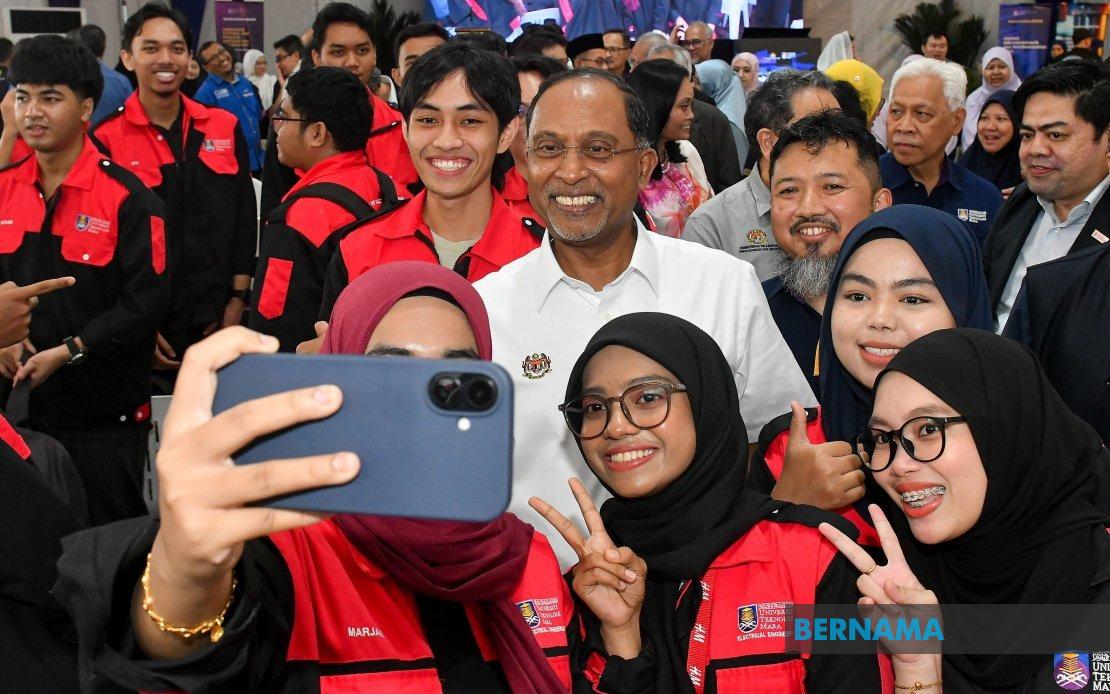
The Light Rail Transit 3 Shah Alam Line, which commenced operations with free fares through July 31, is already reshaping transportation patterns for students at Universiti Teknologi MARA Shah Alam. Higher Education Minister Datuk Seri Dr Zambry Abd Kadir observed during a campus visit that the dedicated UiTM Shah Alam Station represents a watershed moment for institutional accessibility, reducing both travel friction and the costs students incur navigating the sprawling Klang Valley conurbation.
The 20-station corridor spanning from Bandar Utama to Johan Setia creates a direct public transit link to the campus for the first time, fundamentally altering commuting economics for the university's substantial student body. Prior to the line's June 29 opening, transportation to Shah Alam required complex transfers or reliance on personal vehicles, contributing to chronic traffic congestion that disrupted both academic schedules and regional traffic flows. Minister Zambry noted that the visible enthusiasm among students using the new infrastructure reflected the genuine relief afforded by reliable rapid transit in an increasingly congested metropolitan region.
Beyond immediate mobility improvements, the LRT3 investment signals broader connectivity objectives for the Klang Valley as federal planners seek to decongest major arterial routes and integrate secondary centres into the wider urban system. The line's routing through residential developments including Subang, Glenmarie, and Kerjaya extends the transit network's reach into previously underserved communities, potentially catalysing mixed-use development along the corridor. For UiTM Shah Alam specifically, the station access strengthens the institution's competitive positioning in recruiting and retaining talent, as transportation convenience increasingly influences student enrolment decisions across Malaysian universities.
Simultaneously with the transit improvements, UiTM unveiled the Semiconductor@UiTM initiative, a RM20 million strategic programme reflecting the institution's pivotal role in Malaysia's semiconductor industry expansion strategy. The initiative, launched at the Tuanku Abdul Halim Mu'adzam Shah Engineering Complex, translates substantial government investment into infrastructure development, curriculum modernisation, and ecosystem building aligned with international technical standards. Minister Zambry framed the allocation as a direct translation of government policy into human capital formation, emphasising that semiconductor talent development carries outsized economic importance for national prosperity and technological sovereignty.
Malaysia's semiconductor sector currently commands approximately 13 per cent of global market share and generates more than RM300 billion in annual revenue, making workforce development in this domain a strategic priority across federal economic planning bodies. The National Semiconductor Strategy, which provides the policy framework for initiatives like UiTM's programme, targets sustained industry growth through enhanced domestic talent pipelines and deepened integration with multinational supply chains. UiTM's Electrical and Electronics Engineering disciplines occupy a central position in this strategy, and the upgraded facilities and industry-aligned coursework emerging from the RM20 million investment position graduates as competitive participants in global technical labour markets.
The programme extends beyond classroom instruction to emphasise sustained engagement between academic researchers and industry practitioners, creating pathways for students to engage directly with current manufacturing technologies and supply chain dynamics. This practical apprenticeship component addresses a persistent gap in Malaysian technical education, where graduates often lack exposure to operational semiconductor manufacturing environments and the collaborative problem-solving that characterises modern fabrication facilities. By formalising these industry linkages through the initiative, UiTM enhances the immediate employment prospects for graduates while building institutional capacity for applied research that strengthens Malaysia's competitive positioning in high-value semiconductor segments.
Vice-Chancellor Professor Datuk Dr Shahrin Sahib@Sahubuddin's participation in the initiative launch underscores institutional commitment to translating government funding into measurable capabilities, a concern that has historically characterised higher education sector dynamics across Southeast Asia. Malaysian universities frequently encounter expectations to deliver world-class research and industry partnerships without commensurate resource allocation, making the explicit RM20 million commitment to UiTM's semiconductor capacity a notable exception. The allocation represents confidence in UiTM's stewardship and reflects broader federal acknowledgment that semiconductor industry growth depends critically on institutional investment in engineering education and research infrastructure.
The concurrent advancement of both transit connectivity and technical education capacity at UiTM Shah Alam illustrates integrated policy approaches to urban development and economic competitiveness. Prime Minister Datuk Seri Anwar Ibrahim's announcement of free LRT3 fares through July 31, announced during the line's official launch, signals government willingness to subsidise public transport adoption during critical adoption phases, a strategy increasingly common among Southeast Asian metropolitan authorities seeking to shift commuting patterns toward sustainable transit. For UiTM students, the free-fare period reduces financial barriers precisely during the institutional transition to the new infrastructure, maximising adoption rates and establishing commuting habits that may persist beyond the promotional period.
The LRT3 Shah Alam Line's completion also reflects broader aspirations to construct comprehensive rapid transit networks across the Klang Valley, reducing dependence on private vehicle use that has historically characterised Malaysian urban mobility. The region's continued rapid development, which Minister Zambry acknowledged, creates persistent traffic management challenges that individual infrastructure projects cannot entirely resolve. However, strategic transit investments like LRT3 create frameworks within which mixed-use development can occur with reduced automobile dependence, potentially reshaping land-use patterns across the corridor and contributing to more sustainable metropolitan growth trajectories.
Looking forward, UiTM's Semiconductor@UiTM initiative carries implications extending beyond the institution itself, as Minister Zambry explicitly positioned the programme as a benchmark for peer universities seeking to contribute to Malaysia's high-technology sector expansion. The RM20 million allocation and the strategic framework guiding its deployment may establish templates that other institutions emulate, potentially accelerating sectoral-level human capital development. Whether comparable investments materialise at other universities remains uncertain, but the UiTM initiative establishes demonstrated pathways for translating government allocations into industry-aligned technical education and signals policymaker confidence in engineering education's economic returns.
The convergence of improved physical accessibility through LRT3 with expanded technical education capacity at UiTM Shah Alam addresses complementary dimensions of institutional competitiveness and regional development. Students navigating the Klang Valley now encounter both reduced transportation costs and access to semiconductor training aligning with global industry requirements, positioning UiTM Shah Alam as an increasingly attractive destination for serious engineering candidates. Over coming years, whether the initiatives deliver anticipated outcomes—reduced congestion, enhanced graduate competitiveness, and strengthened semiconductor industry participation—will illuminate broader policy questions about infrastructure-education coordination and the effectiveness of sectoral human capital strategies.

