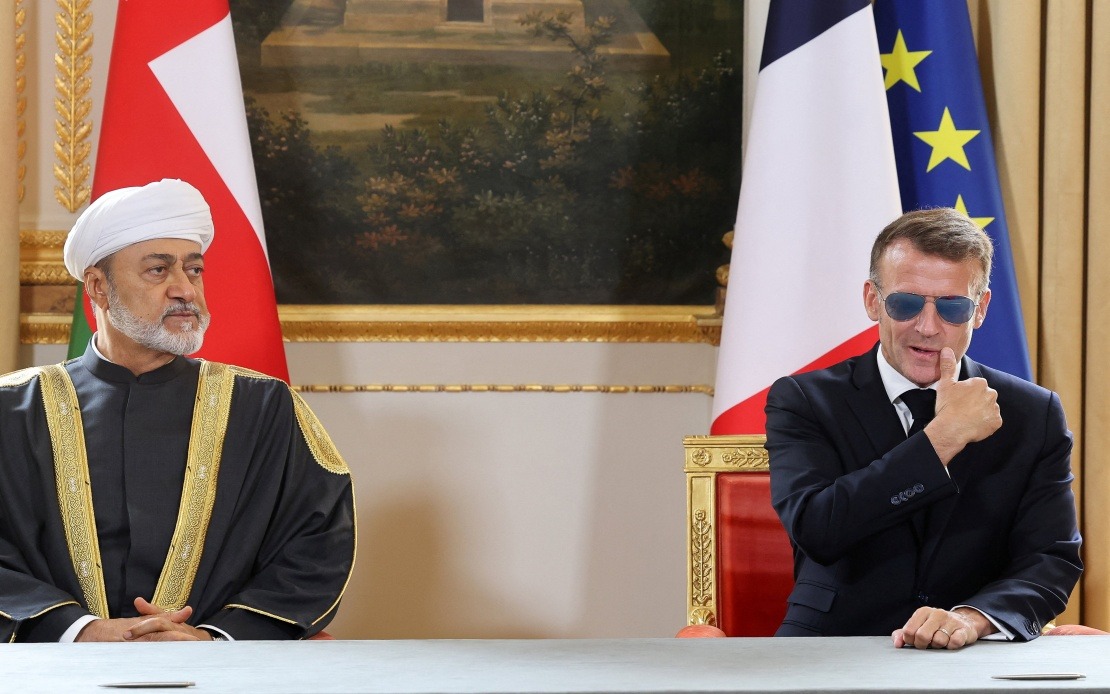
French President Emmanuel Macron donned his now-familiar aviator sunglasses during a diplomatic visit with the Sultan of Oman on Monday, reigniting discussion about the eyewear that has become unexpectedly central to his public image. The French leader wore the dark shades while receiving Sultan Haitham bin Tariq at the Élysée Palace in Paris and maintained them throughout their subsequent bilateral discussions, prompting fresh scrutiny from French media outlets and international observers tracking the president's sartorial choices.
According to sources in the French president's inner circle, the decision to wear sunglasses stemmed from a genuine medical concern rather than any fashion statement or diplomatic symbolism. Medical professionals had identified an inflammatory condition affecting Macron's eyes, necessitating protective eyewear to manage the discomfort and sensitivity. This explanation echoes earlier clarifications from his office, when officials attributed similar eyewear use in January to a minor eye inflammation that required roughly two weeks of protective measures.
The sunglasses in question belong to an aviator style that has become recognisable across continents following their prominent appearance at the World Economic Forum in Davos earlier in the year. During that high-profile gathering of global political and business leaders, Macron's choice of eyewear drew considerable international attention, with reactions ranging from bemused commentary to outright ridicule. United States President Donald Trump was among those who mocked the French leader's appearance, turning the sunglasses into an unlikely talking point among world powers convened to discuss pressing economic and geopolitical matters.
Within France, the sunglasses inspired a different strain of commentary and popular humour. Domestic observers noted a resemblance between Macron's appearance and the iconic look associated with Tom Cruise in his acclaimed film roles, particularly those featuring the actor in action sequences requiring dramatic sunglasses. This comparison circulated widely across French social media and in entertainment-focused commentary, transforming a medical device into a cultural reference point.
The commercial ramifications of Macron's eyewear choice have proven substantial and measurable. Henry Jullien, a prestigious French luxury eyewear manufacturer, reported a significant uptick in customer inquiries specifically requesting the model worn by the president. Rather than treating the attention as a fleeting curiosity, the company has strategically capitalised on the heightened visibility by incorporating photographs of Macron wearing the sunglasses into its promotional campaigns and marketing materials. This approach has transformed an inadvertent endorsement into a deliberate branding opportunity, with the presidential association providing a powerful marketing vehicle for the luxury accessories.
For Malaysian readers and Southeast Asian observers, the incident illustrates the peculiar intersection of diplomacy, media coverage, and contemporary political communication. In an era where every public appearance receives photographic documentation and instantaneous global distribution, even medical accommodations become subjects of international commentary and speculation. The tendency of world leaders to face intense scrutiny regarding their physical appearance reflects broader trends in how modern populations consume political news, with visual elements often commanding as much attention as substantive policy discussions.
The Oman meeting itself represents part of Macron's broader diplomatic engagement with Gulf and Middle Eastern states, a strategic priority for France's foreign policy. Sultan Haitham bin Tariq has sought to position Oman as a constructive mediator in regional conflicts and an important hub for international commerce. The bilateral discussions between France and Oman likely touched upon matters of mutual economic interest, security cooperation, and regional stability, though global media coverage remained disproportionately focused on the president's eyewear rather than the substantive diplomatic agenda.
The recurring nature of Macron's sunglasses usage across multiple months and diplomatic occasions underscores the genuine medical basis for the accessory rather than any calculated image strategy. Chronic or recurring eye conditions requiring ongoing management are relatively common among individuals in high-stress public positions, where environmental factors, extended periods under bright lighting, and intensive travel schedules can exacerbate ocular sensitivities. The transparency from French officials in addressing the health dimension of the eyewear choice, while subject to mockery, ultimately reflects an attempt to establish factual clarity in an era of frequent misinformation and speculation.
The incident also reveals how luxury brands benefit from unexpected celebrity exposure and presidential visibility, creating marketing opportunities that companies could never replicate through conventional advertising channels. Henry Jullien's strategic decision to lean into the Macron association rather than distance itself from the attention demonstrates sophisticated brand management in response to external circumstances beyond the company's control. The eyewear now carries dual significance: a functional medical tool and a luxury status symbol.

