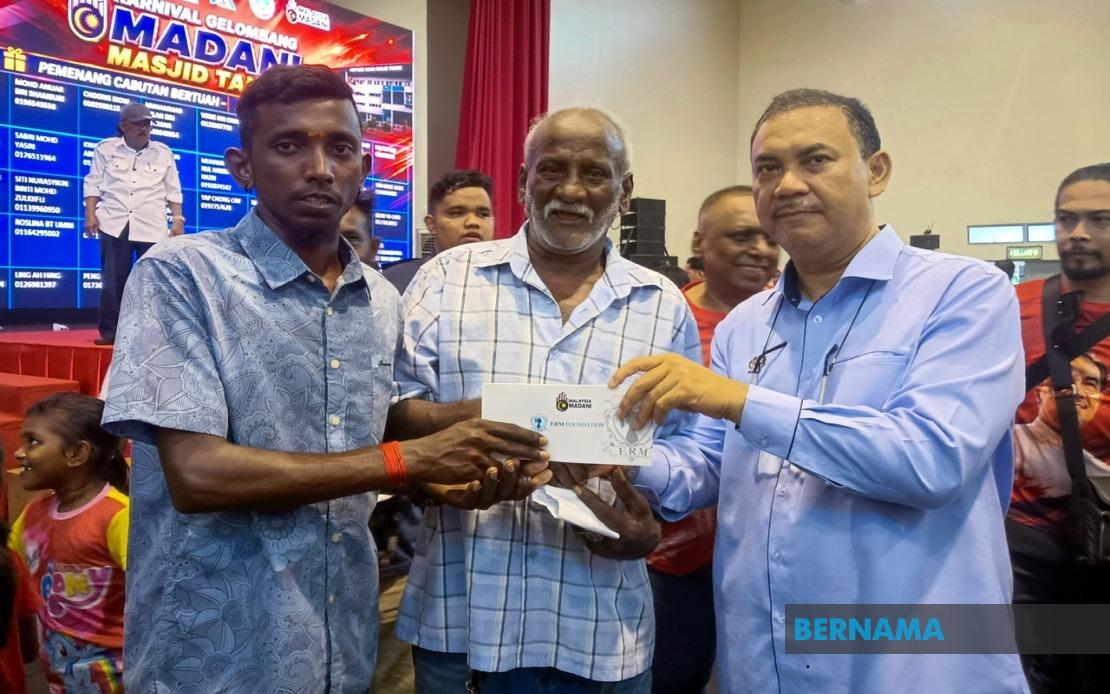
The government's Sentuhan MADANI Donation initiative reached 2,000 economically disadvantaged residents in the Masjid Tanah parliamentary constituency on Wednesday, delivering tangible relief through a RM200 cash grant to each recipient. The distribution occurred during the Gelombang MADANI Carnival at the Masjid Tanah Sports Complex in Alor Gajah, marking another phase of the administration's targeted welfare approach to assist vulnerable population segments.
Datak Azman Abidin, who serves as the Prime Minister's political secretary, oversaw the donation ceremony and explained the programme's structured approach to identifying beneficiaries. The initiative deliberately encompassed five state constituencies nested within the broader Masjid Tanah parliamentary district: Kuala Linggi, Lendu, Tanjung Bidara, Ayer Limau and Taboh Naning. This multi-constituency framework ensured geographical distribution of assistance and demonstrated systematic coordination across administrative boundaries to maximise outreach.
The selection criteria reflected a comprehensive understanding of poverty in Malaysia's landscape. Recipients included members of the B40 income group—the bottom 40 percent of earners by household income—alongside persons with disabilities and senior citizens, categories that often experience compounded financial vulnerability. The inclusion of low-income wage earners acknowledged that employment alone does not guarantee financial security for many Malaysian families, particularly those engaged in informal or precarious work sectors.
For many recipients, the RM200 grant represented meaningful immediate relief rather than aspirational funding. Ramlah Othman, a 63-year-old from Tanjung Bidara, articulated the practical significance of the assistance, emphasising how the contribution would reduce pressure on household budgets stretched thin by daily living costs. Her gratitude reflected a broader sentiment among beneficiaries who recognised the government's acknowledgment of their financial constraints and willingness to provide direct monetary support.
The programme's relevance extended particularly to senior citizens and persons with disabilities, demographics often marginalised in Malaysia's economically competitive landscape. N. Mariappan, a 69-year-old stroke patient from Ladang Sungai Baru, viewed the initiative as governmental recognition of the specific challenges faced by these groups. Beyond the tangible cash value, the donation symbolised institutional acknowledgment that disability and advanced age frequently complicate economic participation and that targeted intervention represents legitimate state responsibility.
The Gelombang MADANI Carnival itself functioned as more than a distribution mechanism; it created a public platform for demonstrating government commitment to welfare while building political capital through direct constituent engagement. Such events, combining celebratory atmosphere with material assistance, operate as visibility exercises that reinforce narratives of responsive governance whilst providing bureaucratic efficiency in reaching dispersed beneficiaries across multiple constituencies.
Malaysia's approach to poverty alleviation has evolved considerably, moving progressively toward direct cash transfers rather than relying exclusively on subsidies or indirect support mechanisms. The Sentuhan MADANI programme exemplifies this shift, recognising that direct monetary assistance grants recipients agency in determining their most pressing needs—whether addressing medical expenses, food security, transport costs, or debt servicing. This flexibility contrasts with earlier welfare models emphasising controlled distribution of specific goods or vouchers.
The scale of distribution—reaching 2,000 individuals simultaneously—necessitated substantial administrative coordination across multiple government agencies and constituencies. Successful execution at this scale required advance verification of eligibility, logistics planning for payment distribution, and crowd management at designated venues. Such operational capacity, whilst often unremarked in reporting, represents significant institutional investment in welfare delivery infrastructure.
From a regional perspective, Malaysia's targeted cash transfer approach aligns with broader Southeast Asian trends toward direct assistance programmes, reflecting evolving understanding that poverty requires multifaceted rather than monolithic responses. However, the sustainability and adequacy of such interventions remain subjects of ongoing policy debate, particularly regarding frequency of distribution and aggregate assistance levels relative to actual cost-of-living pressures.
The programme's geographical specificity to Masjid Tanah constituency, whilst serving genuine welfare objectives, occurred within a broader political calendar where parliamentary constituencies receive sustained governmental attention during election cycles. The timing and targeted nature of such assistance often correlates with electoral competition, suggesting that welfare distribution and political interest intersect, though this need not diminish the genuine benefits received by disadvantaged residents.
Looking forward, the effectiveness of such initiatives depends partly on complementary policy frameworks addressing structural causes of poverty rather than providing episodic relief. While the RM200 assistance meaningfully addresses immediate hardship, sustainable poverty reduction requires concurrent investments in education, healthcare, employment opportunity creation, and wage adequacy—elements typically requiring longer-term institutional commitment than carnival-based distribution events.
Recipient feedback highlighted psychological dimensions beyond monetary value. Many beneficiaries expressed gratitude not merely for cash received but for institutional recognition of their circumstances. This validation function—where government acknowledgment of hardship carries importance separate from financial amount—constitutes a significant yet often overlooked component of effective welfare programming.

