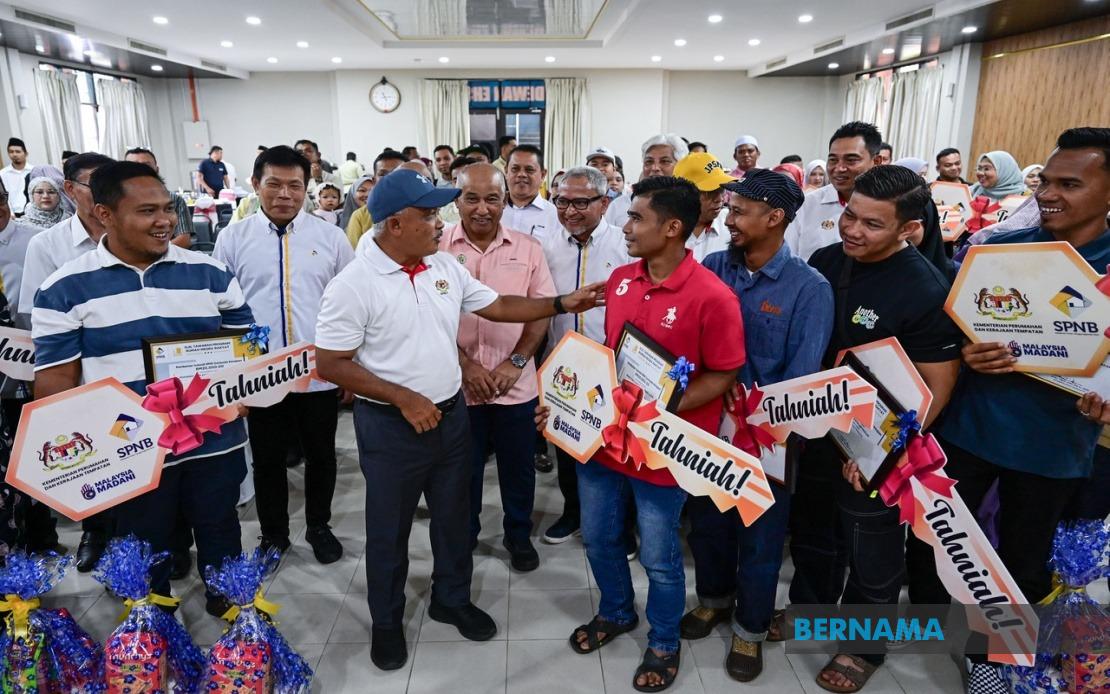
The MADANI Government marked another milestone in its affordable housing drive, distributing assistance to fifty families across two Terengganu parliamentary constituencies on June 28. The beneficiaries, residing in Kuala Terengganu and Kuala Nerus, received either completed homes or construction contracts under the Rumah Mesra Rakyat (RMR) programme, with thirty units handed over immediately and twenty more offered for new construction. The presentation ceremony took place at Dewan Ehsan in Felda Wilayah Timur, underscoring the government's focus on rural and semi-rural development corridors where housing shortages remain acute.
The RMR initiative, administered through Syarikat Perumahan Negara Berhad (SPNB) under the Housing and Local Government Ministry, targets a specific demographic often overlooked by conventional mortgage schemes: landowners from lower-income backgrounds who possess property but lack adequate shelter. By channelling resources toward this group, the programme addresses a genuine gap in Malaysia's housing ecosystem, where land ownership does not automatically translate into safe or dignified living conditions. Datuk Dr M. Noor Azman Taib, the ministry's secretary-general, framed the initiative beyond mere structure provision, emphasizing that home ownership serves as a springboard for broader quality-of-life improvements and community strengthening.
The scale of ambition embedded in Budget 2026 reflects government determination to expand the programme's reach. Planners aim to construct 6,545 RMR units across the nation, representing a significant acceleration from current implementation rates. As of the ministry's latest tally, 3,900 units have entered the pipeline: 2,478 have been fully completed and transferred to recipients, while 1,422 remain under construction. This two-to-one ratio of finished-to-pending units suggests construction capacity constraints, a challenge common across Malaysia's housing sector when scaling affordable programmes.
Terengganu's allocation demonstrates the programme's particular relevance to East Coast states where rural populations predominate. The state is implementing 680 RMR units backed by RM46.67 million in funding, making it a regional concentration point. By May, the state had completed and handed over 246 units, with another 154 advancing through construction phases. These figures indicate steady progress, though the five-month completion rate suggests the full rollout will extend over multiple years, requiring sustained political and budgetary commitment beyond typical electoral cycles.
Within Terengganu's distribution, the two parliamentary constituencies receiving June's assistance represent distinct contexts. Kuala Terengganu, the state capital and an urban-adjacent zone, has seen 34 RMR units materialise, with eighteen completed and sixteen under way. Kuala Nerus, further north and more rural in character, hosts 32 units: twenty-five finished and seven in progress. The parallel deployment suggests the programme adapts to local development patterns rather than applying uniform approaches, a flexibility that increases relevance for dispersed communities where standardised mass-housing models often fail.
Historical perspective underscores the RMR's accumulated impact. Since inception in 2002, the scheme has benefited more than 80,000 families nationwide, a figure representing genuine penetration into Malaysia's lower-income housing market. Over two decades, this translates to roughly 4,000 households annually—a modest pace relative to total national housing demand, yet meaningful for programme participants who otherwise would face decades of inadequate shelter. The longevity and consistency of RMR's operation, spanning multiple administrations and political transitions, suggests cross-party recognition of its legitimacy as social infrastructure.
For Malaysian policymakers, the RMR model offers insights into targeted affordability mechanisms. Rather than attempting wholesale subsidy of housing markets, the programme concentrates resources on landowners unable to access conventional financing or development pathways. This targeting reduces deadweight loss and focuses support where market failures are most pronounced. In Southeast Asian contexts where informal land tenure and limited credit access plague rural populations, the RMR's approach of working within existing property ownership provides a practical entry point.
The MADANI administration's emphasis on this programme reflects broader governance philosophy emphasising inclusive development and family stability. Housing conditions directly influence educational outcomes, health metrics, and economic productivity—dimensions that ripple across household lifecycles. By securing housing for lower-income families, the government positions itself as addressing root causes of inequality rather than merely managing symptoms. This framing resonates with urban-rural divides that have widened across Malaysia, particularly in states like Terengganu where resource extraction and commodity dependence have historically overshadowed diversified development.
Implementation challenges remain considerable. Scaling from current rates to 6,545 units demands sustained contractor capacity, ministerial focus amid competing priorities, and beneficiary identification mechanisms that effectively reach eligible populations without bureaucratic friction. Cost overruns, construction delays, and beneficiary satisfaction issues have periodically affected affordable housing programmes across Malaysia. Success requires not merely announcing targets but embedding accountability mechanisms and adaptability within administrative structures.
Looking forward, the RMR's trajectory will test government commitment to inclusive housing beyond rhetoric. Terengganu's experience, as a programme incubation zone, will likely inform scaling decisions for other states. Regional leaders will monitor whether the programme maintains momentum through inevitable political transitions and whether recipient communities report genuine quality-of-life improvements. For Southeast Asian observers, Malaysia's RMR offers a replicable model for government-supported affordable housing, particularly for landowners facing financing barriers in systems where informal credit and family networks dominate capital access.

