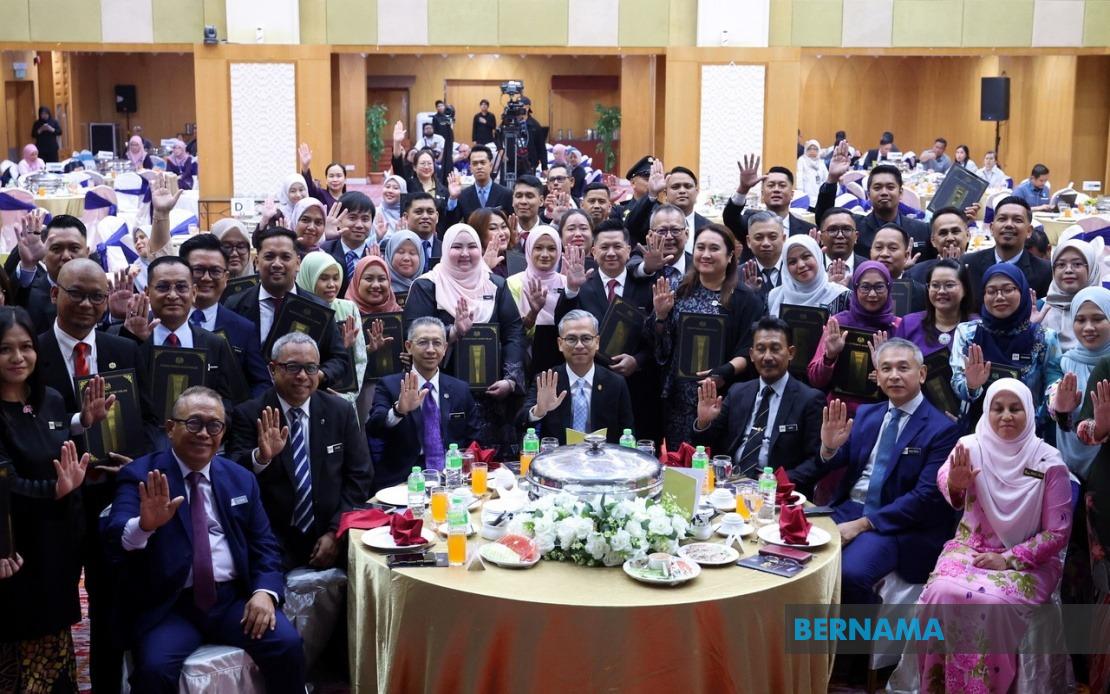
The MADANI government's economic agenda extends beyond impressive headline figures to encompass meaningful improvements in how ordinary Malaysians experience their daily lives, Communications Minister Datuk Seri Fahmi Fadzil said during an awards ceremony in Kota Kinabalu. Speaking at the Communications Ministry's Sabah and Labuan Zone Excellent Service Awards ceremony, Fahmi underscored that while national and state-level economic indicators demonstrate solid expansion across investment, government revenue, foreign reserves, gross domestic product and international trade, the true barometer of policy success remains whether citizens feel tangible benefits in their wallets and financial security.
Fahmi's remarks highlight a strategic pivot in how the government frames its economic narrative to regional and rural constituencies. Rather than focusing solely on macroeconomic metrics that dominate international business publications, the minister emphasised that the MADANI administration prioritises what he termed the "people's economy"—the lived economic reality experienced by individuals and families across the country. This framing acknowledges a critical gap that often exists between encouraging aggregate statistics and the actual purchasing power and cost-of-living pressures facing Malaysian households, particularly those in geographically challenging areas.
The minister cited the government's diesel subsidy retargeting programme, known as BUDI MADANI, as a concrete example of how national policies must account for regional complexities. In states like Sabah and Sarawak, residents frequently traverse considerable distances between districts, making transportation costs a substantial portion of household expenditure. The BUDI MADANI initiative demonstrates that Prime Minister Datuk Seri Anwar Ibrahim and his Cabinet recognise these geographical realities and are calibrating economic interventions accordingly. Such targeted approaches acknowledge that economic policy cannot be uniformly applied across Malaysia's diverse terrain and demographic profiles without accounting for local circumstances.
Fahmi stressed that demonstrating the connection between macroeconomic excellence and individual prosperity represents a crucial priority for the government going forward. The challenge facing the MADANI administration involves convincing Malaysians that national-level economic improvements—however impressive they appear in official statistics—genuinely translate into improved standards of living for average families. This communication challenge is particularly acute in a country where economic growth has not always filtered evenly across income groups and geographical regions, creating public scepticism about whether development benefits the majority or primarily concentrates among urban elites and investors.
The minister's emphasis on policy transparency reveals an implicit acknowledgment that economic messaging requires clarity to maintain public confidence. Fahmi highlighted that government ministries and agencies bear responsibility for comprehensively explaining policies and programmes to prevent public confusion or misinterpretation. This responsibility becomes especially critical when implementing complex measures like targeted subsidies, which necessarily create winners and losers, or redistribute benefits in ways that may not be immediately intuitive to affected populations. Poor communication around economic policy can generate resentment even when underlying policy design is sound, undermining public support for government initiatives.
Sabah and Sarawak represent particularly important constituencies for demonstrating the "people's economy" framework. Both states contain significant rural populations and face legitimate infrastructure and accessibility challenges that complicate the delivery of government services and economic benefits. The long distances between population centres increase transportation costs and limit market access for businesses and consumers alike. When the government highlights these regional realities in high-level policy discussions, it signals recognition that East Malaysian residents should not be afterthoughts in national economic planning but rather deserve policies explicitly designed around their specific circumstances.
The broader implications of Fahmi's statement extend to how the MADANI government distinguishes its economic approach from predecessors. By emphasising direct, tangible benefits for ordinary citizens rather than celebrating abstract economic indicators, the administration positions itself as focused on inclusive growth and equitable distribution of prosperity. This rhetorical stance carries weight in a Malaysian political context where voters increasingly demand to see concrete improvements in services, employment opportunities, and purchasing power rather than merely accepting assurances that aggregate economic data looks favourable.
The award ceremony itself, attended by senior Communications Ministry officials including Secretary-General Datuk Abdul Halim Hamzah and representatives from various government broadcasting and information agencies, underscores the administration's commitment to ensuring consistent messaging across the government apparatus. When communications-focused officials and agencies gather to celebrate excellence in public service delivery, the underlying message emphasises that how government communicates with citizens matters as much as the policies themselves. Effective communication can enhance policy impact; poor communication can sabotage well-intentioned initiatives.
Looking forward, the government's emphasis on connecting macroeconomic performance to household-level prosperity will likely shape how it frames upcoming budget allocations and policy announcements. Rather than leading with growth statistics, government communications will probably increasingly highlight concrete programmes—subsidy targeting, infrastructure development in rural areas, job creation initiatives—that demonstrably improve daily life for ordinary Malaysians. This approach represents a recognition that in an era of sustained political competition and voter sophistication, economic credibility depends on translating numbers into human outcomes that citizens can personally verify and experience.

