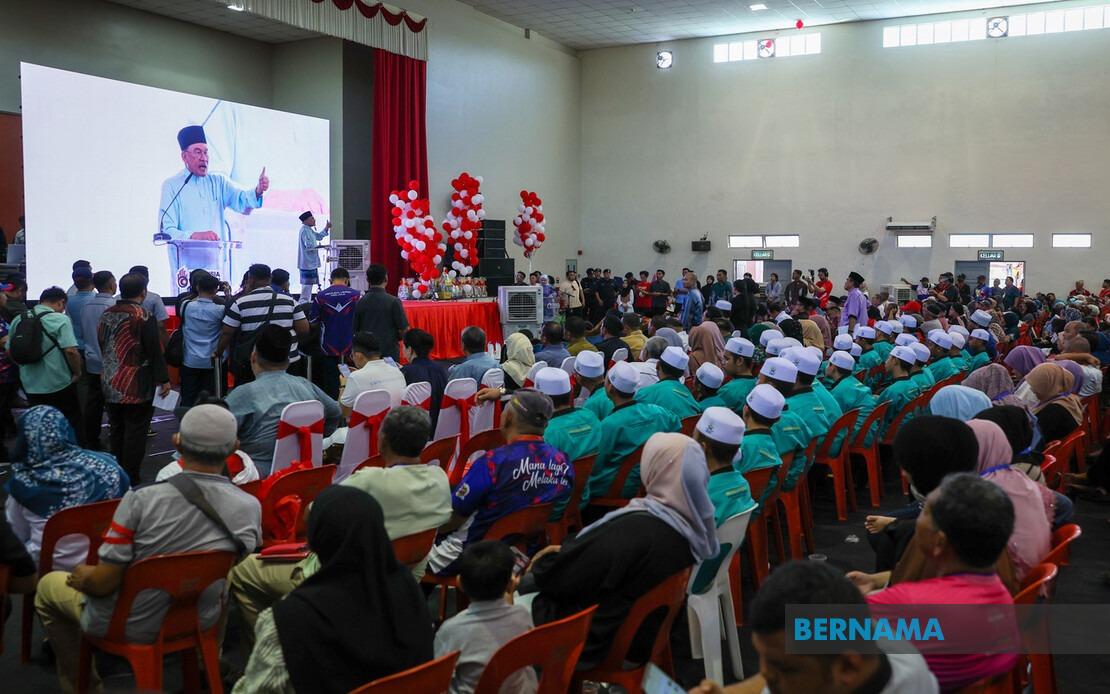
Prime Minister Datuk Seri Anwar Ibrahim has pledged that the MADANI Government will maintain equitable assistance across all educational streams in Malaysia, directly addressing concerns that recent increases in support for Islamic institutions might come at the expense of other school systems. Speaking at the Gelombang MADANI Carnival in Alor Gajah, Anwar emphasised that ensuring every community receives appropriate attention is fundamental to preserving the nation's peace and social cohesion in an increasingly diverse society.
The Prime Minister's remarks appear designed to quell perceptions of imbalance in education funding, a sensitive issue in Malaysia's plural society where communal tensions can quickly escalate over resource allocation. Anwar explicitly stated that previously approved allocations for Chinese and Tamil schools remain intact, with formal announcements expected within two weeks in Kuala Lumpur. This timeline suggests a carefully orchestrated approach to demonstrating that the government's educational priorities encompass all communities simultaneously rather than prioritising one group.
Anwar highlighted the historical context underpinning current funding decisions, noting that Islamic educational institutions, particularly pondok schools and tahfiz centres, had faced sustained neglect and received minimal government support prior to the Unity Government's formation in 2022. The Prime Minister explained that rectifying this disparity became a priority when he took office, with restoration of assistance beginning in 2023 and subsequent increases in 2024. This narrative frames enhanced Islamic education funding not as preferential treatment but as addressing a long-standing equity deficit within the broader education system.
The government's commitment extends beyond financial allocations to curriculum modernisation. Anwar announced plans to upgrade pondok schools and introduce artificial intelligence and computer training programmes, acknowledging that without such interventions, Islamic schools risked falling further behind better-resourced Chinese and Tamil institutions. This approach recognises that equal outcomes require differential investment, a principle that may resonate with economically disadvantaged communities whilst requiring careful explanation to avoid perceptions of unequal treatment elsewhere.
At the Masjid Tanah Sports Complex event, Anwar announced RM1.29 million in infrastructure upgrades distributed across thirteen Islamic educational institutions in Melaka, with individual grants ranging from RM100,000 to RM250,000. Beneficiaries included Madrasah Tahfiz Al-Quran Wal Qiraat Kota Melaka, which received the largest allocation, alongside several state-level Islamic schools operating under the Melaka Islamic Affairs Department. The strategic deployment of these funds across multiple institutions in a single state demonstrates the government's intention to show visible progress in Islamic education infrastructure throughout the country.
Anwar contextualised his education policy within broader philosophical frameworks rooted in Islamic principles. Drawing from Surah Al-Baqarah verse 143 regarding 'ummatan wasatan' or a balanced community, he articulated a vision where Muslims exemplify virtues including intellectual development, moral integrity, and harmonious relations with both fellow citizens and the environment. This theological framing elevates education policy beyond resource distribution, positioning it as integral to Malaysia's aspirational identity as a nation exemplifying peaceful pluralism to the world.
The Prime Minister's remarks concerning Malaysia's success as a plural society carried undertones of anxiety about emerging fractures in social cohesion. He specifically contrasted Malaysia's relative stability with other jurisdictions plagued by suspicion, hatred and distrust, suggesting implicit awareness that communities in Malaysia remain watchful for evidence of preferential treatment or systematic disadvantage. Anwar's assertion that people of different backgrounds coexist harmoniously whilst maintaining distinct institutions acknowledged that pluralism in Malaysia functions through parallel systems rather than complete integration, an arrangement requiring constant affirmation of mutual respect.
Anwar's appeal for Muslims to embody values of integrity, good conduct and environmental stewardship appeared directed at countering narratives associating Islamic governance with corruption or mismanagement. By positioning Muslims as exemplars of administrative competence and moral probity, he attempted to reframe debates about Islamic institution funding within broader questions about good governance and institutional excellence. This rhetorical strategy may prove important for maintaining public support for education policy allocations among diverse constituencies.
The presence of senior officials including Melaka Chief Minister Datuk Seri Ab Rauf Yusoh and Deputy Higher Education Minister Adam Adli Abdul Halim at the carnival underscored the government's emphasis on education funding as a priority worthy of high-level political attention. The attendance of Anwar's wife, Datuk Seri Dr Wan Azizah Wan Ismail, signalled family endorsement of the initiatives, a symbolic gesture in Malaysian political culture that can influence public perception of policy importance.
For Malaysian education stakeholders, Anwar's statements suggest the government intends to sustain simultaneous investment in multiple education streams whilst gradually closing historical funding gaps affecting Islamic institutions. However, the approach requires careful implementation to avoid perceptions that overall education budgets favour particular systems. The commitment to announce Chinese and Tamil school allocations within weeks indicates awareness that leaving ambiguity on this point risks undermining broader claims of equitable treatment.
The education policy positioning reflected in Anwar's remarks reveals underlying tensions within Malaysia's multicultural political settlement. Whilst the Prime Minister articulated commitments to all communities, the specificity with which he addressed Islamic education funding and the theological language he deployed suggested particular sensitivity to constituencies viewing religious education as historically marginalised. Successfully navigating these competing demands without exacerbating intercommunal suspicions remains central to the MADANI Government's consolidation of the Unity Government coalition.
From a Southeast Asian perspective, Malaysia's approach to balancing support for religious, vernacular and mainstream education systems offers instructive lessons for other plural societies managing education policy within contexts of competing communal identities. The MADANI Government's attempt to frame simultaneous investment across diverse educational streams as complementary rather than competitive reflects sophisticated understanding of how education funding becomes entangled with questions of group recognition and social status in diverse democracies.

