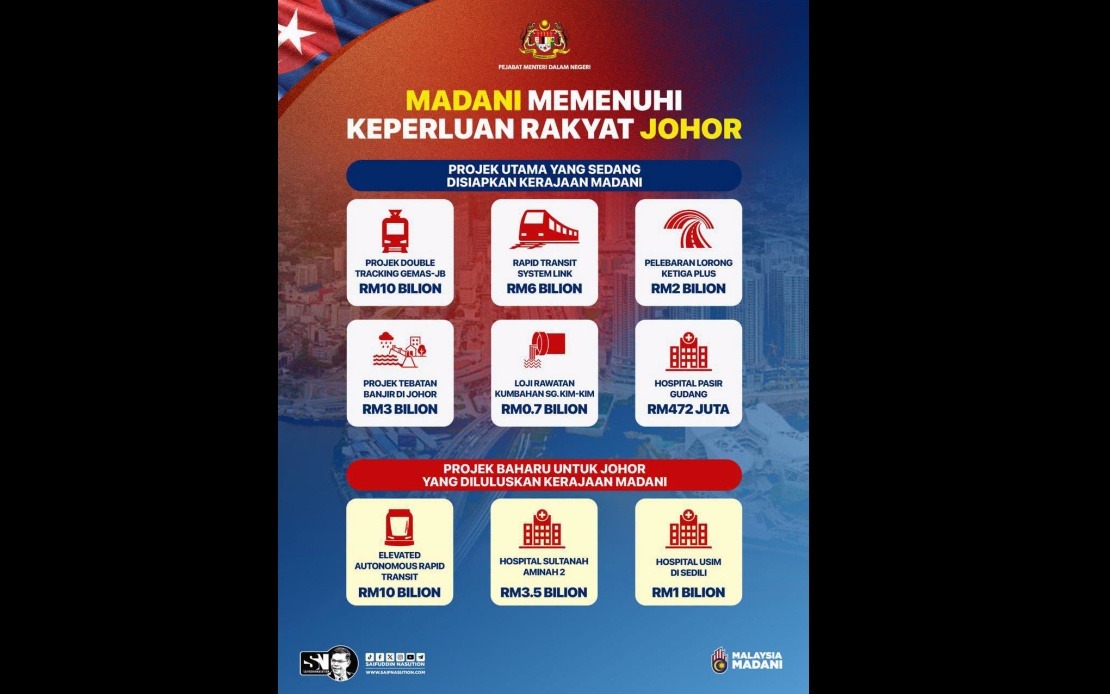
The MADANI Government has reinforced its commitment to delivering balanced and inclusive development across Malaysia's states, with Johor identified as a key focus area for transformative growth. Datuk Seri Saifuddin Nasution Ismail, Pakatan Harapan secretary-general and Home Minister, articulated this pledge during a visit to Johor Bahru on June 29, emphasising that the administration under Prime Minister Datuk Seri Anwar Ibrahim remains focused on improving living standards for all Malaysians through strategically directed investments and large-scale projects.
The government's developmental framework rests on four pillars that have become defining features of its policy agenda: infrastructure modernisation, enhanced public transportation networks, healthcare expansion, and climate resilience through flood mitigation. These investments represent a deliberate shift towards addressing systemic challenges that have constrained quality of life across both urban and rural communities. By concentrating resources in these domains, policymakers aim to create multiplier effects that extend beyond simple infrastructure provision to generate economic opportunities and social stability across participating regions.
Johor's development trajectory has gained significant momentum through the execution of several flagship projects that reshape regional connectivity and services. The Gemas-Johor Bahru Electrified Double Tracking Project stands as a cornerstone initiative, addressing long-standing railway capacity constraints that have limited freight and passenger movement between the peninsula's interior and southern regions. Simultaneously, the Rapid Transit System (RTS) Link promises to revolutionise intra-state mobility, particularly benefiting the Iskandar region and Greater Johor Bahru through seamless cross-border commuting capabilities.
Road infrastructure enhancements form another critical component of the state's expansion strategy. The third lane widening of the PLUS Highway addresses congestion pressures that have intensified as economic activity concentrates along this vital economic corridor. For Malaysian commuters and businesses, improved highway capacity directly translates into reduced travel times, lower logistics costs, and enhanced commercial competitiveness—factors particularly significant for companies operating within Johor's manufacturing and port sectors that supply markets throughout Southeast Asia.
Water security and environmental management have emerged as increasingly pressing concerns across Malaysia, with Johor's vulnerability to seasonal flooding making mitigation infrastructure essential. The government's Johor flood mitigation project represents a long-overdue investment in community protection, while the Sungai Kim Kim Sewage Treatment Plant addresses water quality degradation that has affected both residential areas and industrial zones. These initiatives reflect recognition that sustainable development requires environmental stewardship alongside economic growth, a principle gaining traction across the region as climate impacts intensify.
Healthcare capacity expansion represents another strategic investment area, with multiple hospital projects demonstrating commitment to medical accessibility. The Pasir Gudang Hospital currently serves growing populations in the district's industrial and residential communities, whilst newly approved facilities—Sultanah Aminah Hospital 2 and USIM Hospital in Sedili—signal expansion into previously underserved areas. For a state with Johor's demographic growth trajectory and industrial workforce, adequate healthcare infrastructure prevents bottlenecks that could otherwise discourage investment and talent attraction.
The Elevated Autonomous Rapid Transit (E-ART) system represents an innovative urban mobility solution that positions Johor at the forefront of transportation technology adoption within Malaysia. This elevated autonomous system could establish efficiency benchmarks for other Malaysian cities while generating valuable operational data for future national applications. Such pioneering projects enhance Johor's appeal to technology-focused investors and skilled workers seeking modern urban amenities.
Saifuddin Nasution's articulation that development encompasses more than numerical investment figures reflects a shift in developmental discourse away from GDP-centric metrics toward human-centred outcomes. Employment generation, transportation efficiency, healthcare accessibility, and quality-of-life improvements constitute the actual measures through which citizens experience government commitments. This framing acknowledges that infrastructure alone—however impressive in scale—succeeds only when it translates into tangible daily improvements for ordinary Malaysians and residents of Johor across income levels.
For Malaysia's broader regional standing within Southeast Asia, Johor's development trajectory carries significance beyond state boundaries. As the peninsula's southern gateway and Malaysia's primary land link to Singapore, Johor's infrastructure modernisation affects regional trade corridors, logistics networks, and cross-border economic integration. Enhanced transportation networks and capacity improvements in Johor facilitate smoother goods movement throughout ASEAN supply chains, benefiting Malaysian exporters competing in regional markets.
The concentration of major projects within Johor reflects not merely regional favoritism but strategic investment in critical economic corridors. The state hosts Malaysia's busiest port in Port Klang's vicinity, significant manufacturing clusters, and emerging smart city developments through Iskandar Malaysia. By strengthening foundational infrastructure, the government addresses bottlenecks that constrain broader national economic performance. This logic justifies intensive investment in high-impact states where returns extend throughout interconnected regional economies.
Implementation challenges remain significant despite ambitious project portfolios. Construction delays, cost overruns, and coordination complexities between federal and state authorities could constrain delivery timelines. Additionally, ensuring that development benefits reach lower-income communities rather than concentrating advantages among already-advantaged populations requires deliberate policy design and monitoring mechanisms. Malaysian and regional observers will scrutinise whether MADANI's inclusive development rhetoric translates into equitable outcomes across Johor's socioeconomic strata.

