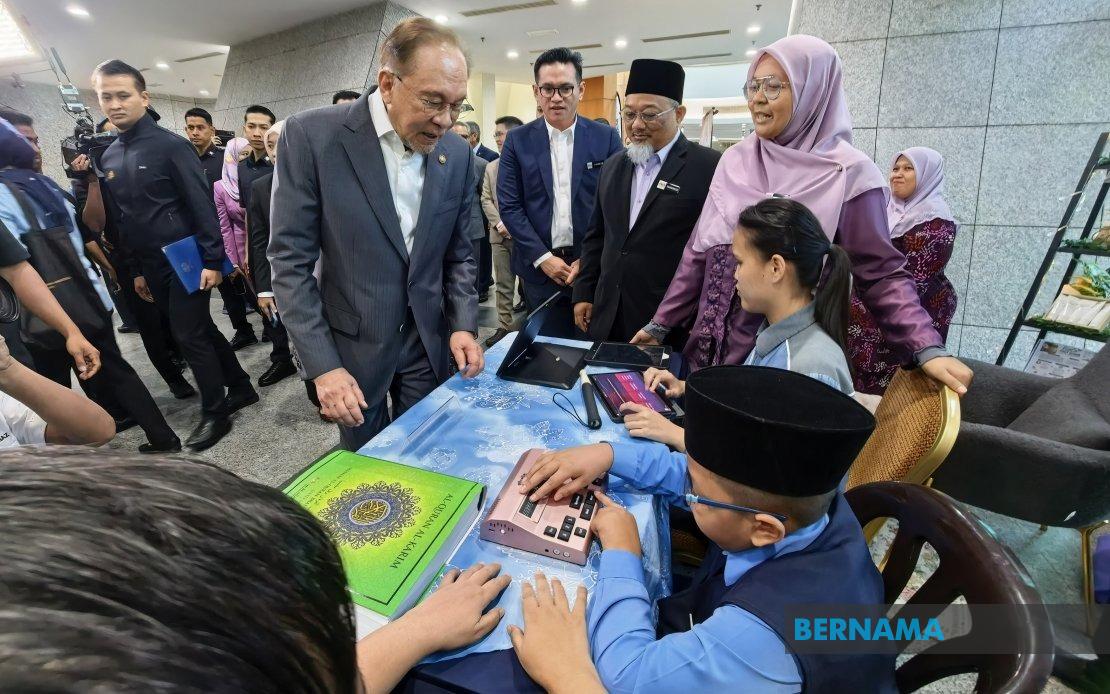
Prime Minister Datuk Seri Anwar Ibrahim has underscored the MADANI Government's unwavering commitment to placing teachers at the centre of the country's development agenda. Speaking at a gathering with Ministry of Education staff in Putrajaya on July 28, Anwar stressed that educator welfare and education system strengthening remain foundational pillars for Malaysia's future progress. The remarks come as the government pursues an ambitious reform programme that encompasses salary enhancements, expanded career opportunities, and structural improvements to teaching as a profession.
Since assuming office, the administration has deliberately positioned the education sector as a leading priority within its broader governance framework. This commitment translates into concrete measures across multiple dimensions: enhancing remuneration packages for teachers, creating clearer pathways for professional advancement, and addressing longstanding grievances that have prompted educators to seek alternative career trajectories. Anwar highlighted that the government recognises teaching should offer recognition and advancement without requiring teachers to abandon classroom work for administrative roles—a structural problem that has traditionally limited career options within the profession.
The Prime Minister articulated a strategic vision connecting education quality directly to Malaysia's broader economic aspirations. He emphasised that realising the nation's goals in economic growth, artificial intelligence integration, and technological leadership depends fundamentally on educators who possess the expertise and motivation to prepare successive generations for increasingly complex challenges. This framing positions teacher development not as a peripheral social policy concern but as an economic and strategic imperative central to competitive advantage in the twenty-first century.
An significant point of emphasis was Malaysia's budgetary allocation to education. Anwar cited UNESCO data indicating that Malaysia dedicates the highest proportion of its national budget to the education sector compared with other countries—a distinction that reflects both the government's stated priorities and a comparative advantage in resource commitment. However, this statistical claim warrants contextual understanding: while proportional allocation may be notable, absolute spending levels and per-student investment require separate assessment, particularly given Malaysia's diverse regional development needs.
The government's reform initiatives extend beyond teacher compensation to encompass substantive curriculum and pedagogical transformation. Strengthening Science, Technology, Engineering and Mathematics education alongside integrating artificial intelligence into educational delivery represents a forward-looking agenda. Anwar explicitly acknowledged that such ambitious reforms cannot succeed without teacher buy-in and active participation. Educators function not merely as implementers of centrally designed curricula but as essential agents in translating policy objectives into classroom reality—a recognition that distinguishes the rhetoric of teacher empowerment from superficial acknowledgment.
Attendance at the gathering by senior officials—including Education Minister Fadhlina Sidek, Chief Secretary to the Government Tan Sri Shamsul Azri Abu Bakar, Public Service Director-General Tan Sri Wan Ahmad Dahlan Abdul Aziz, and MOE Secretary-General Datuk Wan Hashim Wan Rahim—signalled institutional commitment across multiple governmental levels. Such high-level participation underscores that education policy operates within a broader whole-of-government framework rather than remaining isolated within the education ministry's remit.
Anwar's appeal to public recognition of educator contributions reflects an often-overlooked dimension of teacher morale and social standing. He articulated the asymmetry whereby individual failures within education systems generate immediate media and public scrutiny, yet systematic success in guiding millions of students receives minimal acknowledgment. This observation addresses a fundamental challenge in education policy: generating sustained public and political support for teacher investment requires reframing how societies recognise and value educational outcomes. The perception gap between public criticism and genuine appreciation can undermine educator motivation independent of compensation levels.
The emphasis on sustained budgetary support carries particular significance in Malaysian governance contexts where education funding fluctuates with broader fiscal conditions and competing priorities. Anwar's explicit commitment to maintaining education investment through annual budgeting processes provides some assurance regarding consistency, though macroeconomic pressures and alternative claims on resources will inevitably test such commitments. For Malaysian educators and education stakeholders, such statements establish benchmarks against which future budget allocations can be assessed.
Implications for regional education systems merit consideration. As Malaysia repositions itself within Southeast Asia's education landscape, teacher quality and motivation directly affect competitiveness and comparative performance. Countries across the region compete for talent and investment based partly on education system quality, which depends substantially on educator quality and commitment. The MADANI Government's signals regarding teacher prioritisation potentially influence regional perceptions of Malaysia's education trajectory and institutional capacity.
The government's reform agenda intersects with global trends in education transformation. Artificial intelligence integration, STEM emphasis, and modernisation of curricula reflect internationally recognised priorities. However, successful implementation hinges critically on educator capacity, training opportunities, and genuine involvement in pedagogical design. Teachers who feel valued and supported prove more likely to embrace change initiatives rather than resist or implement them mechanically without genuine engagement.
Moving forward, the substantive test of MADANI Government commitment to education and educator welfare will manifest in budget allocations, implementation of announced reforms, and tangible improvements in teacher compensation and working conditions. Policy rhetoric, while important for establishing direction and priorities, requires institutional follow-through and resource commitment to generate meaningful change. For Malaysian educators, civil society observers, and citizens invested in education quality, monitoring whether announced priorities translate into budgetary reality and practical implementation will remain essential.

