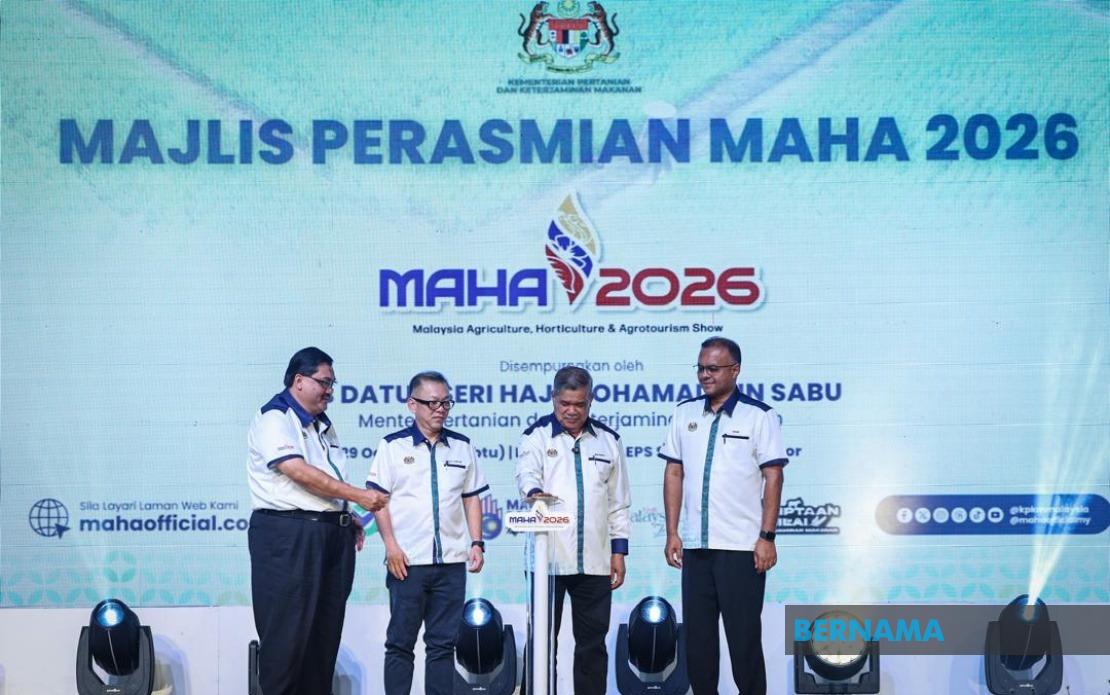
The Malaysia Agriculture, Horticulture and Agrotourism Show (MAHA) 2026, which opened its doors at the Malaysia Agro Exposition Park Serdang (MAEPS) on August 28, represents a watershed moment for the nation's farming sector, according to Agriculture and Food Security Minister Datuk Seri Mohamad Sabu. Speaking at the inaugural ceremony, he positioned the nine-day event not merely as an annual trade showcase but as a deliberate turning point where Malaysia commits itself to embedding sustainability throughout its agricultural value chain—from production through to consumer markets.
Mohamad framed environmental responsibility as central to the industry's future viability. By adopting sustainable agricultural practices, he argued, Malaysia can simultaneously tackle two critical challenges: reducing its carbon emissions to contribute meaningfully to global climate goals, and mitigating the local impacts of climate volatility that increasingly threaten yields and farm incomes. The minister underscored that these practices extend beyond abstract environmental stewardship; they constitute practical strategies for positioning Malaysian agricultural products competitively in both domestic and international markets, where sustainability credentials increasingly influence purchasing decisions among consumers and bulk buyers alike.
The concrete manifestations of sustainability on display throughout MAHA 2026 span the full operational spectrum. Exhibitors and participating farms are showcasing innovations in renewable energy adoption, systematised management of agricultural waste to minimise environmental leakage, careful reduction of single-use plastics in packaging and operations, regenerative soil management techniques that rebuild rather than deplete natural fertility, and circular economy principles through enhanced recycling initiatives. This comprehensive approach signals that the ministry views sustainability not as a niche concern but as an organising principle reshaping how Malaysian agriculture conducts business.
Underpinning this shift is an explicit revival of Malaysia's foundational approach to food security. Mohamad invoked the Green Book Policy, established in 1974 by former Prime Minister Tun Abdul Razak, which sought to wean Malaysia off excessive food import dependence and cushion households against international commodity price shocks by boosting domestic production. Decades later, that rationale remains urgent. The cost of living crisis affecting Malaysian households has renewed focus on how much the nation relies on foreign suppliers for basic foodstuffs—a vulnerability exposed repeatedly during global supply disruptions. By resurrecting and modernising that policy framework through MAHA 2026, the ministry is articulating a vision in which food security and economic resilience move forward together.
To realise this vision, the government has outlined a multi-pronged sectoral strategy. The fisheries and livestock industries, which form the protein backbone of Malaysia's food system, are earmarked for systematic modernisation. This encompasses upgrading the fishing fleet with contemporary vessels that operate with greater fuel efficiency and catch sustainability, transitioning traditional farms toward technology-enabled operations, developing high-value aquaculture segments that generate employment and export revenue, integrating mechanisation and data analytics into animal feed production, and fortifying biosecurity frameworks to prevent livestock disease outbreaks that can devastate production and incomes across entire communities. These measures acknowledge that food security is ultimately built on competitive, profitable enterprises capable of scaling to meet growing national demand.
The international dimension of MAHA 2026 reveals the ministry's ambition to embed Malaysian agriculture within regional and global trade networks. Delegations from fourteen countries are attending the event, transforming it into a working venue for forging agricultural cooperation frameworks. However, Mohamad's emphasis on translating memoranda of understanding into concrete outcomes rather than allowing them to languish as ceremonial signatures points to a deeper frustration: the gap between bilateral agreements and actual commercial collaboration. He explicitly called for partnerships to generate tangible results—expanding export sales channels for Malaysian producers, creating investment opportunities for agricultural entrepreneurs and technology start-ups to attract funding from both domestic and foreign sources, and building the institutional relationships necessary to move from handshakes to sustained business relationships.
For Malaysian agribusiness stakeholders, particularly the cohort of emerging entrepreneurs and innovation-focused agricultural technology firms, MAHA 2026 functions as both marketplace and investment showcase. The attendance of capital providers alongside buyers creates rare opportunities to simultaneously demonstrate operational capability and secure funding. This convergence reflects recognition that Malaysia's agricultural future depends not merely on inherited practices but on entrepreneurial renewal—younger operators applying digital tools, precision farming techniques, and novel value-added processing to traditional crops and emerging niches.
The scale of MAHA 2026 itself underscores the sector's economic footprint. Approximately two thousand exhibitors have registered, and organisers are targeting more than four million visitors over the nine-day run from August 28 to September 6. Such numbers reflect participation from across the agricultural ecosystem: farmers, equipment manufacturers, input suppliers, processors, exporters, technology providers, government agencies, and international participants. This diversity transforms the event beyond a product showcase into an arena where the sector's trajectory is collectively debated and reshaped.
For regional observers and policymakers across Southeast Asia, Malaysia's repositioning around sustainable agriculture carries broader significance. As a middle-income nation with substantial agricultural heritage but facing intense pressure to urbanise and industrialise, Malaysia's strategic choices on how to integrate sustainability into farming influence regional perceptions of whether environmental responsibility and agricultural competitiveness can coexist. If MAHA 2026 catalyses genuine transformation—if the showcased innovations translate into widespread adoption, the international collaborations spawn lasting trade relationships, and the focus on food self-sufficiency yields measurable improvements in domestic production—then Malaysia positions itself as a model. Conversely, if the event devolves into ceremonial pageantry without driving sectoral change, it signals regional scepticism about whether agriculture can evolve fast enough to meet climate and food security imperatives simultaneously.
Deputy Minister Datuk Chan Foong Hin and the ministry's Secretary-General Datuk Seri Isham Ishak's attendance at the opening ceremony underscored institutional commitment across administrative levels. Yet translating ministerial rhetoric into farmer adoption and corporate investment remains the enduring challenge. The policies articulated at MAHA 2026—whether centred on modernising production infrastructure, attracting investment, or deepening international partnerships—will ultimately succeed or fail based on implementation fidelity and the willingness of market actors to embrace change. The show itself is merely the conversation starter; the real work of transformation unfolds across Malaysia's farms, fisheries, processing facilities, and export terminals in the months and years ahead.

