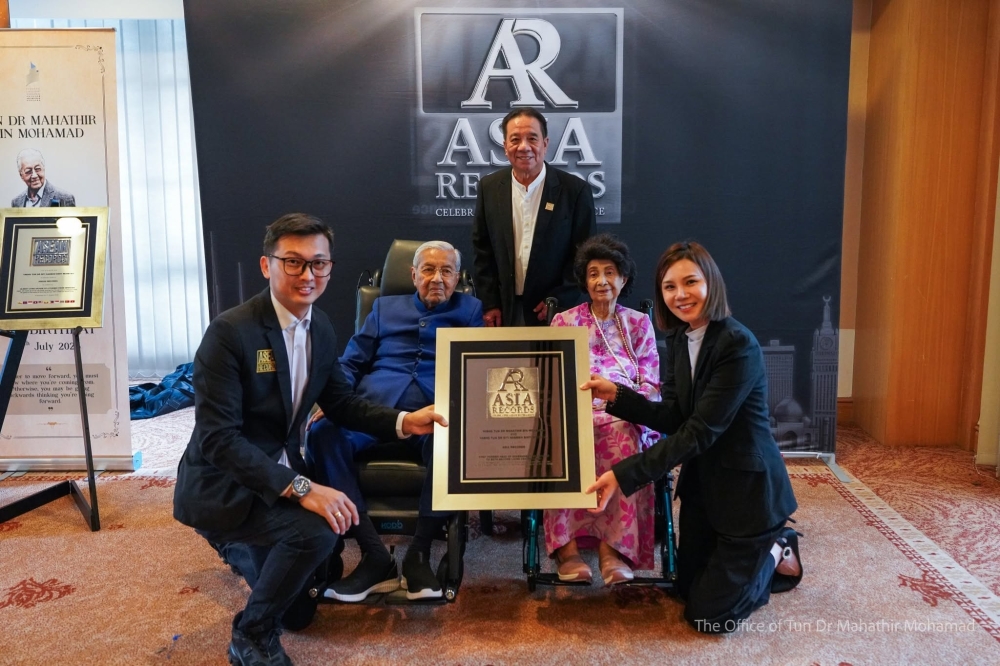
Tun Dr Mahathir Mohamad and Tun Dr Siti Hasmah Mohd Ali have entered the exclusive club of centenarians while simultaneously etching their names into the Guinness World Records, a rare achievement that reflects both their remarkable longevity and their enduring impact on Malaysian public life. The couple's milestone birthdays have drawn widespread recognition, with the official record-keeping body acknowledging their extraordinary contributions and sustained presence on the national and international stage over nearly a century of combined experience.
The three Guinness World Records awarded to the former Prime Minister and his wife underscore the significance of their respective journeys and their partnership across decades of Malaysian history. While the specific categories for these records reflect different dimensions of their lives, they collectively represent recognition of achievement, service, and resilience that extends far beyond the typical scope of such acknowledgements. This recognition places them among an exceptionally small group of individuals worldwide whose lives have been deemed sufficiently noteworthy to warrant multiple simultaneous record designations.
Dr Mahathir's career as Malaysia's longest-serving Prime Minister from 1981 to 2003, during which he oversaw the nation's transformation into an industrial power and initiated major infrastructure projects, forms the foundation of his historical significance. His return to office as Prime Minister from 2018 to 2020 proved equally consequential, demonstrating a continued political relevance and capacity to influence national affairs even as he entered his tenth decade. These chapters of his political life, spanning multiple generations of Malaysian governance, likely contribute substantially to the recognition he has received.
Tun Dr Siti Hasmah's distinct legacy encompasses her work in the medical field and her influential role as a First Lady during critical periods of Malaysia's development. Her intellectual contributions and advocacy have positioned her as a figure of substance in her own right, rather than merely as a supportive spouse. Her progression through the century reflects her own resilience, intellectual engagement, and commitment to public service, qualities that have earned her separate recognition and respect across Malaysian society.
The attainment of centenarian status itself carries cultural and symbolic weight in Malaysia, a nation where such longevity remains relatively uncommon among public figures. Both individuals represent an older generation that witnessed Malaysia's independence, the early formation of the nation-state, and its gradual ascent on the global stage. Their survival into the twenty-first century, remaining cognitively engaged and occasionally active in public discourse, defies common expectations about age and capability.
For Malaysian readers, the records represent more than mere trivia. They reflect the possibility of sustained engagement and relevance across an extended lifetime, challenging assumptions about retirement and obsolescence that characterise many societies. Both individuals have demonstrated that advancing age need not necessitate withdrawal from public conversation or loss of influence, a perspective that carries implications for how Malaysians conceptualise ageing and the role of elder statesmen in national dialogue.
The Guinness World Records recognition also situates Malaysia within a global context of notable longevity. International record-keeping bodies receive submissions from across the world, making any official acknowledgement a marker of global significance. The fact that Malaysian citizens have achieved multiple records simultaneously elevates the nation's profile in discussions of health, longevity, and the conditions that enable individuals to thrive across extended lifespans. This international dimension adds prestige to the national achievement.
From a biographical standpoint, the couple's journey together spanning more than half a century of marriage represents a partnership that has weathered significant political and social turbulence. Their relationship, publicly visible throughout Malaysia's major political transitions, has endured through periods of intense scrutiny and dramatic change. The mutual attainment of centenarian status suggests shared exposure to factors—whether lifestyle, genetics, medical care, or psychological resilience—that have enabled both to reach this advanced age.
The records also prompt reflection on the broader context of ageing populations across Southeast Asia. Malaysia, like its regional neighbours, faces demographic transitions that will result in increasing numbers of elderly citizens requiring diverse forms of support and engagement. The recognition of Dr Mahathir and Dr Siti Hasmah as record-holders may catalyse conversations about how societies accommodate, value, and utilise the contributions of centenarians and other elderly citizens, transforming potential challenges into opportunities for intergenerational dialogue.
Looking forward, the couple's achievement establishes a new reference point for Malaysian longevity and public visibility across extended lifespans. Subsequent generations will likely reference their milestone as a benchmark, and their continued presence—or eventual passing—will be marked as significant moments in national history. The Guinness World Records recognition ensures that their achievement receives permanent documentation, accessible to future researchers, historians, and the general public seeking to understand Malaysia's recent past through the lens of those who shaped it.

