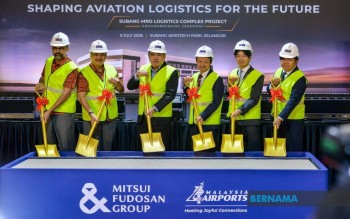
Malaysia Airports Holdings Bhd and Japanese property giant Mitsui Fudosan have launched a joint venture to construct an RM80 million air cargo logistics complex at Subang Airport, marking a significant expansion of cargo handling infrastructure in the Klang Valley region. The partnership sees MAHB retain a 30 per cent equity stake while Mitsui Fudosan assumes the larger 70 per cent interest, with development undertaken through their joint entity MFMA Industrial Sdn Bhd. The groundbreaking ceremony took place on Thursday at the site within Subang Aerotech Park, signalling the formal commencement of what Transport Minister Anthony Loke Siew Fook described as a strategically vital project for Malaysia's aviation sector.
The collaborative arrangement reflects MAHB's broader strategic pivot toward monetising its extensive airport real estate portfolio by engaging international partners with proven track records in logistics development and operations. Rather than undertaking such projects independently, the airport operator has opted to marry its land assets and operational airport access with the technical expertise and development capacity of established international players. This model reduces capital deployment while bringing specialized knowledge that Malaysian airports have historically lacked in air cargo facility management. The minister indicated that this risk-mitigation approach would benefit Malaysia Airports by introducing international best practices and reducing implementation risks inherent in new facility development.
Mitsui Fudosan's credentials in airport logistics are substantial and directly relevant to the Subang project. The Tokyo-based real estate conglomerate has developed and currently operates logistics complexes adjacent to Haneda Airport, one of Asia's busiest aviation hubs. Those facilities handle the sophisticated cargo operations demanded by modern air freight, including temperature-controlled environments, hazmat handling, and customs integration. The Haneda experience provides a proven operational model that can be adapted for Malaysian conditions and regulatory requirements. By importing these international standards and operational protocols, the Subang facility will be positioned to attract regional and international air cargo operators seeking premium facilities.
The facility's location within Subang Aerotech Park places it strategically within Malaysia's established aviation ecosystem. Subang Airport, though superseded by Kuala Lumpur International Airport as the primary international hub, remains a critical secondary airport serving regional passenger traffic and general aviation. The aerotech park itself has developed into a cluster for aviation maintenance, repair and overhaul services, aircraft engineering, and aerospace manufacturing. The new cargo complex will complement this existing industrial ecosystem, creating synergies between maintenance operations, aerospace manufacturing, and air freight logistics. Operators in the park can utilise the same cargo infrastructure, reducing operational fragmentation and creating efficiency gains.
The project's timing aligns with broader trends in Southeast Asian supply chain regionalisation. As manufacturing and assembly operations distribute across the region, air cargo capacity has become increasingly critical for time-sensitive goods, high-value components, and just-in-time manufacturing support. Malaysia's geographic position as a regional logistics hub, combined with its established FTA networks and container port infrastructure, positions it to capture growing air cargo volumes. The Subang facility will add critical capacity to Malaysia's air cargo ecosystem, which has been constrained by limited dedicated facilities outside KLIA's cargo operations.
The RM80 million investment represents a measured entry into what appears to be a phased development approach. The sum, while substantial, suggests an initial phase facility that could be expanded as market demand materialises. This staged investment approach reflects realistic expectations about cargo facility demand growth and allows for incremental capacity deployment aligned with actual market uptake. Should the facility perform successfully, the partnership framework provides a foundation for subsequent phases or related logistics infrastructure investments elsewhere within MAHB's airport portfolio.
Mitsui Fudosan's presence in Malaysia through this venture extends the Japanese conglomerate's footprint in Southeast Asia's logistics and real estate sectors. The company has been progressively expanding its regional presence as Japanese companies seek to diversify investment exposure beyond China and strengthen supply chain resilience through manufacturing and logistics network dispersion. This Malaysian investment reflects confidence in the country's position within broader regional supply chain reconfiguration, despite macroeconomic uncertainties affecting the sector.
Transport Minister Loke's emphasis on risk minimisation through partnership speaks to administrative pragmatism within Malaysia's airport development strategy. Large-scale infrastructure projects face significant execution risks, particularly when they involve emerging sectors like dedicated air cargo facilities. International partnerships allow public agencies to access expertise and assume financial discipline without bearing full capital risk. However, such arrangements also require robust governance frameworks to protect public interests and ensure that MAHB's strategic objectives—particularly regarding capacity expansion and revenue generation—remain aligned with the private partner's commercial imperatives.
The complex's development arrives at a moment when Malaysia's aviation sector faces headwinds from regional competition and changing travel patterns. Domestic air traffic has shifted toward low-cost carriers operating from secondary airports, whilst international connectivity remains concentrated at KLIA. Secondary facilities like Subang must therefore identify niche market segments where they can compete effectively. Air cargo logistics represents precisely such a niche—it requires proximity to industrial centres, sophisticated infrastructure, and integration with ground logistics networks. Subang's location northwest of Kuala Lumpur places it advantageously relative to the Klang Valley's manufacturing concentrations.
The project's success will depend significantly on its ability to attract anchor tenants and establish reliable, cost-competitive operations. Mitsui Fudosan's international marketing capacity and existing relationships with major air freight operators should facilitate tenant acquisition. However, Malaysian operators must compete with established cargo hubs in Singapore, Hong Kong, and Bangkok that offer scale advantages and entrenched market relationships. The facility's competitive positioning will therefore hinge on delivering superior service quality, operational efficiency, and integrated supply chain solutions rather than competing on price alone.
Looking forward, the Subang air cargo complex represents a template that MAHB could apply across its portfolio of secondary and regional airports. Should this venture succeed, it may catalyse broader airport infrastructure development within Malaysia, particularly at facilities with existing industrial clusters or strategic geographic advantages. The partnership model itself—where MAHB provides land and airport access while international partners contribute development capital and operational expertise—offers a scalable framework for unlocking value from underutilised airport assets while managing financial and execution risk.

