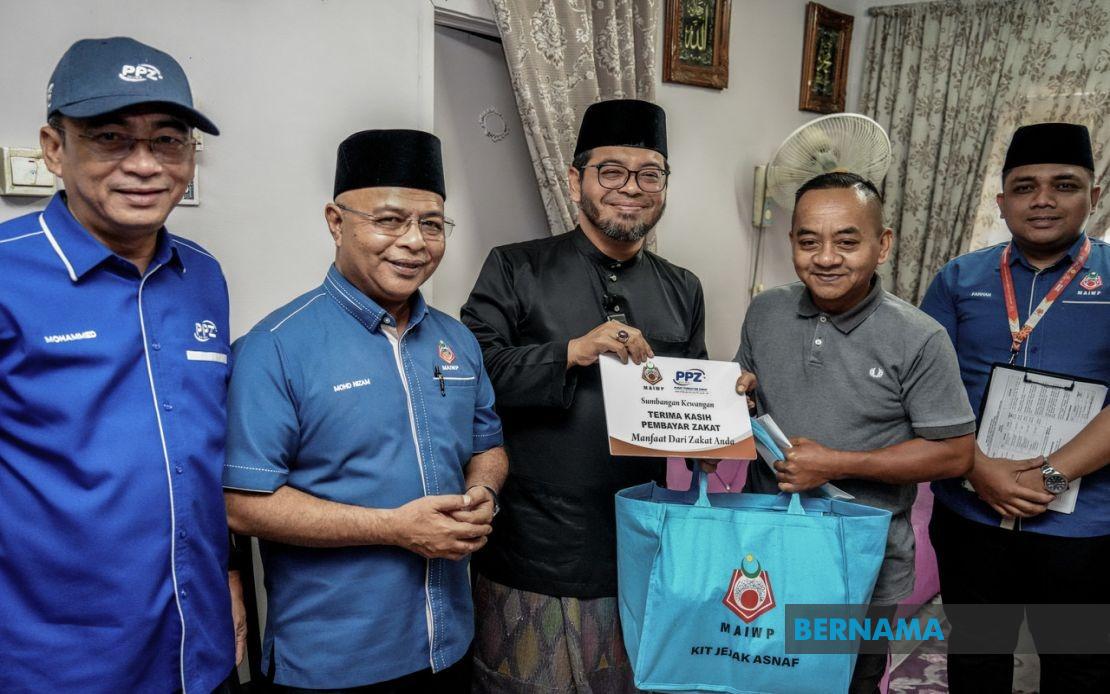
The Federal Territories Islamic Religious Council (MAIWP) has intensified its social welfare interventions by providing comprehensive financial support to families experiencing acute hardship, focusing on direct aid for living costs, accommodation, and children's education. The initiative comes in response to the pressing needs of households that have lost primary income earners or face mounting expenses beyond their means, reflecting a broader commitment by Malaysia's Islamic welfare institutions to address poverty and vulnerability across urban communities.
Datak Dr Zulkifli Hasan, the Minister in the Prime Minister's Department overseeing Religious Affairs, emphasised that field-based assessments form the backbone of MAIWP's distribution strategy, allowing officials to evaluate genuine circumstances and tailor assistance appropriately. This ground-level engagement model contrasts with more formulaic welfare approaches and recognises that cookie-cutter solutions often fail to address the nuanced challenges facing different family structures and economic situations. The minister's emphasis on understanding recipients' actual conditions signals a shift towards more responsive and contextualised welfare delivery within Malaysia's Islamic institutional framework.
One notable case involves a widow who became the sole provider for five children aged between six and 15 following her husband's death earlier this month. Beyond immediate emotional trauma, her family now faces cascading financial pressures: school fees mount as children progress through their education, rent remains a constant obligation, and daily living expenses stretch limited resources. MAIWP had previously provided General Schooling Aid to this family, but the council recognised that this measure alone proved insufficient following the breadwinner's loss. The expanded assistance package now encompasses monthly stipends for household expenses, rental support, and expanded educational funding—a holistic response designed to stabilise the family's situation during this critical transition period.
The council's interventions extend beyond widowhood cases to encompass working families navigating complex medical and educational demands. A household headed by a Kuala Lumpur City Hall driver and his homemaker wife, raising eight school-going children, demonstrates how employment alone provides insufficient security when children require specialised care or resources. This family receives monthly General Medical Assistance covering essential supplies including diapers and diabetic medications, alongside support for wheelchair provision and educational costs. The case illustrates how MAIWP recognises that formal employment in lower-income brackets often leaves families vulnerable to unexpected medical expenses that rapidly deplete savings and create debt spirals.
A third family profile highlights the particular vulnerability of divorced mothers managing single-parent households. A divorced woman who has independently raised three school-going children since 2018 receives monthly assistance for basic living costs and essential supplies, supplemented by school-related financial support. The pattern across these cases reveals MAIWP's recognition that family disruption—whether through death, disability, or marital breakdown—creates cascading disadvantages for dependents, particularly when mothers assume full economic responsibility without male household income. By combining regular stipends with targeted support for specific needs, the council attempts to address both chronic poverty and acute vulnerability.
The scope of MAIWP's operations reflects substantial institutional commitment to welfare provision. As of August 12, 2026, the council had distributed RM699.57 million in accumulated assistance, demonstrating the scale of need across Malaysia's federal territories and the ongoing financial commitment required to address vulnerability among Muslim populations. This figure suggests that welfare demands continue expanding, particularly as economic pressures mount for lower-income households facing inflation, housing costs, and education expenses that outpace wage growth.
For Malaysian and Southeast Asian observers, MAIWP's approach carries broader policy implications. Islamic welfare institutions increasingly serve as crucial social safety nets, particularly in countries where government welfare provisions remain fragmented or inadequately funded. The council's willingness to conduct individual assessments and provide multi-dimensional assistance suggests recognition that poverty requires complex rather than simplistic responses. Single cash transfers, while valuable, prove insufficient when families face simultaneous pressures around housing, health, and education.
The minister's visit to multiple families underscores deliberate efforts to maintain high-level political engagement with welfare delivery, signalling that religious authorities consider poverty alleviation a core institutional responsibility rather than peripheral charity. This approach potentially influences how welfare is conceptualised within Malaysia's broader social policy framework, emphasising moral obligation and communal responsibility rather than framing aid primarily as government responsibility.
Looking forward, MAIWP's model raises questions about scalability and sustainability. As the council's financial commitments expand to reach more vulnerable households, questions emerge regarding long-term funding sources and whether current assistance levels can be maintained without substantial increase to institutional resources. The emphasis on personalised assessment also raises questions about administrative capacity—whether MAIWP possesses sufficient staff to conduct thorough evaluations of all families seeking assistance and monitor whether interventions achieve intended outcomes.
For vulnerable households across Malaysia's federal territories, MAIWP's expanded assistance represents tangible relief during periods of acute hardship. For policymakers, the council's approach offers a model for responsive welfare delivery that combines institutional resources with community engagement. Whether these interventions prove sufficient to lift families above poverty lines or merely provide temporary stabilisation remains an important question for ongoing evaluation and refinement of Malaysia's evolving welfare architecture.

