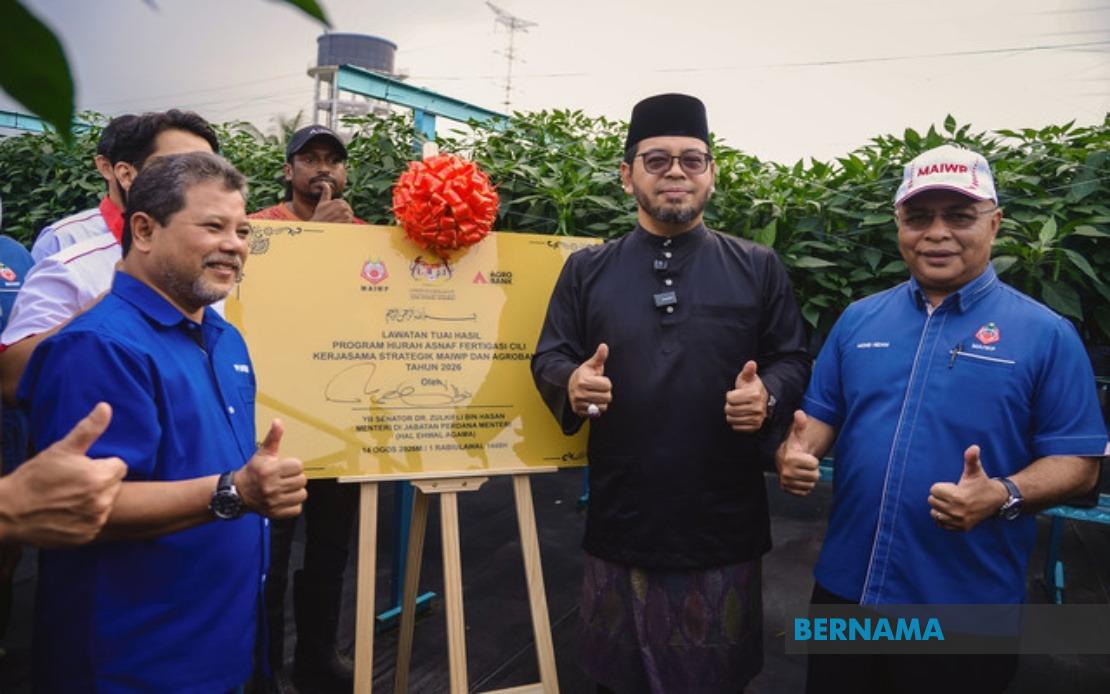
Malaysia's Islamic Welfare Organisation (MAIWP) is scaling up its innovative chilli farming programme for asnaf beneficiaries, extending the successful hydroponics-based initiative across a larger land footprint. The expansion represents a significant step in the organisation's broader effort to equip marginalised communities with sustainable livelihood skills and income-generating capabilities. Minister in the Prime Minister's Department (Religious Affairs) Dr Zulkifli Hasan commended the project's performance, noting that initial results have exceeded expectations and demonstrated the viability of modern agricultural techniques within the asnaf support framework.
The project's early success serves as compelling evidence for the potential of technology-driven farming among lower-income populations. During its first harvest cycle, the chilli farming venture produced more than 16.7 tonnes of output, translating into financial returns surpassing RM207,000 for participating families. These figures underscore how properly structured agricultural initiatives, combined with technical training and market access, can deliver tangible economic uplift for vulnerable communities. The yield represents not merely a harvesting statistic but rather a concrete demonstration of poverty alleviation in action within Malaysia's Islamic welfare ecosystem.
Dr Zulkifli highlighted a critical dimension of the programme that extends beyond simple agricultural production: the framework enables participants to explore downstream value-addition opportunities. By shifting focus from raw chilli sales to processed products, farmers can capture greater profit margins and establish themselves within supply chains for specialised food markets. This approach transforms basic cultivation into a more sophisticated commercial enterprise, allowing participants to build sustainable businesses rather than relying on seasonal commodity sales. The downstream potential includes chilli paste, dried varieties, spice blends, and other packaged products that command premium pricing in both domestic and export markets.
One participant whose life trajectory was fundamentally altered by the programme is Alinda Rosely, a 49-year-old single mother who has struggled to maintain financial stability while raising her family independently. She credits the fertigation training and structured support from MAIWP with providing her the knowledge and confidence necessary to establish a viable farming operation. Rosely's personal testimony carries particular weight given Malaysia's considerable population of single-parent households facing pronounced economic vulnerability. Her specific reference to earning RM40,000 within a six-month window during a period of favourable chilli market conditions illustrates the income potential available to participants when circumstances align favourably.
The programme's focus on fertigation technology—a precision irrigation methodology that delivers nutrients directly to plant roots—represents a deliberate choice to equip asnaf participants with knowledge applicable beyond chilli cultivation. This skill set remains valuable across multiple horticultural contexts, allowing beneficiaries to adapt their expertise to emerging market demands or different seasonal opportunities. The technical foundation provided through training ensures that participants possess genuinely marketable capabilities transferable across the agricultural sector, rather than learning purely commodity-specific techniques. This approach acknowledges the broader challenge facing Malaysia's agricultural workforce, particularly the shortage of skilled practitioners in modern farming methodologies.
MAIWP's strategic positioning of this initiative aligns coherently with its overarching mandate to develop economically self-sufficient communities among asnaf populations. The organisation operates within a framework that recognises poverty reduction requires not merely cash transfers but rather structural interventions that build human capital and create sustainable opportunity pathways. By channelling resources toward agricultural skills development and market-linked production, MAIWP addresses both immediate income needs and longer-term economic resilience. This philosophy reflects contemporary international understanding that welfare effectiveness hinges on complementing income support with capacity-building investments.
The financial commitments underlying these efforts illustrate the scale of MAIWP's welfare operations across Malaysia. As of mid-August 2026, the organisation had distributed RM699.57 million in zakat funds through 38 distinct assistance schemes, alongside additional allocations addressing specific community needs. These figures position MAIWP as a substantial institutional actor within Malaysia's Islamic social welfare infrastructure, managing resources comparable to government agency budgets. The diversification across multiple programmes indicates a sophisticated understanding that poverty manifests through varied pathways, requiring correspondingly differentiated interventions tailored to specific beneficiary populations and their particular circumstances.
The expansion to five acres represents a calculated scaling decision that balances ambition with operational capacity. Rather than pursuing unlimited expansion, MAIWP appears committed to maintaining quality programming and ensuring adequate supervision for participating families. This measured approach reflects lessons learned through the initial implementation phase and suggests the organisation is prioritising depth of support over pure quantitative growth. For asnaf communities in rural areas particularly, five acres represents a substantial production footprint capable of supporting multiple family units while remaining manageable for relatively inexperienced farmers receiving ongoing guidance.
From a regional perspective, Malaysia's experience with integrated asnaf welfare programming holds lessons for other Southeast Asian nations grappling with persistent poverty among Muslim minorities. The combination of religious obligation, government policy alignment, and technical innovation demonstrated through MAIWP's approach offers a model potentially adaptable to differing contexts across the region. Countries including Thailand, Philippines, and Indonesia manage significant asnaf populations, yet approaches to structured livelihood support vary considerably. Malaysia's chilli farming example illustrates how culturally-embedded institutions can operationalise targeted poverty reduction through agriculture when structured methodically.
The programme also reflects Malaysia's positioning within broader Asian agricultural trends emphasising precision farming, value-addition, and market-oriented smallholder development. Rather than pursuing subsistence-level cultivation, the initiative explicitly targets commercially viable operations capable of generating meaningful family income. This distinction matters considerably when assessing whether interventions genuinely transform economic circumstances or merely provide temporary relief. The emphasis on direct market returns, profit measurement, and business sustainability suggests MAIWP understands that true poverty alleviation requires creating genuine earning opportunities rather than dispensing welfare.
Looking ahead, the expanded chilli programme will likely generate increased programme visibility and potentially inspire similar initiatives across other agricultural sectors. Should additional expansion phases succeed, MAIWP may position itself as a model institution for technology-enabled asnaf economic development. The availability of quantifiable outcomes—specific yield figures, documented earnings, participant testimonies—provides the evidentiary foundation necessary for scaling while maintaining donor and government confidence in programme effectiveness. For Malaysian asnaf communities, the project represents tangible evidence that structured opportunity can genuinely reshape individual and family economic trajectories.

