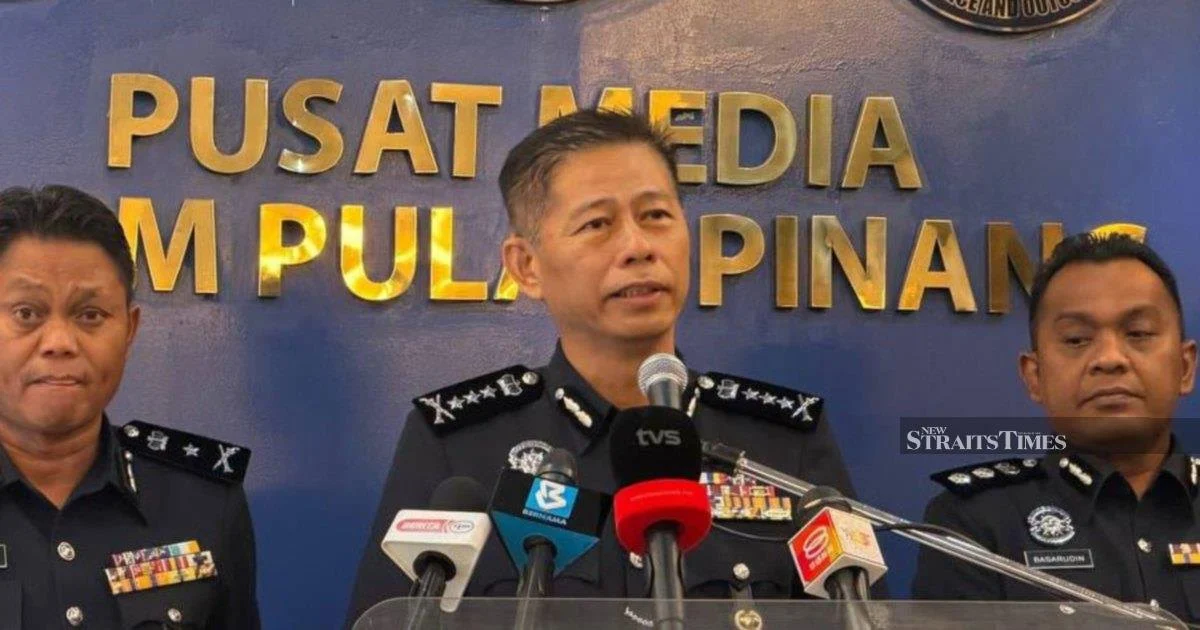
Penang police have successfully dismantled what they describe as a sophisticated liquid methamphetamine processing and distribution operation, marking a substantial victory in the state's ongoing battle against organised narcotics trafficking. The enforcement action resulted in the arrest of a single suspect, a 40-year-old individual whose identity has not been disclosed, alongside the seizure of controlled substances with a combined street value exceeding RM450,000. The operation took place in the Nobong Tebal area, indicating that trafficking networks continue to establish manufacturing facilities in suburban locations across the northern state.
The significance of this seizure extends beyond the monetary value alone. Liquid methamphetamine, commonly referred to as syabu in its liquid form, represents a particularly insidious variant of amphetamine-based drugs circulating throughout Malaysia and the broader Southeast Asian region. Unlike crystalline methamphetamine, the liquid formulation presents distinct challenges for law enforcement agencies, as it is more easily concealed during transport, requires less sophisticated equipment for conversion into consumable forms, and can be diluted to increase distribution volumes. The discovery of a processing facility suggests that traffickers have shifted toward in-country manufacturing rather than relying solely on importation, a trend that has concerned regional narcotics agencies.
The structure of the syndicate indicates a deliberate division of labour typical of larger-scale trafficking operations. By maintaining separate facilities dedicated specifically to processing and distribution, the network demonstrated an understanding of supply chain management that distinguishes it from opportunistic street-level dealers. This compartmentalisation, while making individual nodes more vulnerable to interdiction once detected, allows larger operations to insulate higher-level organisers from direct contact with drug stocks or street distribution networks. Penang police have not yet detailed how the suspect's specific role within this hierarchy, whether as a production technician, logistics coordinator, or mid-level distributor, influences the investigation's direction.
The value of seized drugs provides important insight into trafficking volumes moving through the state. A haul exceeding RM450,000 suggests that the Penang operation supplied a market segment capable of absorbing significant quantities of methamphetamine. The state's strategic position as a gateway to the Straits of Malacca, combined with its substantial urban population and proximity to major transportation hubs, has consistently made it attractive to trafficking syndicates. The port facilities in Penang remain a critical vulnerability in Malaysia's border security architecture, as international shipping traffic provides opportunities for concealing drug imports within legitimate cargo shipments.
This operation aligns with broader patterns observed across Malaysian law enforcement agencies over the past eighteen months. Police and narcotics authorities have reported an increased focus on liquid methamphetamine variants, particularly those refined to higher potency levels for distribution to users in entertainment venues and recreational contexts. Unlike heroin, which traditionally dominated Malaysian drug seizures, methamphetamine presents different consumption patterns and different demographic targets, reaching younger populations and individuals in urban employment sectors. The shift in manufacturing location from purely external sources to domestically-based production facilities suggests evolving trafficking strategies intended to increase supply reliability and reduce vulnerability to international border interdictions.
The enforcement approach demonstrated by Penang police reflects evolving operational tactics emphasising production facility disruption. Rather than focusing exclusively on street-level enforcement or transport interdiction, authorities have begun targeting the manufacturing infrastructure itself. This represents a more resource-intensive investigative pathway requiring sustained surveillance, intelligence development, and coordination between multiple agencies. The success of such operations depends heavily on tip-offs from community sources, informant networks within criminal circles, or electronic surveillance data that establishes probable cause for raid operations.
The arrest represents a potential opportunity for intelligence gathering. Interrogation of the detained suspect could yield valuable information regarding supplier networks, distribution routes, customer bases, and connections to other syndicates. Malaysian law enforcement has benefited significantly from cooperative arrangements with regional partners in Thailand and Indonesia, where related methamphetamine production facilities operate at larger scales. Intelligence sharing within Southeast Asia has become increasingly sophisticated, with agencies coordinating responses to trafficking organisations that operate across multiple jurisdictions.
The implications for Penang's broader security landscape remain significant. The existence of production facilities within the state suggests that trafficking organisations have secured sufficient operational space to establish infrastructure requiring days or weeks to implement. This indicates either incomplete surveillance coverage in suburban areas or active protection of facilities through corruption or intimidation of local officials and community members. Sustained enforcement momentum will require continued resource allocation toward investigation of related networks and dismantling of additional facilities that likely remain operational.
Future enforcement priorities in Penang should address both immediate operational disruption and longer-term systemic vulnerabilities. The state's borders, transportation networks, and port facilities require enhanced screening capacity. Community engagement programs that encourage reporting of suspicious activities remain underutilised in many jurisdictions. Drug demand reduction initiatives, while resource-intensive, address the market dynamics that sustain trafficking operations. Without simultaneous reduction in methamphetamine consumption patterns, eliminating individual production facilities and distribution networks provides only temporary disruption before competing syndicates establish replacement operations.

