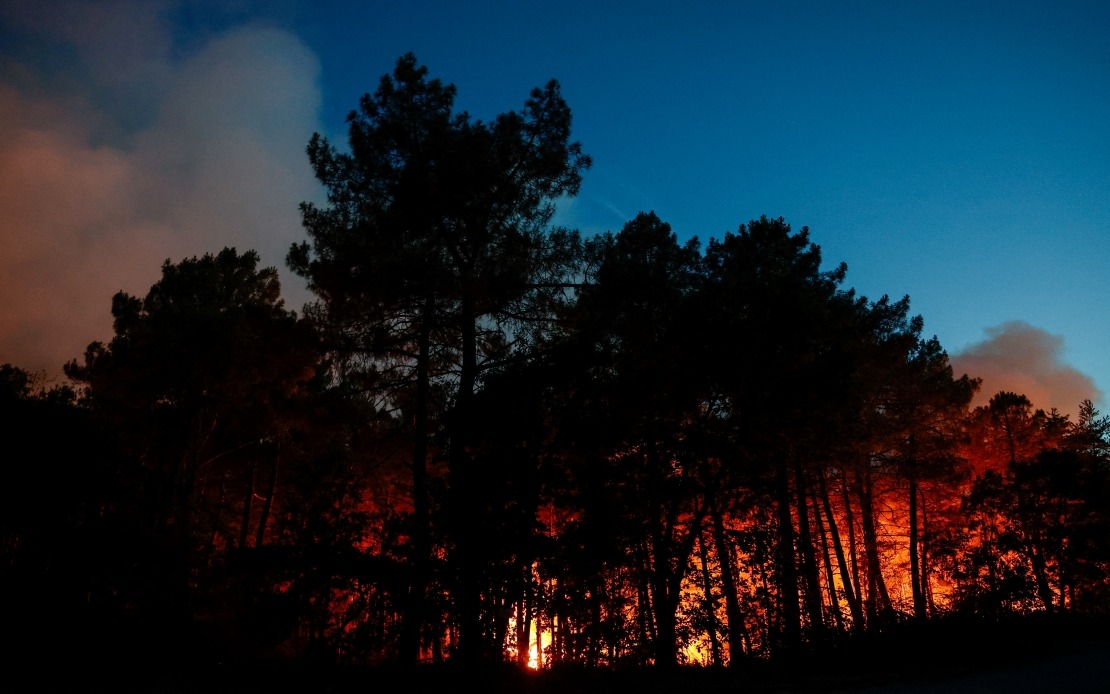
France confronted an exceptional wildfire crisis on Monday as approximately 400 firefighters mobilised to combat a rapidly advancing inferno consuming the renowned Fontainebleau forest, located south of Paris. The blaze, which ignited late on Sunday evening near a motorway corridor, has already ravaged 800 hectares of forest—an area equivalent to more than 1,100 football pitches—and posed an immediate threat to surrounding communities and vital national heritage sites.
The scale of the conflagration prompted an unusually aggressive response from French authorities. Two water-bombing aircraft joined ground crews in the battle against the flames, drawing their supplies directly from the Seine river with coordination by the Seine-et-Marne department. This aerial intervention underscored the severity of the situation, as such resources are typically reserved for catastrophic events. The speed and intensity of the fire's advance created chaotic scenes, with residents and tourists witnessing what witnesses described as "a wall of flames" consuming forests and advancing toward inhabited areas.
More than 1,000 people—a mixture of permanent residents and visitors—were evacuated from their homes and accommodations, particularly from the village of Le Vaudoué situated at the forest's edge. Local authorities described scenes of panic as flames approached residential properties, prompting urgent mass evacuation procedures. The human cost of the disaster extended beyond those directly threatened, encompassing the broader population whose safety and livelihoods depended on swift emergency response.
A particularly troubling dimension emerged when French Interior Minister Laurent Nuñez visited the fire scene and announced preliminary suspicions of deliberate arson. His assessment was grounded on a striking geographical pattern: multiple separate fire outbreaks had been detected within a remarkably confined 1,000-metre radius, a concentration far too precise to suggest natural ignition. Such clustering of ignition points typically indicates human intervention rather than lightning strikes or accidental combustion. The gendarmerie immediately opened a criminal investigation into the suspected arsons, transforming what was initially a natural disaster into a potential crime scene.
The Fontainebleau forest holds immense cultural and ecological significance, extending across one of Western Europe's largest continuous forested expanses. The woodland has served as both a nature reserve of international importance and the setting for the historic Château de Fontainebleau, a royal residence of architectural and artistic merit that has shaped European cultural history for centuries. The proximity of the wildfire to this irreplaceable heritage site amplified the urgency of containment efforts and raised questions about protection measures for France's cultural treasures.
French government spokeswoman Maud Bregeon characterised the emergency as truly exceptional, noting that resources from across the country were being mobilised to suppress the flames. Her remarks highlighted a significant point: while wildfires rage regularly in southern Mediterranean regions of France and Europe, such catastrophic blazes remain relatively uncommon in the northern French territories. This scarcity meant that regional firefighting capabilities, while substantial, faced a challenge approaching the limits of standard preparedness protocols.
The Fontainebleau fire occurred amid broader climatic conditions that had transformed France into a tinderbox. The nation was enduring its third major heatwave of the summer, creating dangerously dry conditions and elevated temperatures that rendered forests and grasslands extremely vulnerable to ignition and rapid fire spread. The national meteorological service, Météo-France, had escalated its warnings to maximum severity, placing 37 departments under red heat alert status as the week commenced—a dramatic indication of the widespread atmospheric instability affecting the country.
Firefighting teams were simultaneously contending with multiple blazes across different French regions, stretching resources and personnel thin. This fragmentation of the emergency response reflected a broader summer pattern of climate-driven fire activity affecting Southern Europe. The concurrent nature of these crises created strategic challenges for logistics, equipment deployment, and personnel rotation, as each active fire demanded skilled professionals and specialised resources.
The suspected arson dimension introduces a troubling human element to an already severe environmental and public safety crisis. Intentional fire-setting during extreme heat and drought conditions represents not merely criminal behaviour but poses an existential threat to entire ecosystems, cultural heritage, and human settlement patterns. For Southeast Asian observers, the Fontainebleau incident illustrates how climate extremes interact with human malice to create disasters of unprecedented scale, a dynamic increasingly relevant to the region as heatwaves intensify across Asia.
The scale of evacuations and the deployment of extraordinary resources demonstrated how modern European societies mobilise during environmental emergencies, offering both reassuring competence and sobering indicators of increasing climate pressures. As investigation proceeds into the fire's origins, the incident raises profound questions about security vulnerabilities during climate crises and the adequacy of current preparedness frameworks for increasingly extreme weather patterns.

