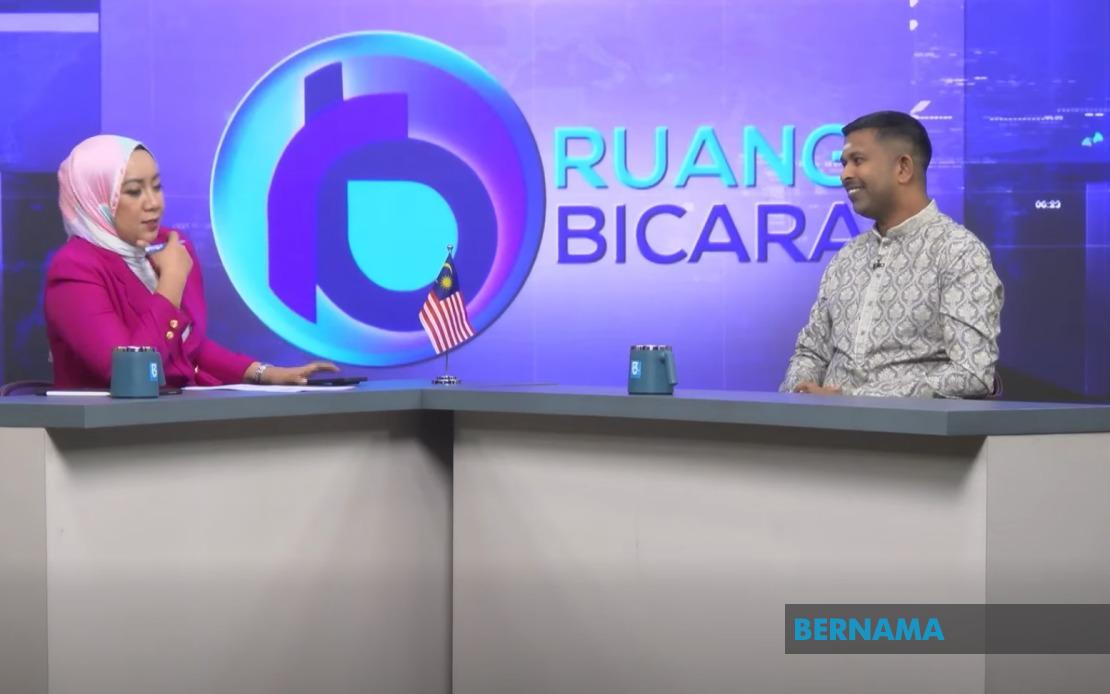
Constitutional safeguards alone cannot guarantee the vitality of Malaysia's national language—what is required instead is a coordinated, multi-sector push involving government agencies, educational institutions, the business community, and citizens themselves, according to a leading legal scholar. Prof Dr Ramalinggam Rajamanickam, who holds dual roles as Faculty of Law professor at Multimedia University and board member of Dewan Bahasa dan Pustaka, made the assertion during a national broadcast discussion on the role of Malay language in shaping national identity and sovereignty.
Article 152 of the Federal Constitution explicitly designates Malay as the national language, a constitutional fact that carries deep symbolic weight in the Malaysian legal and political order. Yet Ramalinggam stressed that this foundational provision places an affirmative duty on all citizens to preserve and enhance the language's standing, a responsibility that transcends government action alone. The challenge, he argued, is not one of legislative framework but rather of sustained cultural and intellectual investment across multiple domains of society. Without such comprehensive commitment, even constitutional protections can become hollow.
The actual problem confronting Malay today is not inadequate usage levels, which Ramalinggam characterized as generally satisfactory across the population. Rather, the language faces a qualitative crisis: a deterioration in the standards of its use, evident in phenomena such as "bahasa rojak"—the blending of Malay with English and other languages—and the prevalence of linguistic imprecision in both formal and informal contexts. This distinction matters significantly because it reframes the policy conversation away from simply promoting Malay and toward ensuring that when the language is employed, it maintains grammatical integrity and structural coherence.
In digital and social media environments, the mixing of languages and use of abbreviations reflects practical adaptation to technological constraints rather than fundamental weakness. However, such linguistic informality becomes problematic when it spills over into official communications, legal documentation, academic work, and government administration, where clarity and precision are essential. Ramalinggam underscored that the National Language Act 1963/67 mandates Malay usage in official contexts, but this legislative requirement means little without sustained institutional enforcement and cultural reinforcement at all levels.
Educational institutions bear particular responsibility in this framework. Universities must actively position Malay as a genuine vehicle for specialized knowledge transmission—in sciences, engineering, economics, and emerging fields—rather than relegating it to humanities and cultural studies alone. Simultaneously, institutions cannot abandon English-language instruction, as proficiency in that language remains crucial for accessing global research and maintaining Malaysia's international competitiveness. This represents a balancing act rather than a zero-sum choice between languages.
The emergence of artificial intelligence and advanced technology presents both existential threat and strategic opportunity for the Malay language. Rather than waiting passively for technological development to accommodate Malay, Ramalinggam argued, Malaysia must proactively engineer the language's integration into AI systems, programming environments, and digital platforms. This demands coordinated effort among government bodies, research institutions, technology specialists, and language scholars to develop terminology, establish linguistic standards for technical domains, and ensure that AI algorithms can process and generate Malay with sophistication.
Historically, Malay held status as a regional lingua franca facilitating commerce and communication across Southeast Asia. Contemporary interest from countries including China, Japan, and India in learning Malay demonstrates residual recognition of the language's cultural and economic significance. Rather than merely celebrating this historical prominence, Malaysia should leverage it as foundation for positioning Malay as a language of knowledge capable of expressing complex contemporary ideas in science, technology, and specialized professional fields.
The tension between protecting Malay's status and accommodating multilingualism is not irreconcilable, Ramalinggam contended. A strengthened national language does not require the diminishment of other languages or denial of Malaysia's multilingual reality. Rather, the goal is to establish Malay as the unifying linguistic marker of national identity while permitting individuals and communities to maintain proficiency across multiple languages. This approach acknowledges both the integrative role that a single national language can play and the practical benefits of linguistic diversity.
Implementing this vision requires orchestrated action extending far beyond the Ministry of Education. Government agencies must enforce Malay usage standards in official documentation and communications. The private sector, particularly technology companies and media organizations, must invest in Malay-language content and systems development. Research communities should prioritize the creation of Malay-language academic literature and technical terminology. Civil society organizations can promote cultural appreciation for the language while maintaining critical standards about linguistic quality.
For Malaysia and other Southeast Asian nations navigating the tensions between global integration and national identity, the Malay language case illustrates a broader challenge: how to sustain and develop local languages in an era of English-language dominance and rapid technological change. The answer, according to Ramalinggam's analysis, lies not in linguistic protectionism or reactive policy responses, but in proactive investment in making the language capable of serving contemporary intellectual and professional needs. This positions language maintenance as an investment in national capacity rather than a cultural indulgence.

