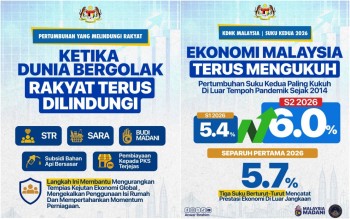
Malaysia's economy has delivered a robust six per cent growth rate for the second quarter of 2026, a performance that has exceeded the consensus expectations of financial analysts and stands as the strongest second-quarter expansion in over a decade when pandemic-distorted figures are excluded. Prime Minister Datuk Seri Anwar Ibrahim announced the result, highlighting the achievement as a significant demonstration of economic resilience during a period of considerable global uncertainty and economic headwinds.
The timing of this announcement carries particular significance given the challenging international backdrop against which the growth has been achieved. The global economy has been experiencing a visible deceleration, with supply chain disruptions continuing to reverberate through international markets and geopolitical tensions in West Asia creating additional pressures on commodity prices and investor sentiment. That Malaysia has managed to accelerate its growth trajectory in this environment suggests that domestic demand and structural economic factors have provided sufficient momentum to offset external constraints.
Prime Minister Anwar attributed the strong performance directly to the strategic interventions implemented by the MADANI Government framework, emphasizing that the administration has successfully insulated the majority of Malaysians from the worst effects of global inflationary pressures that have plagued other economies. This claim underscores a deliberate policy approach that prioritizes protecting household purchasing power and living standards during periods of international economic stress, a lesson many Southeast Asian policymakers have learned from observing the social consequences of unmanaged inflation in neighbouring economies.
The government's targeted assistance programmes have played a visible role in maintaining consumption levels and household resilience. Direct cash transfers through initiatives such as BUDI MADANI, Sumbangan Tunai Rahmah, and Sumbangan Asas Rahmah have provided immediate relief to vulnerable and lower-income groups, helping to sustain demand for goods and services. These programmes represent a countercyclical fiscal response that has enabled domestic consumption to remain a significant engine of growth even as export markets face uncertainty and global investment flows have become more cautious.
Beyond the visible assistance schemes, the Prime Minister noted that the MADANI Government has undertaken less publicized but equally important work to stabilize prices across essential goods and ensure that supply chain disruptions do not translate into acute shortages for consumers. Price management and supply security measures represent the unglamorous but critical infrastructure of economic management, distinguishing between economies that experience controlled inflation and those that suffer from rapid price spirals that erode consumer confidence and purchasing power. Malaysia's approach suggests that administrative attention to supply-side fundamentals has complemented demand-side fiscal support.
The six per cent growth rate is particularly noteworthy when compared to the trajectory of recent years and the performance of regional peers. Malaysia's second-quarter results in years outside the pandemic period had typically ranged from lower levels, making the 2026 achievement a meaningful acceleration. This performance metrics matter for how Malaysia positions itself within Southeast Asia's growth narrative and how international investors assess the region's relative attractiveness. A sustained pattern of outperformance against expectations can shift investor allocation decisions and improve conditions for capital inflows.
However, Prime Minister Anwar presented the growth figure not as a destination but as a foundation requiring further consolidation and expansion. He acknowledged that the MADANI Government faces the ongoing responsibility of translating raw economic growth into meaningful improvements in living standards for ordinary Malaysians. The distinction between headline GDP growth and improvements in household incomes and job quality represents a persistent policy challenge for all developing economies, and Anwar's emphasis on this issue reflects understanding that growth divorced from employment and income gains creates political vulnerability and social discontent.
The administration has committed to pursuing what it frames as sustainable growth expansion, a formulation that suggests awareness of the need to balance near-term economic gains with long-term stability and inclusivity. Concentration of growth benefits among elites while wage earners and vulnerable groups struggle has plagued growth episodes in other developing economies, creating political backlash and social tension. The MADANI Government's rhetorical commitment to ensuring that wealth creation reaches ordinary citizens reflects both ideological positioning and pragmatic recognition that inclusive growth delivers greater political durability.
Job quality and creation represent critical dimensions of the government's forward agenda. Malaysia's labour market has experienced structural shifts, with manufacturing employment pressures and service sector growth creating mismatches between available work and worker expectations regarding compensation and conditions. The government's aspiration to create quality job opportunities alongside broad-based growth suggests recognition that unemployment statistics mask deeper concerns about underemployment and wage inadequacy among segments of the workforce.
Assissstance to vulnerable groups remains an explicit priority in the government's growth strategy, reflecting acknowledgment that market mechanisms alone do not distribute prosperity equitably and that targeted interventions remain necessary components of sound economic management. The existing constellation of assistance programmes suggests that the government views safety nets not as temporary measures but as enduring features of Malaysia's economic model, a departure from earlier approaches that emphasized eventual self-sufficiency without sustained public support.
The international dimension of Malaysia's growth achievement deserves emphasis in assessing its implications for regional economic dynamics. Southeast Asia faces competitive pressures as countries jostle for investment and market share, and Malaysia's demonstrated capacity to grow faster than global averages enhances its competitive position. Stronger domestic growth can attract regional investment, support intra-ASEAN trade, and position Malaysia as a stable economic partner within emerging markets more broadly.
Looking forward, sustaining this growth trajectory while simultaneously improving income distribution and job quality will require careful policy calibration. The MADANI Government's statement that further reforms remain necessary acknowledges that maintaining the current growth rate represents an ongoing challenge rather than an automatic outcome. Persistent global uncertainties, supply chain vulnerabilities, and domestic structural pressures mean that complacency about growth sustainability would prove premature, and the government's continued emphasis on reform signals realistic appraisal of the work required to lock in gains and build foundations for longer-term prosperity.

