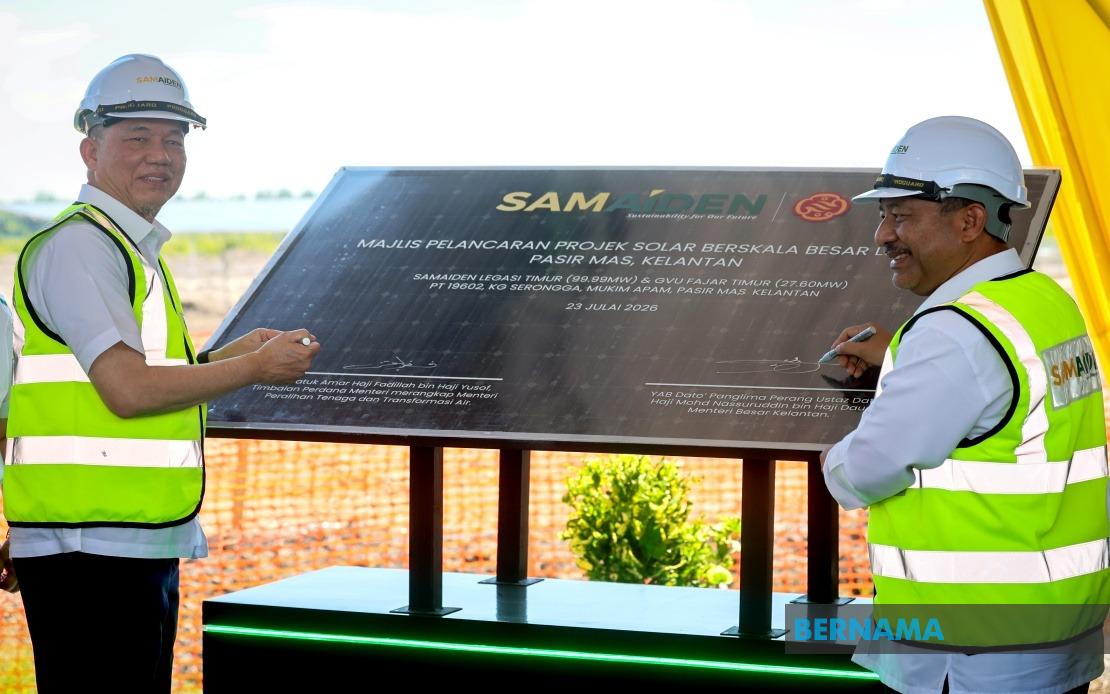
Malaysia's renewable energy sector is accelerating toward its midterm climate objectives, with installed capacity reaching nearly 32 per cent as of June—a significant stride that puts the nation squarely on course to meet its 35 per cent target by 2030. Deputy Prime Minister Datuk Seri Fadillah Yusof, who oversees the energy transition portfolio as Minister of Energy Transition and Water Transformation, confirmed the achievement during the launch of a major solar initiative in Kelantan, underscoring the government's commitment to a comprehensive energy transition strategy.
The figure represents meaningful progress along Malaysia's energy transformation journey, which is anchored in the National Energy Transition Roadmap (NETR). The roadmap provides the strategic framework guiding the country's shift away from fossil fuels, establishing successive targets that stretch to mid-century: 35 per cent renewable capacity by 2030, building toward a more ambitious 70 per cent by 2050. Having already cleared the 31 per cent milestone by December 2025, Malaysia demonstrates that its energy policies are translating into measurable outcomes on the ground.
For Malaysian policymakers and businesses, the renewable energy transition represents far more than an environmental imperative. Fadillah articulated this perspective clearly, framing energy transition as a strategic necessity rather than a discretionary policy choice. The transition simultaneously addresses multiple national priorities: securing the country's energy independence, strengthening economic resilience in an increasingly volatile global energy market, positioning Malaysia as an attractive destination for foreign direct investment in clean technology, and honouring international climate commitments that shape Malaysia's reputation and soft power among trading partners and developed economies.
Balancing competing demands lies at the heart of Malaysia's approach. The government has explicitly committed to achieving its renewable energy targets while maintaining three core principles: energy security, cost affordability for consumers and businesses, and environmental sustainability. This tripartite framework acknowledges that energy transitions, particularly in developing economies, cannot simply mandate clean power without regard to economic impact. Competitive pricing and reliable supply remain essential for maintaining industrial competitiveness and protecting household budgets, especially among lower-income Malaysians who are most vulnerable to energy cost shocks.
The launch of the Large-Scale Solar Project (LSS5) in Pasir Mas, Kelantan, exemplifies how Malaysia's renewable ambitions are materializing across the country's regions. Large-scale solar installations like LSS5 represent a distinct approach to capacity expansion, differentiating them from rooftop or distributed solar systems. These utility-scale projects concentrate generation capacity, achieve significant cost efficiencies, and can be deployed relatively rapidly compared to traditional power infrastructure. The Pasir Mas project signals investor confidence in Malaysia's energy policy framework and the stability of its regulatory environment—a particularly important message for foreign capital considering commitments in the region.
Kelantan's role in this expansion reflects a deliberate strategy to distribute renewable energy development across Malaysia's geography. The northeastern state possesses substantial natural advantages for solar deployment: extensive suitable land, state government backing, and growing private sector participation. Kelantan Menteri Besar Datuk Mohd Nassuruddin Daud positioned the LSS5 project as more than a standalone installation, viewing it as a benchmark that could catalyse additional renewable investments and establish Kelantan as a centre for green technology and sustainability-driven enterprise. This approach recognises that renewable energy development generates ancillary economic benefits beyond electricity generation, including job creation, supply chain development, and opportunities for local enterprises to participate in the clean energy ecosystem.
Complementing large-scale solar projects, the government is promoting distributed renewable capacity through the Solar ATAP Programme, which targets rooftop installations on residential properties, religious institutions, and commercial buildings. This dual-track strategy—combining utility-scale and distributed generation—creates multiple pathways for renewable capacity expansion and engages diverse segments of society in the energy transition. Residential and small commercial rooftop solar systems build grassroots support for renewable energy while reducing strain on the centralized grid during peak demand periods.
The timing of these advances carries particular significance for Southeast Asia. Malaysia's progress toward its 2030 renewable target positions it among the region's more aggressive energy transitions, alongside countries like Vietnam and Thailand that have also adopted substantial renewable capacity goals. As a major economy and ASEAN member, Malaysia's success in balancing growth, affordability, and sustainability provides a template relevant to neighbouring nations navigating similar pressures. The region faces acute challenges in meeting rising electricity demand from industrialisation and urbanisation while transitioning away from coal and gas—the dominant power sources across much of Southeast Asia.
Attraction of high-quality investment remains a central consideration for Malaysian policymakers. The renewable energy sector increasingly attracts capital from multinational corporations, specialized green infrastructure funds, and development finance institutions seeking exposure to clean energy in developing economies. By demonstrating policy consistency, regulatory clarity, and successful project execution, Malaysia enhances its appeal to this investment class. The LSS5 project and its peers provide visible proof points that Malaysia can deliver on its renewable energy commitments, reducing perceived execution risk for potential investors and supporting Malaysia's broader objective of becoming a preferred destination for quality foreign direct investment.
The path forward requires sustained attention to implementation challenges. Large-scale renewable projects depend on robust grid infrastructure, energy storage solutions to manage intermittency, and workforce development in emerging green technology sectors. Regional challenges including grid integration across state boundaries, financing mechanisms for smaller market participants, and technology localisation efforts will shape whether Malaysia sustains the current momentum toward its 2030 target. The government's articulation of clear targets and demonstrated commitment through projects like LSS5 suggests institutional capacity to navigate these complexities.
Looking beyond 2030, the 70 per cent renewable target by 2050 represents an even more transformative ambition. Achieving such deep decarbonisation of the electricity system will require technological breakthroughs in energy storage, advanced grid management, and potentially nuclear or other zero-carbon baseload power sources. Setting long-term horizons now allows Malaysia to align research, industrial development, and infrastructure planning toward this endpoint. The renewable energy trajectory Malaysia is establishing today will determine whether the mid-century goal remains achievable or becomes an aspirational statement disconnected from underlying technical and economic realities.

