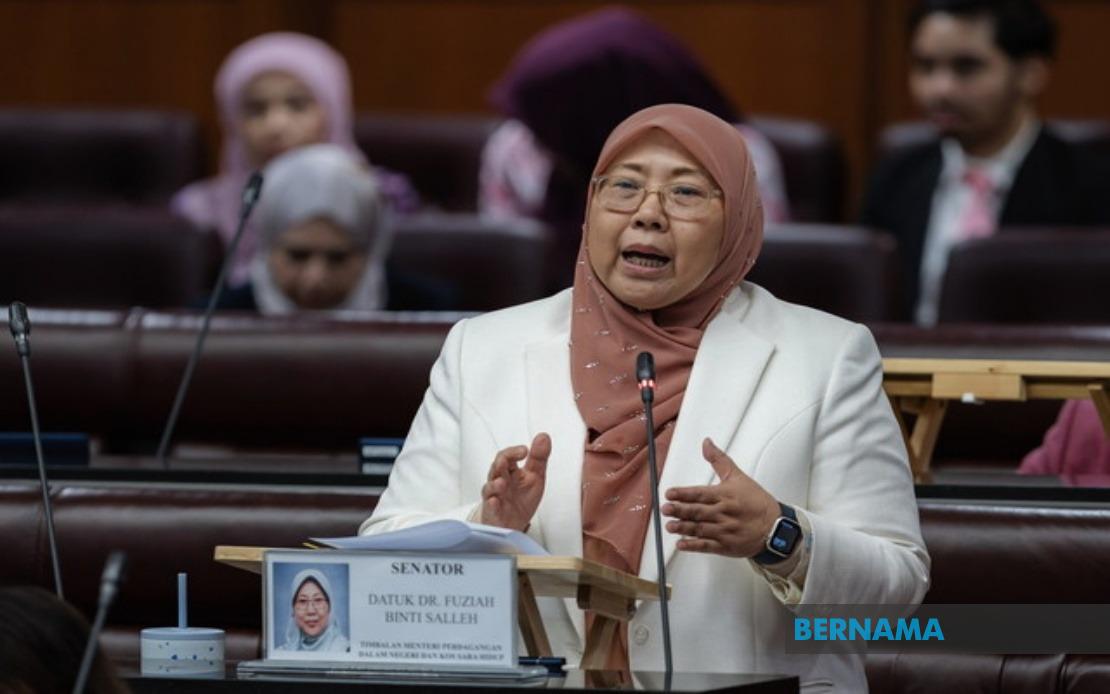
Malaysia's approach to governing artificial intelligence development and copyright protection remains anchored in its existing legal framework, with the government making clear that creators' intellectual property rights remain protected regardless of whether their works are deployed for traditional commercial purposes or for training advanced machine learning systems. Deputy Domestic Trade and Cost of Living Minister Datuk Dr Fuziah Salleh delivered this clarification during parliamentary proceedings, emphasising that the distinction between different technological applications does not diminish the fundamental requirement for copyright owner consent.
The position articulated by the government reflects a cautious but principled stance in an area where international consensus remains fragmented. While some jurisdictions have moved towards permissive frameworks allowing broad use of copyrighted material for AI training under fair use or research exemptions, Malaysia's position maintains that copyright holders retain negotiating power. Section 27 of the Copyright Act 1987 creates a legal architecture flexible enough to accommodate different compensation models, from traditional licensing agreements to contemporary arrangements managed through Collective Management Organisations that can aggregate permissions and royalty distributions on behalf of multiple creators.
The practical implications of this requirement extend across Malaysia's growing creative industries. Content creators, authors, musicians, visual artists and other copyright holders now possess a legal basis to demand compensation when their work is incorporated into AI training datasets. This principle carries particular weight in Southeast Asia's context, where creative industries represent an increasingly important economic sector and where creators have historically struggled with adequate remuneration in digital environments. The requirement effectively prevents technology companies from treating Malaysian creative output as raw material available for unrestricted exploitation.
Yet the government's position also reveals significant uncertainty about how these principles translate into practical administration. Datuk Dr Fuziah acknowledged that Malaysia has not experienced court cases involving copyright violations in the AI context, suggesting that either compliance is occurring organically or that the legal framework's application to AI scenarios remains untested. This absence of litigation may indicate that Malaysia's AI development sector remains nascent, or that disputes have been resolved outside the courtroom through licensing negotiations that the government does not systematically track.
The question of AI-generated content protection introduces additional complexity to Malaysia's copyright regime. The government has explicitly stated that works generated entirely by artificial intelligence without substantial human creative input do not qualify for copyright protection under current law. This distinction preserves copyright protection for traditionally human-authored works while declining to extend that protection to outputs of purely algorithmic processes. The rationale appears sound: copyright exists to incentivise and reward human creativity, not to protect the mechanical outputs of mathematical operations, regardless of how sophisticated those operations have become.
However, this approach generates a secondary challenge that Malaysia has not yet systematically addressed. If AI-generated content lacks copyright protection, then companies developing these systems potentially have free use of their own outputs, creating an asymmetry where human creators must pay to use their own works in training datasets while AI developers need not compensate for the products their systems generate. This imbalance could provide financial advantages to technology companies over traditional creative businesses, potentially distorting competitive dynamics in sectors where human and algorithmic creativity begin to overlap.
The government's admission that no dedicated impact assessment has been conducted on AI's effects on local creative sector employment and earnings reveals a gap in Malaysia's policy development process. Most major economies undertaking AI regulation have commissioned research into labour market implications, copyright enforcement costs, and revenue flows through different compensation mechanisms. Malaysia's reliance on ongoing stakeholder consultations and observation of international approaches, while sensible, means the country is not generating its own evidence base about how these emerging technologies specifically affect Malaysian creators and whether current legal frameworks adequately protect their interests.
The international comparison process mentioned by the government holds significant importance for Malaysia's future regulatory direction. Different countries have adopted divergent approaches ranging from strict licensing requirements to broad exemptions for AI training. The European Union's Digital Services Act and proposed AI Act frameworks emphasise transparency and compensation mechanisms. The United States maintains broad fair use doctrines that currently permit substantial use of copyrighted material for AI training. Japan and Singapore have taken positions closer to Malaysia's, emphasising licensing and negotiation between parties. Understanding these comparative approaches is essential because Malaysia's creative industries increasingly operate in transnational contexts where international standards influence business practices.
The role of Collective Management Organisations in Malaysia's copyright framework deserves particular attention as AI training proliferates. These organisations have historically managed performing rights, mechanical rights and reproduction rights for creators who would otherwise lack individual bargaining power against large commercial users. Extending their mandate to encompass AI training dataset licensing could provide an administrative infrastructure for managing permissions at scale. However, CMOs require clear regulatory guidance, adequate funding, and technical capability to function effectively in this new domain. Malaysia's government has not indicated whether existing CMOs will receive resources or direction to expand into AI licensing or whether new institutional structures might be necessary.
For Malaysia's technology sector, which increasingly develops or deploys AI solutions, the government's position creates both clarity and potential friction. Clarity emerges from the principle that copyright permissions must be obtained; friction arises from the practical challenges of identifying and negotiating with copyright holders, particularly for works in the public domain or those whose ownership has become obscured through time. Technology companies accustomed to free or nearly-free access to training data in other markets may face higher compliance costs and deployment timelines in Malaysia if they must secure granular permissions. This could potentially slow AI adoption but would better align innovation with creator compensation.
The broader policy implication extends to how Malaysia positions itself within global AI governance frameworks. Many countries now recognise that AI regulation requires balancing innovation incentives against creator protections and worker welfare. Malaysia's emphasis on copyright holder protections aligns with developing-economy interests in preventing uncompensated extraction of cultural and intellectual resources. This positioning may prove influential in regional discussions and within international forums where developing countries seek stronger protections against technology companies based in wealthy nations. However, Malaysia's effectiveness on this issue depends on whether it translates its stated principles into enforcement mechanisms and administrative capacity.
The government's acknowledgment that AI evolves rapidly necessitates ongoing policy engagement rather than static regulation reflects appropriate humility about government foresight. Yet this evolutionary approach carries risks if consultation processes fail to produce timely decisions. Malaysia cannot remain indefinitely in a holding pattern of studying international approaches while local creators remain uncertain about their rights and potential revenues. The next phase of Malaysia's AI governance should involve converting stakeholder consultations into specific policy recommendations, legislative amendments if necessary, and institutional preparations that ensure copyright protections translate from principle into operational reality.

